


Microspheres Market Size Forecast at US$7.1 Billion by 2031 Amid Broader Material Adoption
Market Overview and Growth Outlook
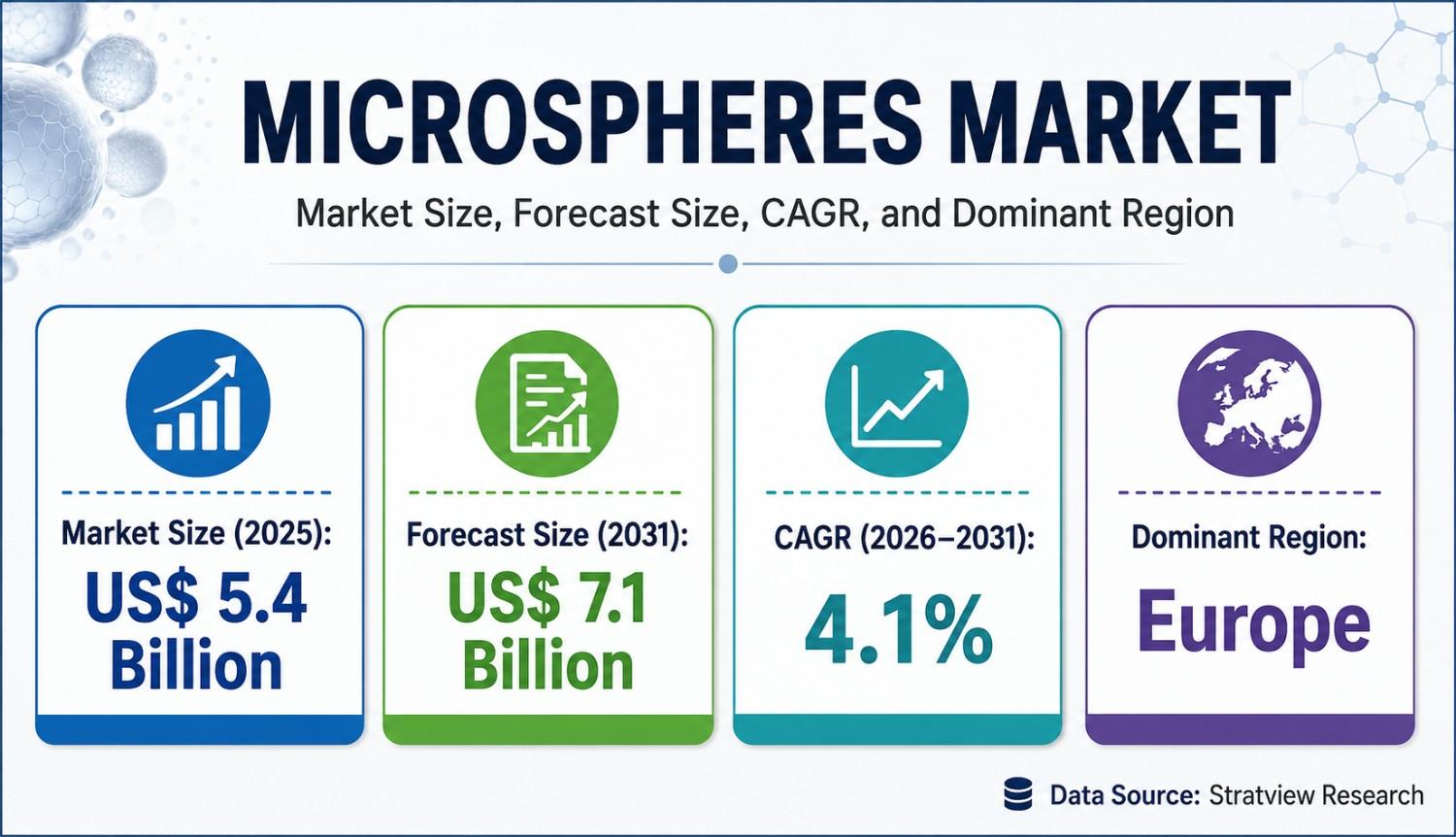
The Microspheres Market generated US$5.4 billion in 2025 and is likely to reach US$7.1 billion by 2031, representing a long-term CAGR of 4.1%. Market expansion reflects greater adoption of engineered spherical particles for lightweighting, thermal insulation, surface enhancement, dimensional stability, and reduced material consumption.
“The Microspheres Market is expected to grow at a CAGR of 4.1% during 2026–2031.”
Microspheres typically range from 12 to 300 microns in diameter and are used across diverse industrial formulations. Certain expandable microspheres can expand up to 120 times their original size when exposed to heat, creating specific value in applications where lightweighting is important.
The reported Microspheres Market size reflects demand across paints & coatings, plastics & rubber, construction materials, life sciences & pharmaceutical, agriculture materials, and other applications. Their ability to improve performance while reducing resin, binder, or other input requirements strengthens the economic and functional case for adoption.
Request a free sample report:
https://www.stratviewresearch.com/Request-Sample/microspheres-market#form
Market Segmentation Analysis
By Microsphere Type, the categories are Hollow Microsphere and Solid Microsphere. Hollow microsphere is expected to remain both dominant and fastest-growing. Its lightweight properties, strength-to-weight ratio, thermal insulation performance, and lower material consumption support broad industrial usage. Solid microspheres remain important where dimensional accuracy, controlled particle size, durability, and surface finish are critical.
By Material Type, the market consists of Hollow Glass Microspheres, Foam Glass Granulates, Cenosphere, Perlite Microsphere, Polymeric Microspheres, Ceramic Microspheres, Solid Glass Micropsheres, Solid Polymer Microspheres, and Metallic Microspheres. Hollow glass microspheres dominated in 2025, while polymeric microspheres are expected to grow fastest during the forecast period.
By Application Type, the categories include Paints & Coatings, Plastics & Rubber, Construction Materials, Life Sciences & Pharmaceutical, Agriculture Materials, and Others. Paints & Coatings is forecast to remain both the largest and fastest-growing application because microspheres can lower density and resin demand while enhancing durability, thermal insulation, reflectance, and flow characteristics.
Regional Market Insights
Europe is expected to sustain its dominance as the largest Microspheres Market. Strong demand from automotive, construction, paints & coatings, and industrial manufacturing supports regional consumption, while investment in lightweight materials, energy-efficient buildings, and sustainable manufacturing reinforces the market outlook.
Asia-Pacific is projected to register the highest growth rate, driven primarily by China and India. Expanding manufacturing, infrastructure development, urbanization, automotive production, electrical & electronics activity, construction, consumer goods, healthcare, electric vehicles, and high-performance composites support regional momentum.
Emerging Trends Shaping the Microspheres Market
Replacement of conventional fillers is becoming increasingly important. Microspheres are being adopted as lightweight alternatives to talc, calcium carbonate, and clay because they can reduce weight while maintaining product performance.
Polymeric microspheres represent a notable growth area. Expandability under heat, flexibility, low density, and favorable processability are increasing their relevance in specialty coatings, automotive sealants, packaging, printing inks, synthetic leather, and construction.
Reflective and energy-efficient coatings are also contributing to application development. Microspheres can enhance solar reflectance and thermal insulation while interacting effectively with ultraviolet, visible, and near-infrared radiation.
Key Growth Drivers of the Market
- Demand for lower product weight encourages manufacturers to substitute conventional fillers with lightweight microsphere technologies.
- Material efficiency requirements support microsphere use because they can reduce resin, binder, and other expensive formulation ingredients.
- Advanced performance requirements increase adoption where durability, thermal insulation, flexibility, and dimensional stability are important.
- Growth in coatings applications increases demand for microspheres that improve flow, density, durability, reflectance, and formulation efficiency.
- Sustainability priorities strengthen the market by promoting reduced material consumption, energy efficiency, and lightweight product development.
Competitive Landscape
Top Companies in the Market
Nouryon Holding B.V.
3M Company
Kureha Corporation
Matsumoto Yushi-Seiyaku Co., Ltd
Merck KGaA
Sekisui Chemical Co., Ltd.
Omya International AG
Sinosteel Maanshan New Material Technology Co., Ltd
Conclusion and Strategic Outlook
The Microspheres Market is moving toward US$7.1 billion by 2031, from US$5.4 billion in 2025, at a projected 4.1% CAGR. The industry outlook is anchored in material lightweighting, functional performance, efficiency, and sustainability rather than any single application.
Europe remains the largest market, while Asia-Pacific offers the fastest growth. At the segment level, hollow microspheres, hollow glass microspheres, polymeric microspheres, and Paints & Coatings remain important indicators of where product and application demand is concentrating.
FAQs – Microspheres Market
1. How large is the Microspheres Market?
The Microspheres Market was valued at US$5.4 billion in 2025. It is forecast to reach US$7.1 billion by 2031.
2. What is the forecast CAGR?
The market is expected to grow at a CAGR of 4.1% over the long term. Lightweight materials and advanced-performance requirements underpin this trajectory.
3. Which factors are expanding demand?
Weight reduction, thermal insulation, material efficiency, sustainability, and improved product performance are key demand factors. Microspheres also reduce reliance on conventional fillers in selected applications.
4. Which regions are strategically important?
Europe is expected to remain the largest market, while Asia-Pacific is forecast to grow fastest. Regional demand reflects differing combinations of automotive, construction, coatings, manufacturing, and infrastructure activity.
5. What should market participants consider?
Participants should assess material type, application exposure, regional manufacturing trends, lightweighting requirements, and competitive consolidation. Companies are also strengthening market presence through partnerships, new sites, acquisitions, and distribution expansion.

 English
 Arabic
 French
 Spanish
 Portuguese
 Deutsch
 Turkish
 Dutch
Dutch
 Italiano
 Romaian
 Portuguese (Brazil)
 Greek
Greek
 Bengali