


Utility Scale Solar Plant Site Selection
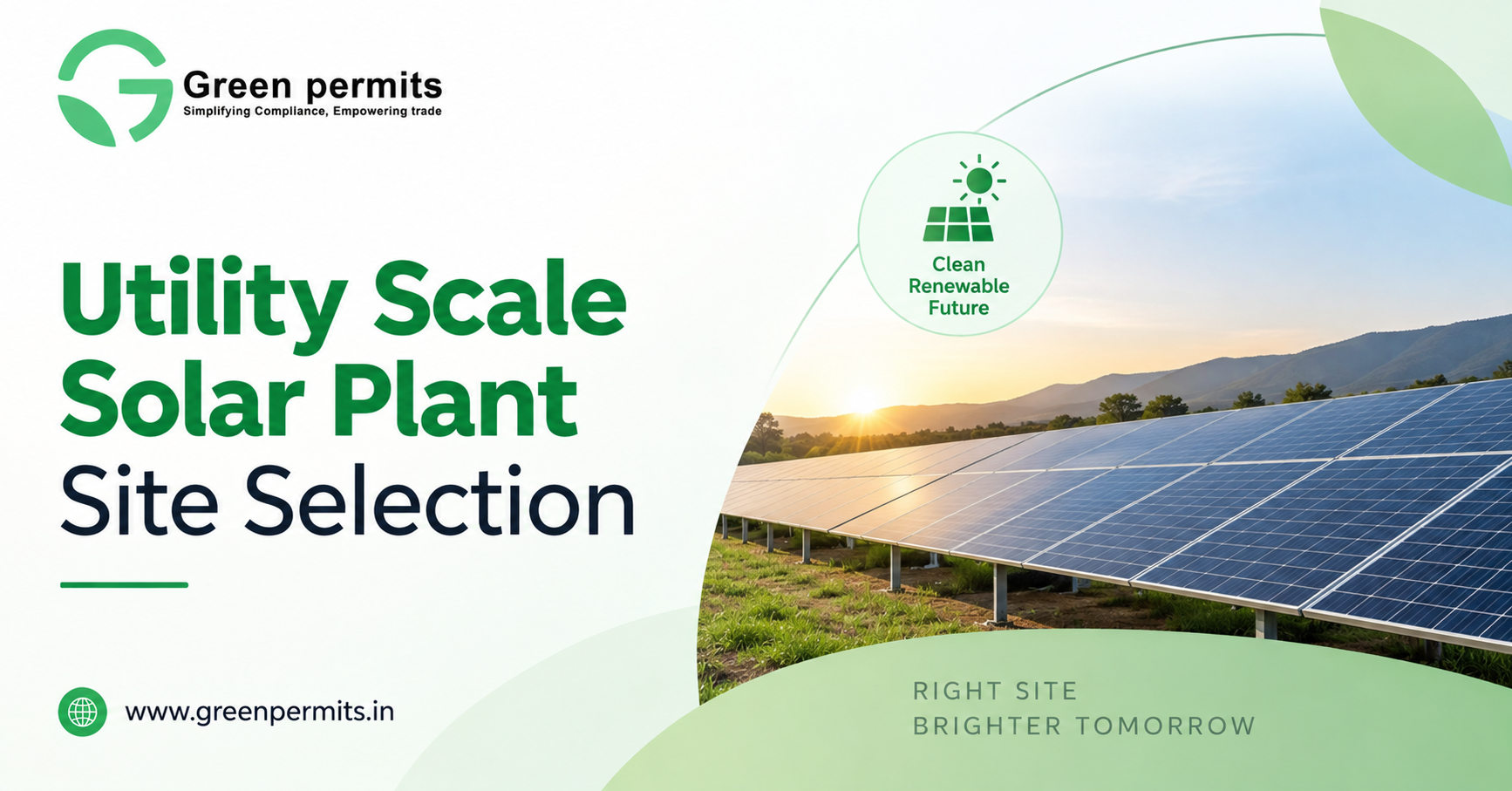
Choosing the right location is one of the most important decisions while developing a utility scale solar plant in India. A site may have excellent sunlight and inexpensive land, but the project can still become expensive if grid connectivity is poor, the terrain requires heavy levelling, or a long transmission line has to be constructed.
For solar developers and investors, site selection should therefore consider solar resource, usable land, grid availability, evacuation distance, terrain, road connectivity, water, drainage and overall project economics before land is purchased or leased.
Green Permits Consulting supports developers with solar project site feasibility, land assessment, DPR preparation, CAPEX analysis, plant layout and project finance planning.
Why Site Selection Matters for a Utility Scale Solar Plant
A utility scale solar project can operate for 20 to 25 years or longer, so the initial site decision has a long-term impact on generation and operating cost.
Two land parcels with the same area can produce very different project economics.
For example, one site may offer lower land cost but require a 15 km evacuation line and major earthwork. Another may cost more per acre but be located only 3 km from a suitable substation on relatively flat terrain.
The second site may ultimately be financially better.
This is why developers should compare total project cost, not land price alone.
Solar Irradiation and Expected Generation
The site should have a strong solar resource capable of supporting the proposed plant capacity.
Solar irradiation, temperature, seasonal cloud cover, dust and local weather conditions all influence electricity generation.
However, a project should not select a location only because it receives slightly higher irradiation.
If the high-radiation site is far from the grid or difficult to construct on, the additional generation may not compensate for higher infrastructure costs.
A proper feasibility study should therefore compare expected annual generation with the complete development cost.
Land Requirement for Solar Power Plant
Land requirement depends on module wattage, mounting technology, terrain, internal roads, drainage, substation area and module spacing.
The total registered land area is not always the same as the usable solar area.
A 300-acre parcel may contain slopes, drainage channels, irregular boundaries or inaccessible sections that reduce the area available for modules.
Therefore:
Total Land Area ≠ Usable Solar Area
A preliminary plant layout should ideally be prepared before the land is finalised.
Grid Connectivity is Critical
For a utility scale solar project, grid availability can be just as important as sunlight.
The developer needs to identify the nearest technically suitable substation and evaluate whether sufficient evacuation capacity is available.
A substation being physically close does not automatically mean the full project capacity can be connected.
For example, a developer planning a 100 MW solar project should assess whether the proposed grid point can actually accommodate another 100 MW.
Grid assessment should therefore happen before major land investment.
Transmission Distance Affects Project Cost
Electricity generated by the plant needs to reach the grid through an appropriate evacuation system.
If the substation is far away, the project may require additional transmission towers, conductors, bay infrastructure and right-of-way arrangements.
This can materially increase project CAPEX.
A practical site-selection calculation should therefore consider:
Land Cost + Site Development + Transmission Cost + Generation Potential
instead of comparing land prices alone.
Terrain and Topography
Flat or gently sloping land generally makes solar construction easier.
Highly uneven land can increase earthwork, foundation cost, drainage requirements and internal road construction.
It can also reduce the number of modules that can be installed efficiently.
A topographical survey helps understand elevations, slopes, natural drainage and usable areas before detailed engineering begins.
The objective should be to minimise unnecessary land modification while maintaining an efficient plant layout.
Soil and Geotechnical Conditions
Solar projects use thousands of mounting-structure foundations.
Soil conditions therefore influence both engineering and cost.
A geotechnical investigation helps determine bearing conditions, groundwater, rock levels and suitable foundation systems.
For example, unexpected hard rock may make pile driving more difficult, while very weak soil may require a different foundation solution.
These issues should ideally be identified before final CAPEX is estimated.
Flood Risk and Drainage
A site that appears dry during summer may behave very differently during the monsoon.
Low-lying land, natural drainage channels and nearby water bodies should therefore be studied carefully.
Poor drainage can affect modules, roads, inverters, transformers and substations.
The plant layout should work with the natural drainage pattern wherever possible rather than attempting to correct major water-flow problems after construction.
Fixed Tilt or Tracker System
Site characteristics also influence the choice between fixed-tilt structures and solar trackers.
Single-axis trackers can increase energy generation in suitable projects but generally require appropriate spacing, terrain and structural design.
Fixed-tilt systems may be simpler where the land is irregular or where additional mechanical complexity is not justified.
The decision should be based on the additional generation versus additional investment.
Technology should follow project economics rather than being selected independently of the site.
Road Connectivity and Logistics
During construction, large quantities of solar modules, structures, inverters, transformers, cables and other equipment need to reach the project site.
The developer should therefore assess the approach road, bridge capacity, road width and heavy-vehicle movement.
A remote site may require new road construction before project installation can begin.
These infrastructure costs should be included in the feasibility analysis rather than treated as unexpected expenses later.
Water and O&M Requirements
Utility scale solar plants generally have relatively low water demand compared with conventional power plants, but water may still be required for module cleaning and domestic purposes.
The requirement depends on local dust levels, cleaning frequency and whether the plant uses manual, mechanised or robotic cleaning.
In water-stressed locations, dry or robotic cleaning may need to be considered.
The cost of maintaining the plant over its operating life should form part of site selection.
Environmental and Land Constraints
Before land acquisition, developers should examine whether the proposed site or transmission corridor interacts with forests, wetlands, protected areas, major water bodies or other environmentally sensitive locations.
Land-use restrictions and local permissions should also be assessed.
A site that looks technically attractive can become difficult to develop if environmental or land constraints are identified only after acquisition.
Early screening reduces this risk.
Site Selection for Solar Plant with BESS
Many utility scale projects are now being evaluated along with Battery Energy Storage Systems - BESS.
If battery storage may be added later, the site should have space for battery containers, power conversion systems, transformers, access roads and safety separation.
Grid capability should also be evaluated for the combined project configuration.
Planning future expansion during the initial site study can be much cheaper than redesigning the project later.
Simple Site Comparison Example
Suppose a developer is comparing two locations for a 100 MW solar project.
Site A has cheaper land and slightly stronger solar irradiation, but the grid point is 18 km away and substantial levelling is required.
Site B has moderately more expensive land but relatively flat terrain and a suitable grid point 4 km away.
Selecting Site A only because land is cheaper may be misleading.
The correct comparison is:
Generation + Land + Civil Work + Grid + Transmission + O&M = Overall Project Economics
This gives investors a much clearer basis for site selection.
DPR for Utility Scale Solar Plant
Once the site has been shortlisted, a Detailed Project Report - DPR can convert the concept into an investment plan.
The DPR can evaluate plant capacity, module technology, energy generation, land requirement, electrical system, grid evacuation, CAPEX, OPEX, project revenue and financial viability.
For projects seeking lender or investor funding, the report can also include cash flow, break-even, debt servicing and sensitivity analysis.
A DPR helps determine whether the selected location is technically suitable and financially bankable before major capital is committed.
Common Site Selection Mistakes
One of the most common mistakes is purchasing land before confirming grid connectivity.
Developers can also underestimate transmission cost, assume all land is usable, overlook flood risk or select a site without considering roads and future expansion.
The better sequence is:
Solar Resource → Grid Assessment → Land Screening → Technical Survey → DPR → Final Site
This significantly reduces development risk.
How Green Permits Helps with Utility Scale Solar Plant Site Selection
Green Permits Consulting supports solar developers, investors and project promoters with site feasibility studies, land assessment, grid and infrastructure review, plant-capacity planning, DPR preparation, CAPEX and OPEX analysis and project finance documentation.
The objective is to identify whether the proposed site can support the project technically and financially before major investment.
Learn More About Utility Scale Solar Plant Site Selection
If you are planning a utility scale solar project in India, the proposed location should be assessed for solar resource, usable land, grid connectivity, transmission distance, terrain, drainage and project cost before land is finalised.
Read more about project feasibility and DPR consulting services here:
👉 https://www.greenpermits.in/09/solar-plant-site-selection-in-india-land-grid-guide/
📞 Get Expert Assistance for Utility Scale Solar Plant Site Selection
If you need help with utility scale solar plant site selection, feasibility study, DPR preparation, land assessment, CAPEX analysis or project finance, Green Permits Consulting can assist you.
🌐 Website: www.greenpermits.in
📞 Phone: +91 78350 06182
📧 Email: wecare@greenpermits.in

 Arabic
 French
 Spanish
 Portuguese
 Deutsch
 Turkish
 Dutch
Dutch
 Italiano
 Russian
 Romaian
 Portuguese (Brazil)
 Greek
Greek
 Bengali