


Bio-CNG Plant Setup in Madhya Pradesh
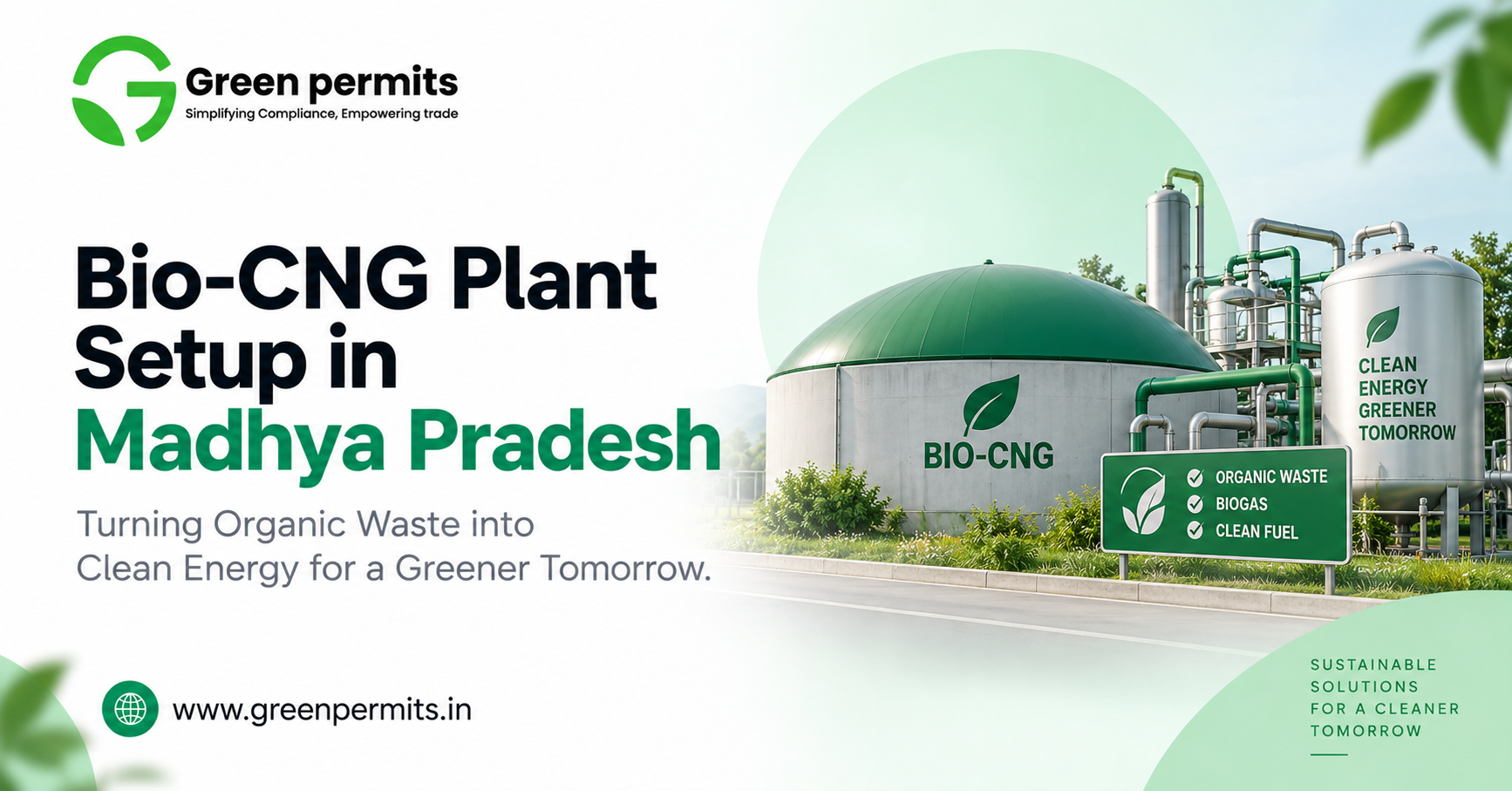
Setting up a Bio-CNG Plant in Madhya Pradesh can be a promising opportunity for entrepreneurs, industries, dairy operators, agricultural businesses, waste-management companies, and investors looking to convert organic waste into renewable fuel.
Madhya Pradesh has access to agricultural residues, cattle dung, food waste, press mud, poultry waste, and other biodegradable feedstocks that can potentially support Bio-CNG projects. However, the success of a plant depends on much more than purchasing a biogas system.
Before investment, the project should be evaluated for feedstock availability, plant capacity, site suitability, technology, MPPCB approvals, Bio-CNG offtake, project cost, and financial viability.
Green Permits Consulting supports businesses with Bio-CNG feasibility studies, DPR preparation, plant layout, machinery planning, environmental approvals, project cost analysis, and complete plant setup consulting in Madhya Pradesh.
What is a Bio-CNG Plant?
A Bio-CNG plant converts biodegradable material into purified and compressed methane-rich gas that can be used as a renewable fuel.
Organic feedstock first undergoes anaerobic digestion to produce raw biogas. The gas is then purified to remove impurities such as carbon dioxide, hydrogen sulphide, and moisture before being compressed.
A typical process is:
Feedstock → Pre-Treatment → Anaerobic Digestion → Raw Biogas → Gas Purification → Compression → Bio-CNG
The digestion process also generates digestate, which can potentially be processed or utilised depending on its quality and applicable requirements.
Which Feedstock Can Be Used in Madhya Pradesh?
Feedstock selection is one of the most important decisions in a Bio-CNG project.
Potential sources in Madhya Pradesh can include cattle dung, agricultural residues, food-processing waste, poultry waste, vegetable-market waste, press mud, Napier grass, and other suitable organic materials.
However, different materials produce different quantities of biogas.
A project should not assume that one tonne of every feedstock will produce the same amount of Bio-CNG.
The feasibility study should evaluate the quantity, moisture content, seasonal availability, transport distance, purchase cost, and expected gas yield of the proposed feedstock.
Feedstock Availability Should Decide Plant Capacity
A common mistake is deciding plant capacity first and searching for feedstock later.
The better approach is to understand how much organic waste can be collected reliably throughout the year.
For example, if a project requires 100 tonnes of feedstock every day but only 60 tonnes can be sourced consistently within an economical radius, the plant may remain underutilised.
For Bio-CNG projects:
Reliable Feedstock → Stable Gas Production → Better Plant Utilisation → Better Financial Viability
A long-term feedstock sourcing plan is therefore essential.
Site Selection for Bio-CNG Plant in Madhya Pradesh
The site should provide sufficient space for feedstock storage, pre-treatment, digesters, gas purification equipment, compression systems, digestate handling, utilities, internal roads, and safety areas.
Location should preferably reduce the distance between feedstock sources and the plant.
Transporting low-density organic feedstock over long distances can significantly increase operating costs.
The site should also be evaluated for electricity, water, road connectivity, drainage, nearby habitation, and availability of land for future expansion.
A low-cost land parcel is not always the best site if daily feedstock transportation becomes expensive.
Bio-CNG Plant Manufacturing Process
The process begins with receiving and preparing the organic feedstock.
Depending on the material, this may involve sorting, chopping, shredding, mixing, or slurry preparation.
The prepared material enters the anaerobic digester, where microorganisms break it down in the absence of oxygen and generate raw biogas.
Raw biogas usually contains methane along with carbon dioxide, hydrogen sulphide, moisture, and other impurities. It is therefore passed through a purification system.
After upgrading, the methane-rich gas is dried and compressed for storage or supply.
The complete process can be understood as:
Feedstock Preparation → Digestion → Gas Collection → H₂S Removal → Gas Upgrading → Drying → Compression → Bio-CNG
Technology should be selected according to feedstock characteristics rather than using the same plant design for every project.
Major Machinery Required
A Bio-CNG plant can require feedstock-handling equipment, shredders or choppers, mixing tanks, feeding systems, anaerobic digesters, pumps, agitators, gas holders, desulphurisation systems, purification equipment, dryers, compressors, and cascade storage systems.
Digestate-handling equipment may also be required.
Machinery should be evaluated according to actual feedstock, expected gas yield, energy consumption, automation, maintenance requirement, and guaranteed output.
A lower machinery quotation is not always a lower-cost project if power consumption or gas losses are high.
MPPCB Consent for Bio-CNG Plant
Environmental approvals should be assessed before construction begins.
Depending on the project configuration, the promoter may need Consent to Establish - CTE from the Madhya Pradesh Pollution Control Board before establishing the facility.
The application generally considers the proposed feedstock, plant capacity, process, water consumption, wastewater, air emissions, waste generation, and pollution-control arrangements.
After installation, the project may also need to assess Consent to Operate - CTO requirements before regular commercial operations.
The preferred sequence is:
Site Selection → CTE → Construction and Installation → Pollution Controls → CTO → Commercial Operation
Other approvals may also apply depending on gas storage, factory configuration, fire safety, local requirements, and project design.
Bio-CNG Plant Setup Cost in Madhya Pradesh
There is no single fixed cost for setting up a Bio-CNG plant.
Investment depends on daily feedstock capacity, feedstock type, digester technology, gas purification system, automation, land, civil construction, compression system, digestate treatment, and storage arrangement.
Project cost should therefore include more than machinery.
A proper investment estimate should consider:
Land + Civil Work + Machinery + Gas Upgrading + Compression + Utilities + Environmental Systems + Working Capital
The DPR should use vendor quotations and project-specific engineering assumptions instead of a generic cost-per-tonne figure.
Bio-CNG Revenue and Offtake
A Bio-CNG plant should identify potential buyers before major investment.
Depending on the project model, Bio-CNG may be supplied to gas marketing companies, industrial consumers, transport applications, or other eligible buyers.
The project should evaluate expected selling price, daily output, transportation or pipeline arrangement, compression cost, and buyer distance.
Digestate or organic manure may provide additional revenue, but this should be estimated conservatively.
The core project economics should remain strong even without assuming unusually high manure income.
DPR for Bio-CNG Plant in Madhya Pradesh
A Detailed Project Report - DPR helps determine whether the proposed Bio-CNG project is technically and financially viable.
The DPR can cover feedstock availability, plant capacity, technology, machinery, land requirement, utilities, process flow, approvals, project cost, operating expenses, gas production, revenue, and profitability.
For projects seeking bank loans or investors, it can also include cash flow, break-even, debt servicing, and sensitivity analysis.
The DPR should test what happens if feedstock prices increase, gas production is lower than expected, or plant utilisation takes longer to stabilise.
Common Mistakes While Setting Up a Bio-CNG Plant
One of the biggest mistakes is relying on theoretical gas yield without analysing the actual feedstock.
Projects can also face difficulties when they select machinery before completing feedstock studies, underestimate transportation costs, ignore digestate management, or begin construction before environmental approvals are assessed.
Another mistake is developing a plant without a clear Bio-CNG buyer.
The better project sequence is:
Feedstock Study → Market and Offtake → Site → DPR → Approvals → Machinery → Construction → Commissioning
How Green Permits Helps with Bio-CNG Plant Setup in Madhya Pradesh
Green Permits Consulting supports entrepreneurs, investors, industries, and waste-management companies with Bio-CNG feasibility studies, feedstock assessment, DPR preparation, site selection, plant layout, machinery planning, MPPCB CTE/CTO support, project cost analysis, and financial modelling.
Our approach evaluates the complete project rather than treating Bio-CNG setup as only a machinery installation.
Learn More About Bio-CNG Plant Setup in Madhya Pradesh
If you are planning a Bio-CNG plant in Madhya Pradesh, the project should be evaluated for feedstock availability, plant capacity, technology, site, approvals, machinery, investment, and Bio-CNG offtake before construction begins.
Read more about Bio-CNG feasibility and DPR consulting here:
👉 https://www.greenpermits.in/09/bio-cng-plant-setup-in-mp-mppcb-dpr-subsidy/
📞 Get Expert Assistance for Bio-CNG Plant Setup in Madhya Pradesh
If you need help with Bio-CNG Plant Setup in Madhya Pradesh, feasibility study, DPR preparation, feedstock assessment, MPPCB approvals, machinery planning, or project finance, Green Permits Consulting can assist you.
🌐 Website: www.greenpermits.in
📞 Phone: +91 78350 06182
📧 Email: wecare@greenpermits.in

 Arabic
 French
 Spanish
 Portuguese
 Deutsch
 Turkish
 Dutch
Dutch
 Italiano
 Russian
 Romaian
 Portuguese (Brazil)
 Greek
Greek
 Bengali