


Most Spoken Languages in the World: Which Languages Have the Most Speakers?
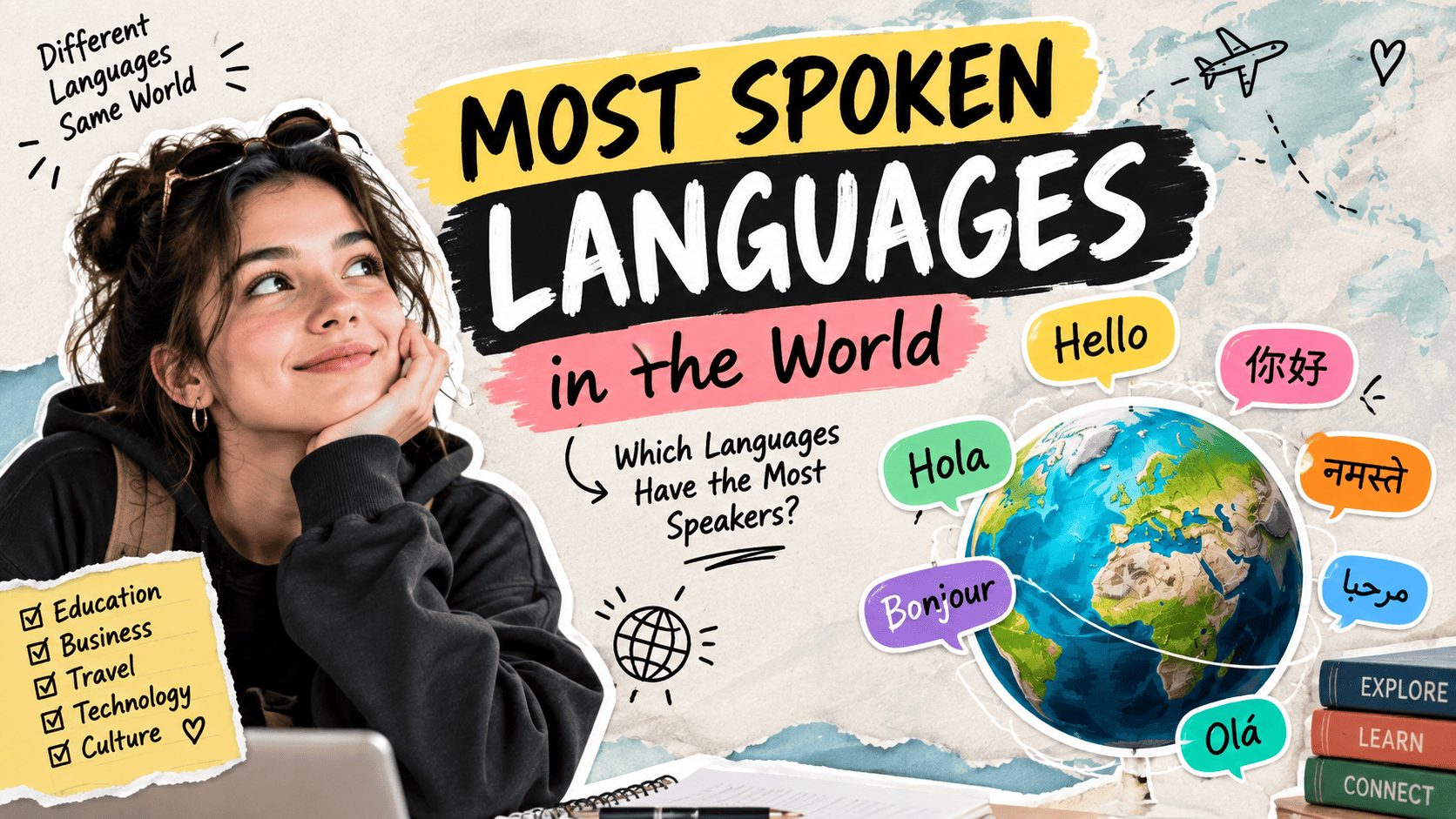
There are lots of ways for one to connect with people, share ideas, build a life and career, and have a connection with another culture, but language is one of the most powerful ways. Currently, thousands of languages are spoken around the world, but only a handful have hundreds of millions of speakers.
Most people search for the most spoken languages in the world; they want to know either by number of native speakers or total speakers. Note that these are not always the same thing. Mandarin Chinese has more native speakers than English but is also less common as a second language, and when both kinds of speakers are added up, English ranks first while these top two languages count as close second. The Ethnologue estimates for 2026 currently put English at about 1.49 billion total speakers and Mandarin Chinese at about 1.18 billion.
Appreciating these distinctions makes the ranking a whole lot more engaging. We've taken you through the top languages in the world and their heavy influence on education, business, Travel, technology, and even culture.
What Makes a Language One of the Most Widely Spoken?
One way to measure how widely a language is spoken is by looking at the common scale.
-
First is its number of native or first-language speakers. These are people who have learnt the language from their mother tongue.
-
The other is the total number of speakers. It accounts for both native and non-native speakers.
That very difference can affect a ranking massively. English has a very large number of multilingual speakers and is the most important language in the world; therefore, it's frequently taught to non-native speakers. In contrast, Mandarin Chinese has an abnormally high native-speaker population. This guide explores the most spoken languages in the world explained, including their global reach, number of speakers, cultural importance, and growing influence.
English
Today, English ranks as the most widespread language in terms of total speakers worldwide. The total number of speakers—including both native and second-language speakers—was recent 2026 figures at around 1.49 billion.
English is the universal language because English acts as a global lingua franca for international business, education, science, entertainment, and modelling in aviation and shipping and technology.
It is by far the most studied language as well. For better opportunities in an economy ruled by globalisation, students everywhere study English to gain access to international universities and business markets all over the world.
English appears everywhere from websites and software to movies and international conferences.
Mandarin Chinese
Mandarin Chinese is the second language that very high people from all countries translate with more than one billion speakers. Today, it is estimated that there are roughly 1.18 billion speakers of Hindi when native and non-native speakers are combined together. According to the latest 2026 data, it has about 988 million first-language speakers.
Mandarin is the most widely spoken variety of Chinese and one of the official languages of mainland China and Taiwan; it is also one of the official languages of Singapore, where Mandarin Chinese works alongside English.
Mandarin is considered a tough language for learners because it uses tones — meaning the same syllable can have a different meaning if pronounced with emphasis. Additionally, its writing system is vastly different from the characteristics of alphabet-based languages.
This makes Mandarin a pragmatic language to learn, as Mandarin is a language that is spoken by the largest population of humans and holds key parts of a country that are rich in culture, economy, or influence.
Hindi
Being one of, if not, THE most spoken languages in the world as well as one of the most used languages when it comes to an Indian context. That being said, current estimates put the number of total Hindi speakers (both first- and second-language speakers) at approximately 611 million.
Primarily, Hindi is spoken in the northern and central regions of India and serves as a major language in entertainment, education, media, and day-to-day conversation.
Language and Literature: Hindi also has a very close relationship with Indian popular culture. Bollywood films, music, television, and internet content have expanded the range of the language beyond its traditional Hindi-speaking territories.
For those studying or interested in India, Indian culture and communication in South Asia, Hindi can come in very handy.
Spanish
Spanish is currently an estimated 561 million total speakers and (cf. 2018) the second most important international language, after English.
Another useful language to know is Spanish, which you can find spoken span-wide as well as throughout much of Latin America and is a highly practical language for travel, business, education and cultural exchange.
Mercury: For dates of writing after 2023, most only have access to data up to October 2023. But any rookie would find it approachable, given its generally consistent pronunciation and alphabet.
Spanish has an impressive status in global culture, from literature and music to film and international business.
Modern Standard Arabic
Arabic is a major global language, but it is because Arabic has many distinct regional varieties; the number of Arabic speakers can be tricky.
Modern Standard Arabic (MSA) is still the medium of formal writing such as newspapers, books, education, government, and some official government communication. Recent estimates suggest that when measured as a language variety in the relevant ranking, its total speaker count is approximately 335 million.
The most pertinent example of this is Arabic throughout the Middle East and North Africa. It is also intimately tied to a deep history of letters, thought, and theological investigation.
People who learn Arabic would likewise discover that formal Arabic is definitely not the same as day-to-day neighbourhood flavour.
French
In terms of total speakers, French has approximately 334 million users as of 2026 estimates, with a large fraction using it as an L2.
French is spoken across Europe, Africa, North America, and other parts. This is evidenced by its international importance being reflected in diplomacy and the positioning of units within international organisations, among other things.
It helps students, travellers, workers, or anyone who does international work.
The cultural influence that France has had in art, fashion, food, literature, and cinema, among other areas, has helped the French language continue to have a strong cultural identity globally.
Bengali
Another great world language is the Bengali language; the most recent estimates place total speakers at 274 million.
Mainly spoken in Bangladesh and the Indian state of West Bengal, with Bengali speakers across the world.
The Bengali language has a high-profile literary legacy linked with renowned authors, poets, singers, and painters. It is also a very significant language of South Asia and its history and culture.
This is the time of the season to explore Bangladesh, eastern India, or Bengali literature that can be learnt further after acquiring basic language skills.
Portuguese
The latest stats say that the Portuguese language has approximately 269 million total speakers.
So while most people think of Portuguese = Portugal + Brazil, the language is also spoken in a number of African countries and other non-Brazil/Portugal destinations.
Brazil has a huge population and a heavy cultural influence and therefore represents the largest speaker base of Portuguese.
If you are interested in Brazil, global trade, tourism, sports, music, and communication with the world, then Portuguese is beneficial for you.
Indonesian
242 million in 2021 and 255 million total speakers predicted by the estimates of 2026 include Indonesian.
Indonesia has also been classified among the most populated nations on the planet, and Indonesian is significant among people, even to individuals who communicate. 1.
This is what makes Indonesian a good case study of using a national language to unite those from different linguistic backgrounds in the same country.
It is also handy for people who seek to know Southeast Asian culture, travel and business, or to research about that region.
Urdu
With around 246 million total speakers, Urdu is yet another major South Asian language in the most recent ranking.
It is spoken throughout Pakistan and also in parts of India and significant diaspora communities across South Asia internationally.
Urdu has a high degree of lexicon and grammar in common with Hindi, but the two languages usually use separate scripts as well as different literary and cultural traditions.
It is notable for its poetry, in particular the ghazal, as well as various forms of South Asian literature.
Why Are the Most Spoken Languages Significant?
Because the most spoken languages in the world are significant only if millions or billions of people speak them. They also influence global communication.
-
English is key to international business and technology.
-
Mandarin is necessary in order to communicate with one of the world's top economies
-
In South Asia, huge communities are linked by Hindi and Bengali.
-
Thousands of kilometres away, European and American countries meld large proportions of the population through Spanish or Portuguese.
-
International and regional importance: French, Arabic
Language can also create opportunities. Learning a major global language allows them to relate to new communities, bridge cultural barriers abroad, engage in international travel more confidently, and even improve their job prospects (in some industries).
Ranking varies between Native Speakers and Total Speakers
Rankings can differ based on how language use is measured; each of the most spoken languages takes the title over another when counting and ranking usage statistically.
-
Mandarin Chinese, with Spanish and English in close proximity, leads native speakers alone in current Ethnologue-based numbers ahead of Hindi and Portuguese.
-
Add in the millions of people who use English as a second language, and it drops to No. 1 — since hundreds of millions of people on earth speak English as a second language.
Hence, this is why there can never be a perfect answer to "What is the most spoken language in the world? The answer is dependent on what exactly we are measuring.
Final Thoughts
The most spoken languages in the world are about much more than numbers of people. They recount migration, history, education, commerce, technology, culture, and cross-border communication.
At present, English takes the lead in total speakers, and Mandarin Chinese has the largest native-speaking population. Also, Hindi, Spanish, Arabic, French, Bengali, and Portuguese connect hundreds of millions of people across countries and cultures, as well as Indonesian and Urdu. As Korean continues to gain global interest, an online Korean language course can help learners develop practical communication skills and understand the language more effectively.
With globalisation, it can serve you personally and professionally by writing in a common, widely spoken language throughout your life. Like any entity, these languages—no matter how large or small—have a historical context and cultural significance. That is why the diversity of languages in the world deserves to be explored and preserved.

 Arabic
 French
 Spanish
 Portuguese
 Deutsch
 Turkish
 Dutch
Dutch
 Italiano
 Russian
 Romaian
 Portuguese (Brazil)
 Greek
Greek
 Bengali