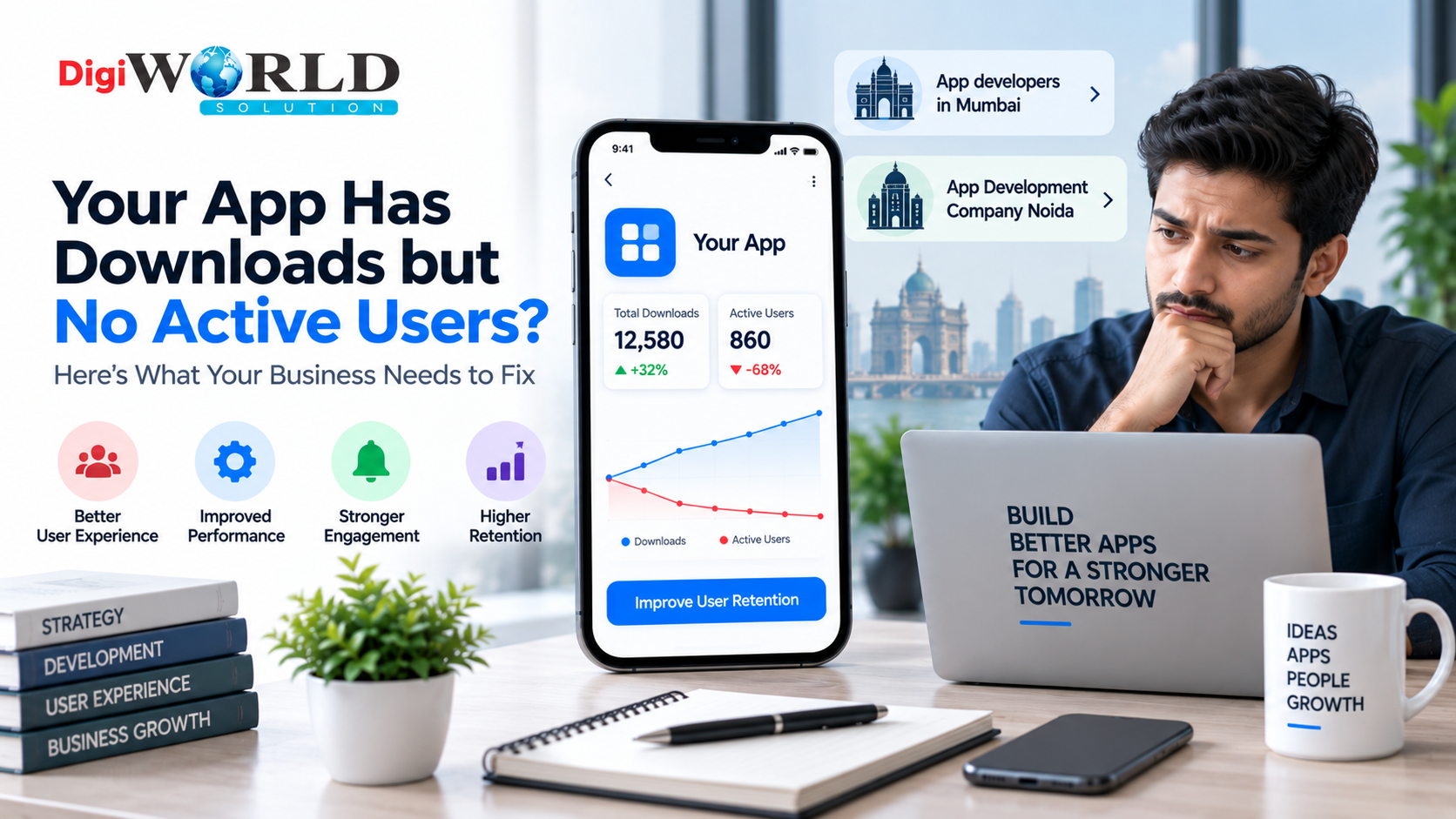
Getting thousands of app downloads may look like a major success. But downloads are only one part of the story.
The more important question is:
How many people are actually using your app regularly?
A business can invest heavily in app development, marketing, and user acquisition, yet still struggle to retain users. People may download the application, open it once, and then never return.
This doesn't necessarily mean the app idea is bad.
Often, the problem lies in the user experience, performance, onboarding, features, communication, or overall value provided by the app.
In 2026, businesses need to think beyond downloads and focus on creating applications that users have a genuine reason to keep using.
Downloads Don't Guarantee App Success
Imagine an app receives 20,000 downloads but only 1,000 monthly active users.
Another app receives 5,000 downloads but has 3,000 active users.
The second app may actually have a much stronger product because more of its users continue to find value in it.
This is why businesses should monitor metrics such as:
- Daily active users
- Monthly active users
- Retention rate
- Session frequency
- Session duration
- Feature usage
- Uninstall rate
- Conversion rate
These numbers can reveal whether people are simply downloading your app or actually finding it useful.
1. Your App May Not Solve a Strong Enough Problem
Before adding more features, ask a simple question:
Why should someone use this app instead of a website, competitor, or another solution?
If the answer isn't clear, users may have little reason to return.
A successful app should solve a specific problem or make something significantly easier.
For example, an app might allow customers to:
- Book appointments quickly
- Track an order
- Make payments
- Manage services
- Access personalized information
- Receive important updates
- Purchase products conveniently
The more clearly the app solves a real customer problem, the stronger its reason to exist.
2. The First-Time User Experience Matters
The first few minutes can determine whether a new user continues using an application.
If registration takes too long, permissions appear immediately, or users don't understand what to do after opening the app, they may leave.
A better onboarding experience should:
- Explain the app's main value.
- Keep registration simple.
- Introduce essential features.
- Guide users toward their first useful action.
- Avoid unnecessary steps.
Don't overwhelm new users with every feature at once.
Show them what matters first.
3. Too Many Features Can Make an App Confusing
Businesses often assume that adding more features automatically makes an app better.
It doesn't.
An application with too many menus, buttons, pop-ups, and complicated options can become difficult to use.
Instead of asking:
"What else can we add?"
Ask:
"Which features do users actually need?"
A clean interface with five useful features can provide a better experience than an application with twenty confusing ones.
4. Poor Performance Can Drive Users Away
Users don't want to wait for an application to load every time they open it.
Slow screens, crashes, freezing, failed payments, and delayed responses can quickly damage the user experience.
Performance issues can be caused by:
- Poorly optimized code
- Heavy images
- Inefficient APIs
- Database problems
- Poor server configuration
- Excessive background processes
- Lack of performance testing
Performance should therefore be considered throughout the development process, not only after users start complaining.
5. Your App May Not Be Easy to Navigate
Users should be able to find important features without thinking too much.
For example, if your app is designed for bookings, the process should be obvious:
Choose Service → Select Date → Select Time → Confirm Booking
If users have to move through multiple unnecessary screens, they may abandon the process.
Good UI/UX design focuses on reducing friction and making common actions easier.
6. You're Not Giving Users a Reason to Come Back
Even a well-designed app can become inactive if users don't have a reason to return.
Depending on the type of business, repeat engagement can be encouraged through:
- Personalized recommendations
- Fresh content
- Useful notifications
- Loyalty programs
- New features
- Relevant offers
- Order or booking updates
- Personalized dashboards
However, notifications should be relevant.
Sending too many unnecessary notifications can have the opposite effect and encourage users to disable notifications or uninstall the app.
7. Listen to What Your Users Are Saying
Your users can tell you exactly what is wrong with your app—if you pay attention.
Monitor:
- App-store reviews
- Customer support questions
- User feedback
- Exit points
- Feature usage
- Failed transactions
- Common complaints
For example, if multiple users complain that checkout is confusing, improving the checkout experience may be more valuable than adding another feature.
Your development roadmap should be influenced by real user behavior and feedback, not assumptions alone.
8. Keep Improving After Launch
Launching an app is not the end of development.
It is the beginning of the next stage.
After launch, businesses should continuously:
Measure → Analyze → Improve → Test → Release
Updates can improve:
- Performance
- Security
- User experience
- Existing features
- Compatibility
- Navigation
- Engagement
Regular improvements show users that the business is actively maintaining the product.
Choosing the Right App Development Partner
The quality of development can have a direct impact on an application's performance, usability, scalability, and maintenance.
When looking for app developers in Mumbai, businesses should evaluate more than just the development cost.
Ask whether the team understands:
- UI/UX design
- Mobile performance
- Backend development
- API integration
- Security
- Testing
- App-store requirements
- Analytics
- Scalability
- Post-launch support
Similarly, businesses searching for an App Development Company Noida should look for a development partner that understands the complete product lifecycle rather than focusing only on coding.
The right development team can help identify potential usability and technical problems before they become expensive issues.
Focus on Retention, Not Just Downloads
Marketing can bring people to your application, but the product itself needs to give them a reason to stay.
Instead of celebrating only download numbers, businesses should ask:
Are users completing important actions?
Are they returning after their first session?
Which features do they use most?
Where are users leaving?
What problems are they reporting?
These questions provide much more useful information about the actual health of an application.
Final Thoughts
An app with thousands of downloads but very few active users has a retention problem—not necessarily a marketing problem.
The solution may involve improving onboarding, simplifying navigation, fixing performance issues, removing unnecessary features, improving UX, personalizing communication, or simply understanding what users actually want.
A successful mobile application is not defined by how many people download it.
It is defined by how many people find enough value to keep coming back.
Whether you're planning a new application or trying to improve an existing one, working with experienced app developers in Mumbai or an App Development Company Noida can help turn your application into a more useful, reliable, and scalable digital product.



 English
 Arabic
 French
 Spanish
 Portuguese
 Deutsch
 Turkish
 Dutch
Dutch
 Italiano
 Russian
 Portuguese (Brazil)
 Greek
Greek
 Bengali