


Why Are Your Paid Ads Getting Clicks but Not Conversions?
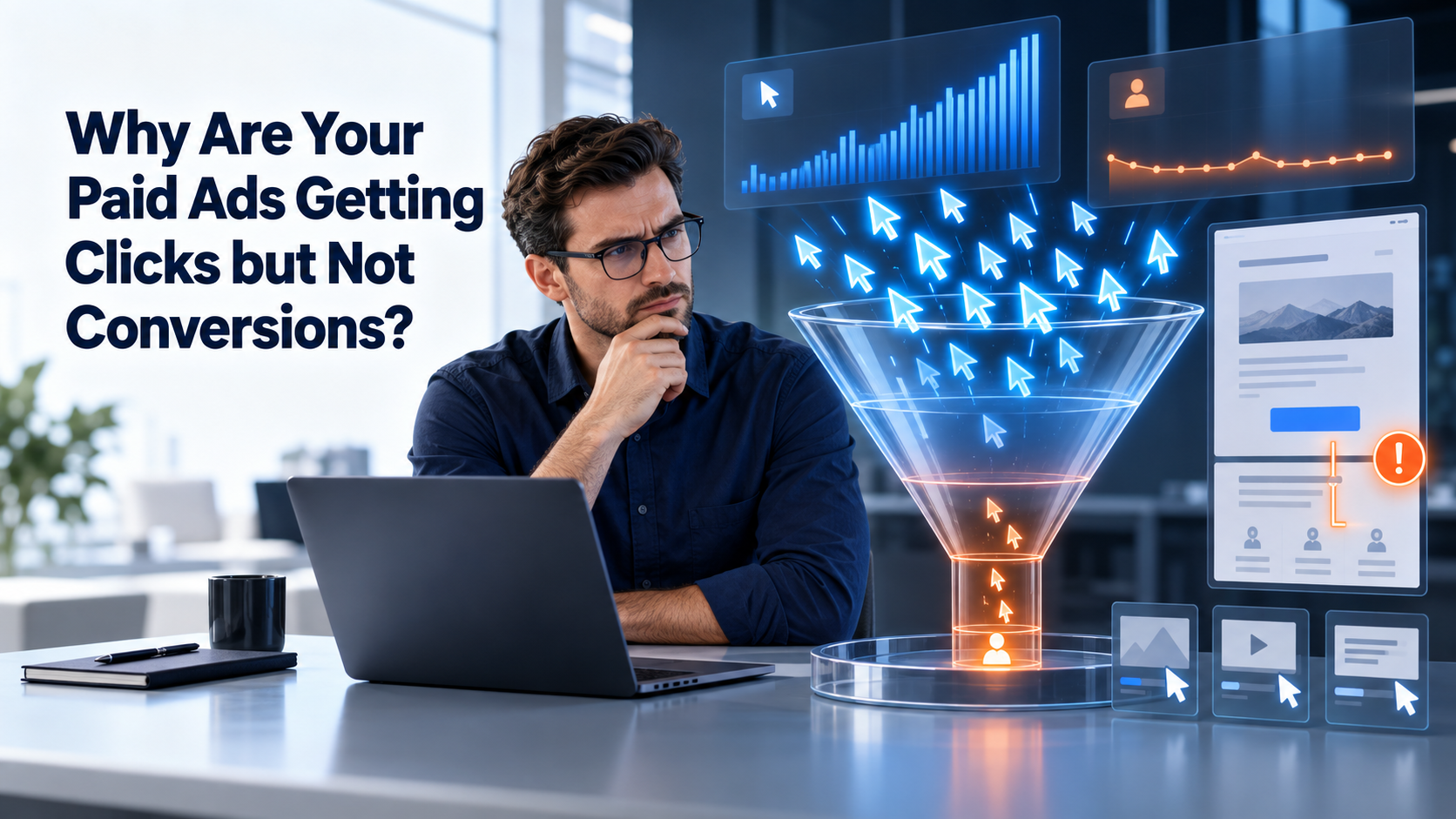
Getting clicks from paid advertising can feel like a positive sign. People are noticing the ads and visiting the website. However, clicks have little value if visitors leave without purchasing, booking a call, or submitting a form.
This is where conversion rate optimization becomes important.
Conversion rate optimization, commonly known as CRO, is the process of improving a website or landing page so more visitors complete the desired action. It connects advertising traffic with actual business results.
A skilled digital marketing strategist looks beyond impressions and clicks. They examine the complete customer journey, including the creative, offer, landing page, checkout process, and follow-up experience.
What Is Conversion Rate Optimization?
Conversion rate optimization is the structured process of increasing the percentage of visitors who take a valuable action.
A conversion may include:
- Purchasing a product
- Booking a strategy call
- Requesting a quotation
- Starting a free trial
- Submitting a lead form
- Creating an account
- Downloading a resource
Suppose 1,000 people visit an ecommerce website and 20 place an order. The conversion rate is 2%. If landing page optimization helps 30 visitors purchase from the same traffic, the conversion rate increases to 3%.
This improvement can produce more revenue without increasing the advertising budget.
Why Clicks Do Not Always Produce Sales
A paid advertisement and its landing page must work together. The ad creates an expectation, while the landing page must continue the same message.
If the advertisement promotes a special discount but the offer is difficult to find on the website, visitors may leave. The same problem occurs when an ad promises a simple solution but sends people to a complicated page.
Other common reasons for low conversions include:
- Slow website speed
- An unclear headline
- Weak product information
- Too many calls to action
- A difficult checkout process
- Missing customer reviews
- Unexpected charges
- Poor mobile experience
- Complicated lead forms
A paid advertising expert should study what happens after the click. Lowering the cost per click is useful, but it does not solve problems on the website.
Begin with a Strong Message Match
Message match means keeping the promise, language, and visual direction consistent between an advertisement and its landing page.
Imagine that a Facebook ad promotes a free marketing audit for ecommerce brands. After clicking, the visitor reaches a general services page that does not mention the audit. The visitor must search for the offer and may leave before taking action.
A better landing page would repeat the main promise immediately. It would explain what the audit includes, who it is for, and how to request it.
Strong message match reassures visitors that they have reached the correct page. It also reduces confusion during the buying journey.
Make the Value Clear Immediately
Visitors should understand the main value of an offer without reading the entire page.
The first section of a landing page should normally include a clear headline, short supporting text, relevant visual, and visible call to action. This area should answer three basic questions:
- What is the offer?
- Who is it designed for?
- What result can it provide?
Complicated headlines may sound creative, but they can reduce clarity. Conversion copywriting should make the offer easy to understand rather than forcing visitors to interpret the message.
A clear headline such as “Get a Custom Meta Ads Strategy for Your Ecommerce Brand” is more direct than a vague statement about unlocking unlimited growth.
Improve the Offer Before Increasing Ad Spend
Sometimes the website is not the main problem. The offer itself may not be strong enough.
Offer development involves improving how a product or service is packaged and presented. A better offer may include a useful bonus, clear guarantee, limited-time benefit, easier payment option, or stronger explanation of the outcome.
A good offer reduces the customer’s perceived risk while increasing the value they expect to receive.
Before increasing the campaign budget, a performance media buyer should ask whether the offer gives people a strong reason to act. Sending more traffic to an unappealing offer usually increases spending without solving the conversion problem.
Use Consumer Psychology Responsibly
Consumer psychology helps marketers understand how people evaluate choices and make buying decisions.
Customers usually want to avoid risk. They may worry about product quality, delivery, hidden charges, long contracts, poor support, or wasting money. A landing page should address these concerns openly.
Trust-building elements may include customer testimonials, case studies, transparent pricing, clear guarantees, secure payment details, and answers to common questions.
Urgency and scarcity can also encourage action, but they must be genuine. False countdown timers and misleading claims may damage long-term trust.
The goal of CRO is not to pressure visitors. It is to remove unnecessary uncertainty and help qualified customers make informed decisions.
Simplify the Call to Action
Every important page should guide visitors toward a clear next step.
Using several competing calls to action can create confusion. A page that asks visitors to buy, subscribe, download, follow social accounts, and contact the company at the same time may reduce focus.
The primary call to action should match the visitor’s level of intent.
An ecommerce product page may use “Add to Cart.” A SaaS landing page may use “Start Your Free Trial.” A service business may use “Book a Strategy Call.”
The button text should clearly explain what happens next. General words such as “Submit” are less helpful than action-focused phrases such as “Get My Free Audit.”
Reduce Friction in Forms and Checkout
Every unnecessary step gives a visitor another opportunity to leave.
Lead generation forms should request only the information needed to qualify or contact the prospect. Asking for too many personal details at the beginning can reduce submissions.
Ecommerce checkout pages should also be simple. Customers need clear shipping information, payment options, delivery expectations, and access to support.
Mobile optimization is especially important because many visitors interact with Facebook Ads, Instagram Ads, and TikTok Ads through smartphones. Forms, menus, images, and buttons must work properly on smaller screens.
Connect Creative Strategy with CRO
Conversion rate optimization should not be separated from creative strategy.
A Meta Ads specialist may create a powerful hook that attracts attention. The landing page must then continue that same angle. If an advertisement focuses on saving time, the page should provide more information and proof related to that benefit.
The same rule applies to Google Ads. Search visitors usually have a specific intention. A Google Ads specialist should direct them to a page that closely matches the keyword and advertisement.
Brands can explore a professional Meta Ads portfolio to see how creative messaging and performance-focused execution work together.
Consistent messaging across the ad and website creates a smoother customer journey.
Test Important Changes Instead of Guessing
CRO should be based on evidence rather than personal preference.
A business can test different headlines, calls to action, page layouts, offers, testimonials, product images, or form lengths. Each test should have a clear reason behind it.
For example, if visitors are reaching the checkout page but not purchasing, the team should investigate the checkout experience. Changing the homepage color is unlikely to solve that particular problem.
Useful data may come from:
- Website analytics
- Advertising reports
- Heatmaps
- Session recordings
- Customer surveys
- Sales conversations
- Form completion data
These insights help a performance marketing team identify the most important points of friction.
Measure Business Results, Not Vanity Metrics
High impressions and engagement may look impressive, but they do not always represent profitable growth.
A full-funnel marketing strategy should monitor meaningful results such as conversion rate, customer acquisition cost, qualified lead rate, average order value, and return on ad spend.
The right metric depends on the business model. Ecommerce marketing may focus on purchases and revenue. SaaS marketing may track trial registrations, demo bookings, activation rates, and paid subscriptions.
Lead generation campaigns must also consider lead quality. A low cost per lead is not valuable if those leads never answer, qualify, or become customers.
Real performance marketing case studies can demonstrate how advertising, creative testing, and conversion strategy contribute to wider business outcomes.
Final Thoughts
Paid ads may bring people to a website, but the complete customer experience determines whether they convert.
Conversion rate optimization helps businesses improve that experience by creating clearer messages, stronger offers, focused landing pages, simpler forms, and more consistent customer journeys.
Before spending more money on Facebook, Instagram, Google, or TikTok advertising, brands should understand why their existing visitors are not converting. Fixing those problems can improve customer acquisition and make every advertising dollar work harder.
Frequently Asked Questions
1. What is a good conversion rate?
A good conversion rate depends on the industry, offer, traffic source, price, and customer journey. Businesses should focus on improving their current results instead of relying only on general benchmarks.
2. How can I improve my landing page conversion rate?
Use a clear headline, explain the main benefit, add relevant proof, remove distractions, simplify the call to action, and make the page easy to use on mobile devices.
3. Can CRO reduce advertising costs?
Yes. If more visitors convert from the same amount of traffic, the average customer acquisition cost may decrease.
4. Should I optimize my ads or landing page first?
Review both together. If the ad attracts the wrong audience, improve its targeting and message. If people click but leave the website, examine the offer and landing page.
5. How long does conversion rate optimization take?
CRO is an ongoing process. Some problems can be fixed quickly, while reliable testing may require more time and enough traffic to produce useful data.

 English
 Arabic
 French
 Portuguese
 Deutsch
 Turkish
 Dutch
Dutch
 Italiano
 Russian
 Romaian
 Portuguese (Brazil)
 Greek
Greek
 Bengali