


Solar module manufacturing plant setup cost
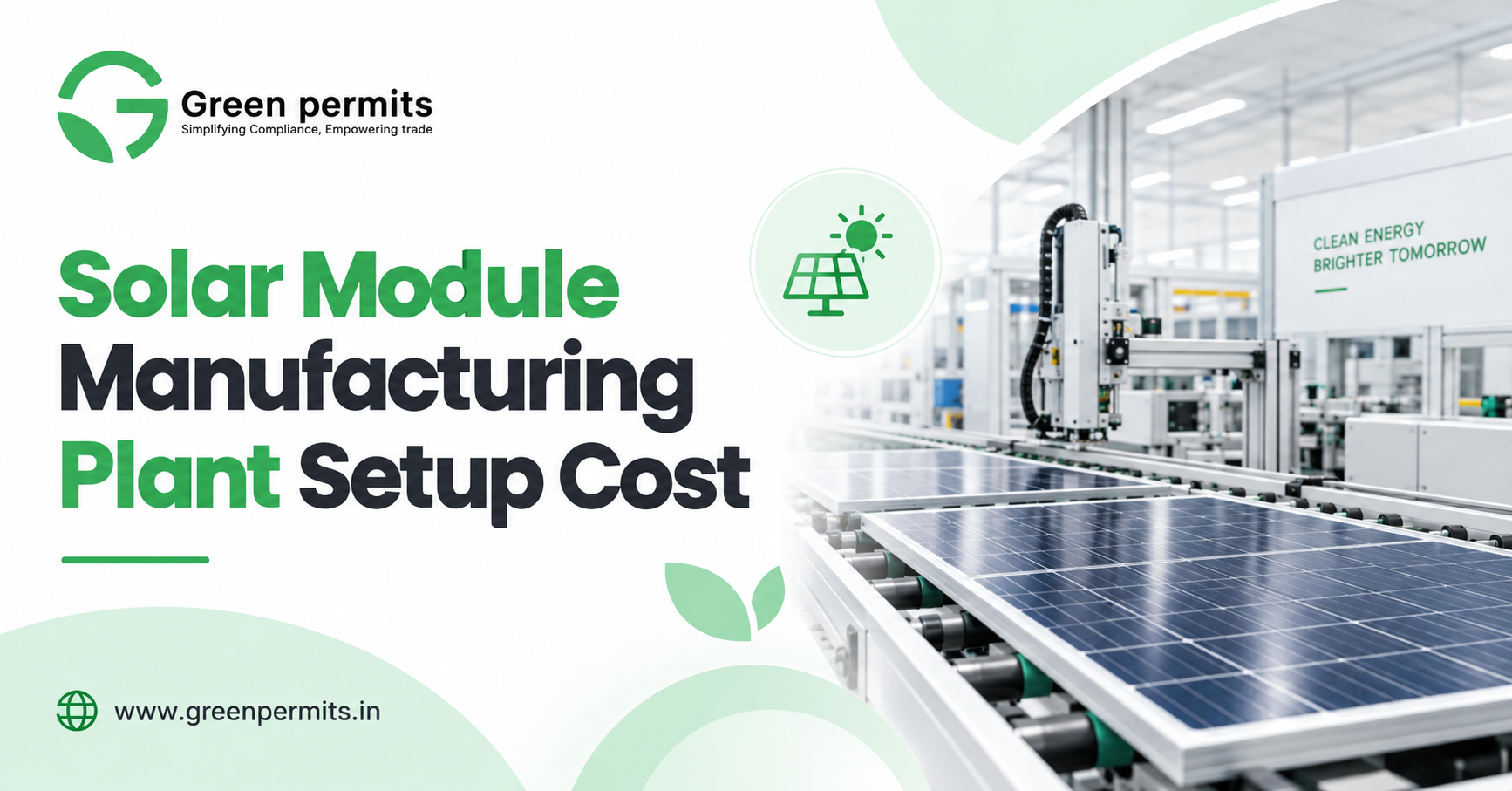
Solar Module Manufacturing Plant Setup Cost in India depends mainly on plant capacity, automation level, module technology, machinery configuration, land, factory infrastructure and whether the project is limited to module assembly or includes backward integration into solar cell manufacturing.
India's solar manufacturing sector has expanded rapidly as utility-scale projects, rooftop solar and domestic sourcing requirements increase demand for locally manufactured modules. Government support has also encouraged investment through the Production Linked Incentive Scheme for High Efficiency Solar PV Modules, which has a total outlay of ₹24,000 crore. MNRE states that awards under the two PLI tranches cover 48,337 MW of integrated and partially integrated manufacturing capacity.
However, investors should not start with a generic statement such as "a solar module plant costs ₹X crore." A 500 MW semi-automated module line, a 1 GW fully automated TOPCon-compatible module factory and an integrated cell-to-module manufacturing project have completely different capital requirements.
Green Permits Consulting supports solar manufacturers and investors with market studies, feasibility reports, Detailed Project Reports, machinery planning, plant layout, CAPEX and OPEX estimation, subsidy assessment, project finance documentation and regulatory planning.
What is a Solar Module Manufacturing Plant?
A solar module manufacturing plant converts finished photovoltaic cells into complete solar panels that can be supplied to rooftop, commercial, industrial or utility-scale solar projects.
The basic manufacturing process is:
Solar Cells → Cell Testing and Sorting → Stringing → Layup → Glass and Encapsulant Assembly → Lamination → Trimming → Frame Installation → Junction Box → Testing → Finished Solar Module
This is different from solar cell manufacturing.
A module plant purchases finished solar cells and converts them into modules. A solar cell factory starts further upstream and requires highly specialised semiconductor manufacturing equipment, clean production environments and substantially greater investment.
Solar Module Manufacturing vs Solar Cell Manufacturing
This distinction is extremely important when discussing project cost.
A module-only manufacturing plant generally requires stringers, laminators, framing machines, junction-box equipment, testing systems, material-handling equipment and factory utilities.
A solar cell manufacturing plant can require wet benches, diffusion furnaces, PECVD or ALD systems, metallisation equipment, clean-room infrastructure and significantly more sophisticated process control.
Recent industry research by CEEW estimated average capital expenditure for a TOPCon solar cell manufacturing facility in India at around USD 70 million per GW, demonstrating how much more capital-intensive cell manufacturing can be compared with module assembly.
Therefore, an investor should first decide whether the proposed project is:
Module Only
or
Cell + Module
or
Fully Integrated Solar Manufacturing
before preparing the investment estimate.
How Much Does a 1 GW Solar Module Manufacturing Plant Cost?
For a modern module-only plant, recent Indian projects provide useful market references.
Solarium Green Energy commissioned a 1 GW fully automated module manufacturing facility in Ahmedabad in March 2026 at an estimated capex of around ₹90 crore. The facility is designed to manufacture large-format G12 modules of up to approximately 725 Wp using technologies such as TOPCon cells, half-cut cells and bifacial configurations.
Another 1 GW TOPCon module project announced by Atal Solar in Rajkot was reported at an investment of approximately ₹125 crore.
These examples suggest that a modern 1 GW module-only manufacturing facility may require roughly ₹70-125 crore or more, depending on machinery, automation, land, building, utilities and project scope.
These figures should be treated as project references rather than a universal fixed cost.
The actual DPR should be prepared using current vendor quotations.
Cost of a 500 MW Solar Module Plant
A 500 MW plant does not necessarily cost exactly half of a 1 GW facility because certain infrastructure costs remain similar regardless of capacity.
For example, the factory may still require a laboratory, warehouse, office, utilities, fire infrastructure, quality-control systems and material-handling arrangements.
A preliminary module-only 500 MW project may therefore require investment in the tens of crores, but the final number should be developed after confirming machinery speed, automation level, module size and building requirements.
For investors deciding between 500 MW and 1 GW, the DPR should calculate the investment per MW and the expected manufacturing cost per watt.
A higher-capacity line can sometimes produce better unit economics if sufficient market demand is available.
Technology Selection Changes the Plant Cost
Solar module manufacturing technology has changed rapidly.
Manufacturers are increasingly planning facilities capable of handling high-efficiency and large-format cells used in TOPCon, bifacial and other advanced module configurations.
Older machinery designed around smaller wafer formats can become commercially outdated quickly.
A new project should therefore evaluate whether its line can handle current and future requirements such as larger cells, half-cut configurations, glass-glass modules, bifacial modules and higher module wattage.
Investing slightly more in a flexible production line can sometimes reduce the risk of major equipment replacement later.
Major Machinery Required for Solar Module Manufacturing
The production line generally starts with incoming cell inspection and progresses through stringing, module assembly, lamination, framing, electrical connection and final quality testing.
A modern factory can include automated tabber-stringers, layup systems, laminators, framing equipment, junction-box systems, EL testers, flash testers and automatic material movement.
Machinery investment depends significantly on line speed.
A plant designed for continuous high-volume production may require multiple stringers and laminators to prevent bottlenecks.
For this reason, machinery capacity should be assessed as a complete production line rather than purchasing individual machines based only on catalogue capacity.
Typical Solar Module Manufacturing Process
The manufacturing process begins when solar cells are inspected and sorted according to electrical characteristics.
The cells are connected into strings using tabbing and stringing machines. These strings are arranged in the required module layout and combined with glass, encapsulant and backsheet or rear glass depending on module design.
The assembled module then enters the laminator, where heat and vacuum create a sealed structure.
After lamination, excess material is trimmed and the aluminium frame is fitted where required. The junction box is installed and electrically connected.
The finished panel then undergoes testing before packing.
Quality control is critical because a manufacturing defect can reduce output or create reliability problems years after installation.
Land Requirement for a Solar Module Manufacturing Plant
Module manufacturing generally requires much less land than a solar power project, but a large-scale factory still needs sufficient space for production, warehousing, utilities and movement of materials.
Land planning should consider the production hall, raw-material warehouse, finished-goods warehouse, testing laboratory, utility area, administrative block and truck movement.
For larger projects, future expansion should also be considered.
An investor planning a 1 GW plant may eventually want to expand to 2 GW or establish solar cell manufacturing at the same location.
Buying land with no expansion possibility can limit future backward integration.
Factory Building and Infrastructure Cost
The building should be designed around the production line rather than selecting an existing warehouse and attempting to fit machinery into it later.
Floor loading, clear height, temperature control, material movement, electrical systems and fire safety all need consideration.
Module manufacturing also requires clean and controlled production conditions because dust or contamination during lamination can affect module quality.
The civil cost depends on location, factory specification and whether the promoter purchases land or leases an existing industrial facility.
Raw Materials and Working Capital
One of the biggest financial requirements after machinery is working capital.
Solar module manufacturing uses materials such as solar cells, tempered glass, encapsulants, backsheets or rear glass, aluminium frames, junction boxes, ribbons, sealants and packaging materials.
For a 1 GW plant, monthly raw-material purchases can be substantial.
A project that spends ₹90 crore on fixed assets can still require significant additional funding to procure cells and other materials before receiving payment from customers.
Therefore:
Plant Setup Cost ≠ Complete Funding Requirement
The project should calculate:
Fixed CAPEX + Initial Working Capital + Pre-Operating Expenses = Total Funding Requirement
Cost Per Watt is More Important Than Factory Cost Alone
Investors should not evaluate the plant only on total CAPEX.
The important commercial question is how much it costs to manufacture each watt of solar module.
Manufacturing cost depends on raw materials, yield, electricity, manpower, depreciation, rejection rate, production utilisation and finance cost.
Suppose two manufacturers invest similar amounts.
Plant A operates at 85% utilisation with low rejection and efficient material procurement.
Plant B operates at only 40% utilisation.
Even with similar machinery, Plant A can have significantly better manufacturing economics.
Capacity utilisation therefore has a direct impact on competitiveness.
Solar Module Manufacturing Capacity in India
India's module manufacturing capacity has increased rapidly.
Mercom reported cumulative solar module manufacturing capacity of around 210 GW at the end of 2025, while domestic solar cell capacity remained much smaller at about 27 GW.
This gap is important for new investors.
It means the Indian module manufacturing market is becoming increasingly competitive while cell manufacturing remains a major area of backward integration.
A new module project should therefore analyse market demand and competition before adding another manufacturing line.
Why a Market Study is Important Before Plant Setup
A new manufacturer should first identify who will purchase the modules.
Potential customers can include utility-scale developers, EPC companies, rooftop solar businesses, commercial and industrial projects, government programmes and distributors.
The market study should compare expected factory capacity with realistic customer demand.
A project should not assume that installing a 1 GW line automatically means selling 1 GW of modules every year.
The correct sequence should be:
Market Demand → Product Strategy → Capacity → Technology → Machinery → Investment
rather than beginning with machinery.
ALMM and Market Access
Manufacturers planning to supply modules into project segments where MNRE's Approved List of Models and Manufacturers - ALMM requirements apply should consider ALMM eligibility and current listing requirements as part of the project's market strategy.
This matters because manufacturing capacity alone does not guarantee access to every solar project segment.
The plant should be designed with appropriate quality systems, testing capabilities and product performance so that its modules can compete in the intended customer market.
Solar Module PLI Scheme
The Government of India is implementing the PLI Scheme for High Efficiency Solar PV Modules with an outlay of ₹24,000 crore.
The scheme is intended to encourage gigawatt-scale manufacturing, higher module efficiency, technology development, domestic sourcing and integrated solar manufacturing. Incentives are available to selected beneficiaries for five years after commissioning, subject to the scheme conditions.
A new investor should not assume that starting a module plant automatically provides PLI benefits.
PLI is linked to the selection process and awarded capacity.
State-level industrial incentives should therefore also be investigated separately.
Which State is Suitable for Solar Module Manufacturing?
Location should be selected based on the complete supply chain.
States with significant solar manufacturing activity include Gujarat, Tamil Nadu, Rajasthan, Telangana, Maharashtra and other industrial regions.
The investor should compare electricity cost, industrial land, port access, logistics, labour, state incentives, customer proximity and availability of suppliers.
For a business importing a significant portion of cells or raw materials initially, port connectivity can materially affect logistics.
A location offering slightly higher land cost but better logistics can have lower operating cost over the life of the plant.
Project Finance for Solar Module Manufacturing
A manufacturing project can generally be financed using a combination of promoter equity, term loan, working capital facilities and other eligible financing or incentive structures.
Banks will want to understand the proposed production capacity, machinery supplier, technology, customer demand, raw-material sourcing and promoter contribution.
The lender will also evaluate projected cash flow and the company's ability to service debt.
A professional financial model should therefore use a gradual production ramp-up instead of assuming full-capacity utilisation from the first month.
DPR for Solar Module Manufacturing Plant
A Detailed Project Report - DPR helps convert the manufacturing concept into an investment and financing plan.
It should clearly explain market opportunity, plant capacity, technology, manufacturing process, machinery, land, utilities, raw materials and manpower.
The financial section should calculate project cost, working capital, manufacturing cost, projected sales, profitability, cash flow, break-even and debt servicing.
Sensitivity analysis is also important.
The project should understand what happens if solar cell prices increase, module selling prices decline or plant utilisation remains below expectations.
Simple 1 GW Project Cost Example
Consider a promoter planning a 1 GW module-only manufacturing plant.
If machinery, building, electrical infrastructure, laboratory and other fixed assets together require approximately ₹90-120 crore, the promoter must still add working capital, financing expenses and contingency.
Therefore, a quoted machinery line price should never be presented as the complete plant setup cost.
A bankable investment calculation should use:
Land + Building + Machinery + Utilities + Testing + Pre-Operative Cost + Contingency + Working Capital
to arrive at the total funding requirement.
Module-Only vs Integrated Manufacturing Economics
Module-only manufacturing allows an investor to enter the solar manufacturing market with comparatively lower capital investment.
However, the business remains dependent on external solar cell suppliers.
An integrated manufacturer with cell and module capacity has greater control over part of the supply chain but requires significantly higher CAPEX and technical capability.
The decision should therefore consider long-term customer strategy, domestic-content requirements, technology and financing capacity.
For many new entrants, starting with module manufacturing and planning backward integration separately may be easier to finance, but the right approach depends on the scale and business model.
Common Mistakes While Planning a Solar Module Plant
A common mistake is selecting machinery before completing a market study. Another is considering only machinery cost and ignoring working capital.
New investors can also underestimate competition, select outdated module technology, assume immediate full-capacity utilisation or make a location decision based only on subsidy or cheap land.
The recommended sequence is:
Market Study → Module Technology → Capacity → Location → Machinery → CAPEX → Working Capital → DPR → Project Finance
This provides a much stronger basis for investment.
How Green Permits Helps with Solar Module Manufacturing Plant Setup
Green Permits Consulting supports entrepreneurs, investors and manufacturers planning solar module facilities with market studies, feasibility analysis, plant-capacity planning, machinery assessment, site selection, Detailed Project Reports, CAPEX and OPEX estimation, subsidy assessment, project finance documentation and implementation planning.
The objective is to help promoters determine the realistic cost of establishing the plant before major machinery or land commitments are made.
Why Choose Green Permits for Solar Module Manufacturing Projects?
A solar manufacturing project should connect technology with market demand and financial viability.
Green Permits evaluates:
Market → Product → Capacity → Machinery → Land → CAPEX → Working Capital → Incentives → Finance → Profitability
This helps investors understand both the factory setup cost and the total capital required to operate the manufacturing business successfully.
Learn More About Solar Module Manufacturing Plant Setup Cost
If you are planning a solar module manufacturing plant in India, the project cost should be calculated after finalising plant capacity, module technology, automation, machinery, land, factory infrastructure and working-capital requirements.
A detailed feasibility study and DPR can help determine whether a 500 MW, 1 GW or larger manufacturing project is commercially suitable before investment.
Read more about project feasibility, DPR and green manufacturing consulting services here:
👉 https://www.greenpermits.in/09/solar-module-plant-cost-land-machinery-in-india/
📞 Get Expert Assistance for Solar Module Manufacturing Plant Setup
If you need help with solar module manufacturing plant setup cost, market study, feasibility report, DPR preparation, machinery planning, subsidy assessment or project finance, Green Permits Consulting can assist you.
🌐 Website: www.greenpermits.in
📞 Phone: +91 78350 06182
📧 Email: wecare@greenpermits.in

 English
 Arabic
 French
 Spanish
 Portuguese
 Deutsch
 Turkish
 Dutch
Dutch
 Russian
 Romaian
 Portuguese (Brazil)
 Greek
Greek
 Bengali