


Why Are Small 5G Base Stations Changing Urban Connectivity?
Cities are becoming more connected, but they are also becoming more crowded with devices. Smartphones, surveillance systems, connected vehicles, sensors, wearables, payment terminals, and smart infrastructure all compete for network capacity. This changing environment is creating a powerful opportunity for the 5G Base Station Market, particularly as operators deploy smaller and more targeted infrastructure to improve connectivity where people and devices are concentrated.
Why One Large Tower Is Not Always Enough
Traditional macro base stations are highly effective for broad-area coverage. However, dense urban locations can create a different challenge. A single tower may provide coverage across a large area while struggling to deliver sufficient capacity in places where thousands of users simultaneously demand high-speed services.
Small base stations address this challenge by bringing network capacity closer to users.
They can be installed in:
-
Shopping centers
-
Airports
-
Stadiums
-
Office buildings
-
University campuses
-
Transportation hubs
-
Business districts
-
Residential developments
This localized approach allows operators to strengthen networks without depending entirely on large towers.
The Growth Story Behind Small Cells
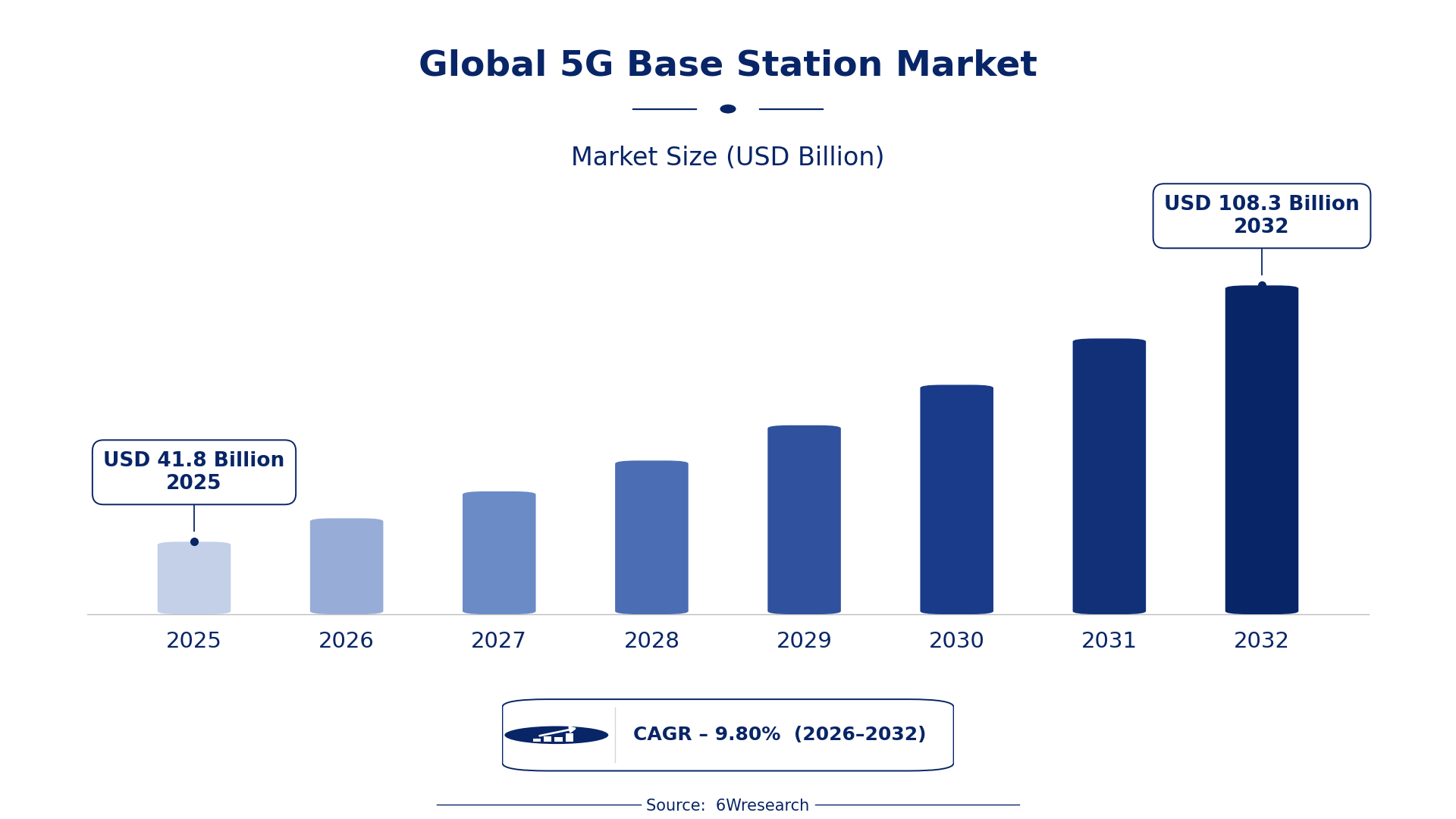
The global market is projected to grow from USD 41.8 billion in 2025 to USD 108.3 billion by 2032. Within this expanding ecosystem, small base stations are positioned as a rapidly growing category.
The underlying reason is simple. Modern digital experiences increasingly depend on consistent network performance rather than coverage alone.
Streaming high-resolution video is one example. Cloud gaming, augmented reality, industrial monitoring, and connected vehicles can place even greater demands on networks.
Small-cell infrastructure helps operators respond to these localized capacity requirements.
The Rise of High-Density Connectivity
Urbanization is transforming network planning.
A city center may have relatively few square kilometers but enormous concentrations of people and devices. During concerts, sporting events, festivals, or business conferences, demand can increase dramatically within a short period.
Small base stations can help operators respond to these temporary or permanent traffic hotspots.
This makes them particularly attractive for venues and commercial districts where network congestion can directly affect customer experiences.
5G and Smart Cities
The small-cell opportunity is not limited to consumer smartphones. Smart-city infrastructure is creating another layer of demand.
Connected streetlights, environmental sensors, intelligent traffic systems, security cameras, parking systems, and public-service devices all require connectivity.
As municipalities develop digital infrastructure, network operators and technology companies can collaborate to create connectivity platforms that support multiple services simultaneously.
This creates opportunities beyond traditional telecom revenues.
Technology Is Becoming More Intelligent
Modern base stations are increasingly connected to software-driven network management systems. AI and machine learning can support predictive maintenance, traffic optimization, and real-time performance monitoring.
Instead of waiting for a network component to fail, operators can analyze patterns and identify potential problems earlier.
This can improve reliability while reducing maintenance costs.
The combination of small cells and intelligent software could therefore change the economics of urban network management.
Sub-6 GHz and mmWave Play Different Roles
Frequency selection will remain important.
Sub-6 GHz networks offer wider coverage and are suitable for broad deployments. mmWave, on the other hand, offers extremely high capacity over shorter distances.
This makes mmWave particularly interesting for crowded locations where enormous volumes of data need to be transferred quickly.
Rather than competing directly, the technologies can work together in layered networks.
The Investment Challenge
Small cells may reduce the need for traditional large-scale coverage solutions in some areas, but deployment is not automatically easy.
Operators still need suitable locations, power, backhaul, permissions, equipment, and maintenance capabilities. Urban regulations can also make site acquisition complicated.
The business case must therefore consider both technical performance and commercial viability.
The Urban Network of Tomorrow
The future city may not be dominated by visible telecommunications towers. Instead, connectivity could increasingly become embedded into buildings, street furniture, transportation infrastructure, and commercial environments.
That transformation gives small 5G base stations a strategic role.
As urban environments become increasingly digital, the ability to place network capacity exactly where it is needed could become one of the most valuable advantages in telecommunications.
Who We Are
About 6Wresearch: It is a commercial strategy and growth advisory firm founded in 2011 and headquartered in New Delhi, India, with partners across Southeast Asia and the Middle East & Africa. The firm has delivered over 20,000 commercial engagements for over 2,000 organizations, including Fortune 500 companies, government agencies, and multilateral institutions such as the World Bank and the Asian Development Bank. 6Wresearch combines proprietary intelligence, advanced analytics, and sector expertise to help organizations navigate market complexity and drive sustainable growth. These capabilities explain why organizations trust 6Wresearch for reliable commercial insights and confident decision-making.
Our Proprietary Platform: 6W Export GTM
6W Export GTM is 6Wresearch's proprietary trade intelligence and go-to-market platform, built on UN Comtrade data and enhanced with 6Wresearch's in-house analytical and simulation models, including system dynamics-based forecasting. Unlike broad, sector-level market sizing tools, 6W Export GTM operates at the individual product level down to specific HS codes and micro-segments to identify precise, actionable export opportunities by country and product pair, including markets where trade currently does not exist. This granular, simulation-driven approach allows 6W Export GTM to surface opportunities that sector-wide analysis typically misses, positioning it among a small number of platforms globally offering this depth of product-and-country-specific export intelligence.

 English
 Arabic
 French
 Spanish
 Portuguese
 Deutsch
 Turkish
 Dutch
Dutch
 Italiano
 Russian
 Portuguese (Brazil)
 Greek
Greek
 Bengali