


Europe Dosimetry Equipment Market: Healthcare Safety, Digital Monitoring and Smart Radiation Management
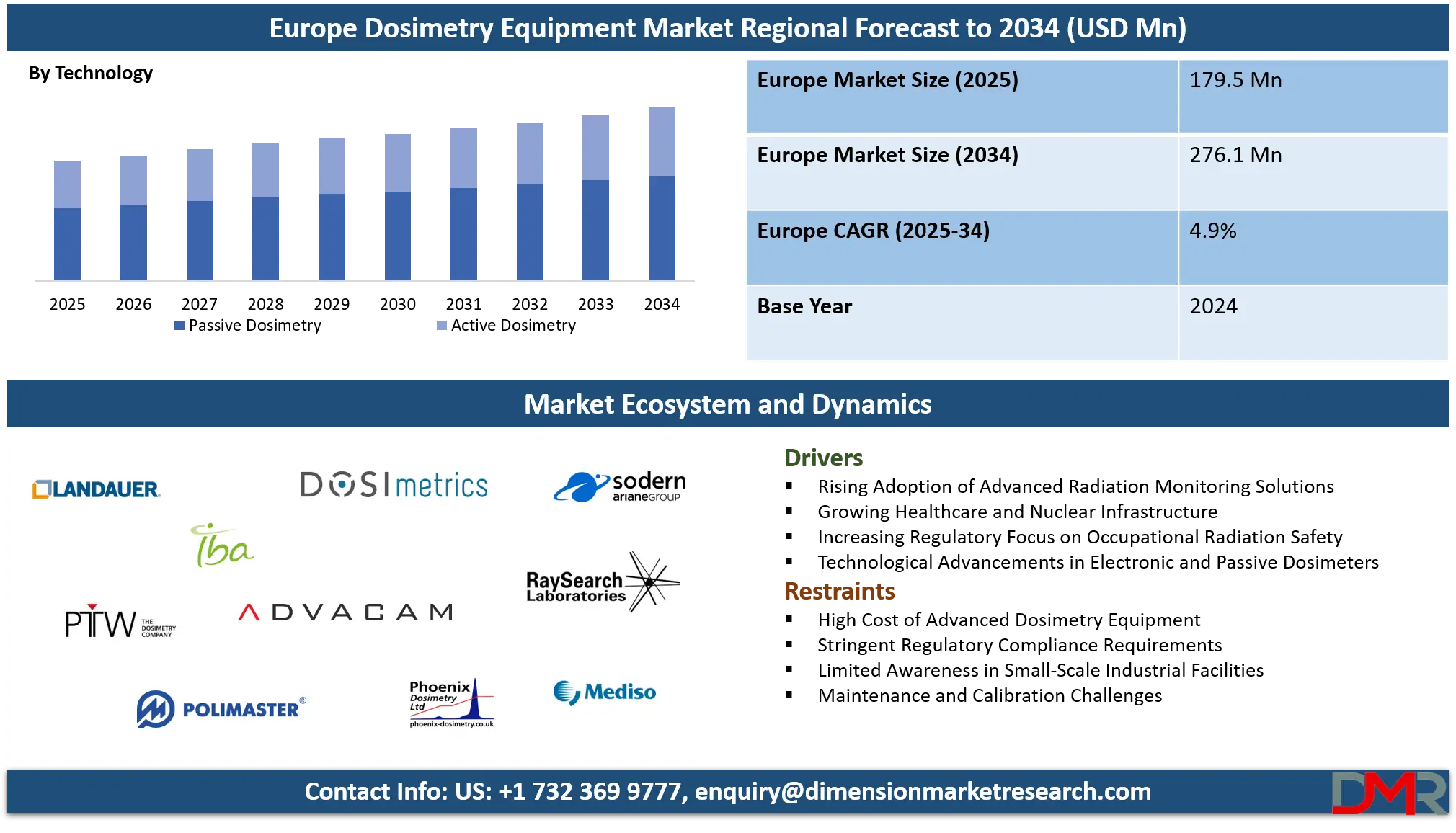
According to Dimension Market Research, the Europe Dosimetry Equipment Market is gaining steady momentum as healthcare providers, nuclear facilities, industrial organizations, and research institutions strengthen radiation-protection programs. The market is projected to grow from USD 179.5 million in 2025 to USD 276.1 million by 2034, registering a CAGR of 4.9% during the forecast period.
Dosimetry equipment is designed to measure and record exposure to ionizing radiation. It plays an important role in medical imaging, radiotherapy, nuclear medicine, nuclear-energy operations, industrial inspection, scientific research, and occupational safety.
The European market is increasingly influenced by digital transformation. Electronic personal dosimeters, wearable monitoring, wireless communication, cloud-based dose management, AI-assisted analytics, and automated reporting are helping organizations improve visibility into radiation exposure while simplifying safety workflows.
Radiation Protection Supports Market Development
Radiation is used across numerous medical, industrial, and research applications.
Hospitals depend on X-ray, CT, radiotherapy, and nuclear-medicine equipment, while industrial facilities use radiation-based systems for inspection and testing. Nuclear organizations also require comprehensive workforce and area monitoring.
Dosimetry equipment enables organizations to measure occupational exposure and maintain safety records.
The continued use of radiation technologies across Europe creates a stable demand base for personal and area-monitoring solutions.
Electronic Personal Dosimeters Improve Real-Time Awareness
Electronic Personal Dosimeters are expected to represent approximately 35.0% of the European market in 2025, making them the leading product category.
Unlike passive devices, EPDs can provide immediate exposure information.
Modern electronic dosimeters may incorporate alarms, digital displays, memory storage, wireless connectivity, and communication with centralized monitoring systems.
Real-time visibility is particularly valuable in environments where radiation conditions can change quickly.
This is helping electronic dosimeters become increasingly important in healthcare, nuclear, industrial, and research environments.
Passive Dosimetry Remains the Largest Technology Segment
Passive dosimetry is projected to account for approximately 75.0% of the technology segment in 2025.
Passive systems are widely used for routine occupational radiation monitoring.
These devices can record cumulative exposure over a defined monitoring period and are suitable for large employee populations.
Their established workflows, reliability, and relatively straightforward operation support continued adoption.
Active and passive dosimetry increasingly complement each other, with passive systems supporting routine records and electronic systems providing real-time exposure awareness.
Healthcare Is the Largest Application Segment
Medical applications are expected to account for approximately 53.0% of market revenue in 2025.
European healthcare organizations use radiation in diagnostic imaging, interventional procedures, radiotherapy, and nuclear medicine.
Medical staff working around these technologies require appropriate radiation-monitoring programs.
Radiotherapy departments also depend on accurate dose-management technologies to support safe treatment workflows.
The continued modernization of healthcare infrastructure is therefore expected to maintain strong demand for dosimetry equipment.
Healthcare Facilities Dominate End Users
Healthcare facilities are projected to represent approximately 39.0% of the market in 2025, making them the leading end-user category.
Hospitals, clinics, diagnostic centers, and specialized cancer-treatment facilities can have multiple radiation-generating departments.
Large healthcare systems may need to monitor exposure across hundreds or thousands of employees.
Digital platforms can help centralize these records and provide radiation-safety personnel with easier access to exposure information.
Radiotherapy Drives Advanced Dose Management
Radiotherapy represents an important area for technology innovation.
Cancer-treatment procedures require controlled delivery of radiation and careful management of exposure.
Advanced dosimetry technologies can support treatment verification, dose measurement, and quality-assurance processes.
Digital systems can also help healthcare teams organize dose-related information and improve workflow efficiency.
As European cancer-care facilities invest in advanced treatment technologies, sophisticated dosimetry solutions are likely to remain important.
Nuclear Facilities Require Continuous Monitoring
Nuclear-energy operations create specialized demand for radiation-monitoring equipment.
Workers involved in plant operation, maintenance, inspection, fuel handling, and waste-management activities may operate in controlled radiation environments.
Electronic dosimeters can provide immediate alerts, while passive systems offer cumulative exposure records.
Area-monitoring technologies can complement personal devices by providing information about radiation conditions in specific work environments.
Industrial Inspection Expands the Market
Industrial radiography and X-ray inspection are widely used for non-destructive testing.
These technologies help companies examine welds, pipelines, machinery, aerospace components, and other structures without damaging them.
Personnel operating radiation-based equipment require appropriate exposure monitoring.
Portable and wearable dosimeters are useful for technicians who move between inspection locations.
This creates opportunities for compact devices that combine mobility with reliable digital measurement.
Research and Scientific Applications Create Additional Demand
European universities and research institutions use radiation technologies in physics, medicine, materials science, chemistry, and other scientific fields.
Researchers may work with radiation-producing equipment or controlled radioactive sources.
Dosimetry helps track exposure and supports laboratory safety procedures.
Advanced electronic systems can simplify monitoring while generating digital records that can be retained for analysis and compliance.
Wearable Technology Improves User Experience
Wearability is becoming an important factor in dosimetry design.
Compact devices can be attached to clothing or protective equipment without significantly restricting movement.
Wearable dosimeters can provide real-time readings, alerts, and wireless data transmission.
Their smaller form factors are particularly useful for healthcare professionals, industrial technicians, emergency workers, and nuclear personnel who need mobility.
IoT Connects Radiation Monitoring
The Internet of Things is creating new possibilities for radiation-safety systems.
Connected dosimeters can communicate with centralized software platforms and transmit measurements without requiring manual data collection.
Radiation-safety teams can potentially monitor multiple personnel and locations from a centralized dashboard.
IoT connectivity can also improve the speed at which abnormal readings are identified.
As European organizations modernize safety infrastructure, connected monitoring is expected to gain importance.
Cloud Platforms Centralize Exposure Data
Large radiation-monitoring programs can generate substantial volumes of exposure information.
Cloud-based platforms allow organizations to centralize this data and provide authorized users with access across departments and locations.
Digital dose management can support reporting, historical analysis, exposure tracking, and record retention.
Centralization can also reduce administrative effort and improve data consistency.
AI Supports Advanced Radiation Analytics
Artificial intelligence is becoming increasingly relevant to radiation monitoring.
Large datasets can be analyzed to identify unusual measurements, recurring exposure patterns, and potential anomalies.
AI-based tools can assist with data classification, trend analysis, predictive alerts, and automated reporting.
In healthcare, AI can also complement radiation-dose analysis associated with imaging and treatment planning.
The combination of AI and dosimetry can therefore provide a more intelligent approach to radiation-safety management.
Predictive Maintenance Improves Equipment Availability
Dosimetry devices require calibration, testing, and maintenance to maintain dependable performance.
Connected equipment can provide operating data that may help identify potential device problems.
Predictive maintenance can allow organizations to service equipment before failures interrupt monitoring programs.
For large hospitals and industrial facilities, proactive maintenance can improve equipment availability and reduce unexpected disruptions.
Emergency Response Supports Portable Dosimetry
Radiological emergency preparedness creates demand for portable and rapidly deployable monitoring devices.
Emergency-response teams may need to assess changing radiation conditions and monitor personnel exposure.
Equipment designed for these situations must be lightweight, durable, accurate, and easy to operate.
Portable electronic dosimeters can provide immediate exposure information and alerts in emergency environments.
Environmental Monitoring Broadens Use Cases
Radiation-monitoring technologies also have environmental applications.
European authorities and research organizations may monitor radiation levels around specific locations and track changes over time.
Portable instruments can support field teams, while networked systems can provide centralized data management.
Environmental monitoring adds another application area for dosimetry and radiation-measurement technologies.
Regulatory Requirements Remain Important
Radiation protection is strongly influenced by regulatory and occupational-safety requirements.
Healthcare providers, nuclear operators, industrial organizations, and research institutions need accurate exposure records and appropriate monitoring procedures.
Regulatory compliance can encourage organizations to replace aging monitoring equipment with more capable digital solutions.
Automated records and reporting can further improve compliance management.
High Investment Costs Can Restrain Adoption
Advanced dosimetry systems may require substantial investment.
Costs can include equipment acquisition, calibration, software licenses, wireless infrastructure, maintenance, and technical support.
Smaller healthcare providers and industrial organizations may prioritize simpler passive systems when real-time monitoring is not essential.
Scalable products and flexible service models can help make advanced technologies more accessible.
Interoperability Remains a Challenge
European organizations often operate a combination of legacy and modern radiation-monitoring equipment.
Connecting new IoT-enabled devices with older systems may require additional integration work.
Differences in communication protocols and data structures can complicate modernization.
Suppliers offering open connectivity, software integration, and implementation services can help customers develop more connected radiation-safety environments.
Skilled Professionals Remain Essential
Advanced technology does not eliminate the need for trained radiation-safety professionals.
Users need knowledge of radiation measurement, exposure management, calibration, and safety procedures.
Specialists are also necessary to investigate unusual readings and determine appropriate corrective actions.
As digital technologies become more sophisticated, training may increasingly combine radiation expertise with data-management capabilities.
Competitive Landscape
The European dosimetry market includes specialist radiation-monitoring companies, medical technology providers, nuclear-sector suppliers, research-equipment manufacturers, and industrial safety companies.
Prominent companies identified by Dimension Market Research include Landauer Europe, IBA Dosimetry, PTW Freiburg GmbH, Polimaster Europe, Dosimetrics, Advacam, Phoenix Dosimetry Ltd, Sodern, RaySearch Laboratories, Mediso Ltd, STUK, NPL, RadPro International, Sun Nuclear Corporation, Kromek Group, Jenoptik AG, Thermo Fisher Scientific, and Mirion Technologies.
Competition is centered on accuracy, reliability, portability, real-time monitoring, connectivity, software integration, and customer support.
Future Outlook
The Europe Dosimetry Equipment Market is projected to expand from USD 179.5 million in 2025 to USD 276.1 million by 2034, reflecting a 4.9% CAGR.
EPDs will remain a major product category because of their digital and real-time capabilities, while passive dosimetry will continue to dominate routine occupational monitoring.
Healthcare is expected to remain the largest application and end-user segment.
Nuclear energy, industrial radiography, scientific research, environmental monitoring, and emergency response will continue to broaden the market opportunity.
The next stage of growth will increasingly involve wearable devices, wireless connectivity, cloud-based dose management, AI analytics, predictive maintenance, and automated compliance reporting.
Conclusion
The Europe Dosimetry Equipment Market is developing toward a more connected and digitally managed approach to radiation safety.
Healthcare remains the central source of demand, supported by diagnostic imaging, radiotherapy, and nuclear medicine. Nuclear facilities and industrial inspection applications provide additional opportunities, while research and environmental monitoring extend the market into specialized fields.
Passive dosimetry continues to provide a strong foundation for routine exposure measurement, while electronic personal dosimeters improve real-time awareness and support digital recordkeeping.
Wearable devices are making monitoring more convenient, while IoT and cloud platforms are connecting individual exposure measurements with broader safety-management systems.
Artificial intelligence can further enhance these platforms through anomaly detection, trend analysis, predictive monitoring, and automated reporting.
Despite challenges related to cost, interoperability, calibration, regulation, and skilled personnel, the long-term outlook remains positive.
With the market expected to reach USD 276.1 million by 2034, companies that combine accurate measurement, wearable design, real-time monitoring, connectivity, intelligent analytics, and dependable technical support can benefit from Europe's continued investment in advanced radiation-safety infrastructure.

 English
 Arabic
 French
 Spanish
 Portuguese
 Deutsch
 Turkish
 Dutch
Dutch
 Italiano
 Russian
 Portuguese (Brazil)
 Greek
Greek
 Bengali