


Building Stable Mechanical Movement Through Precision
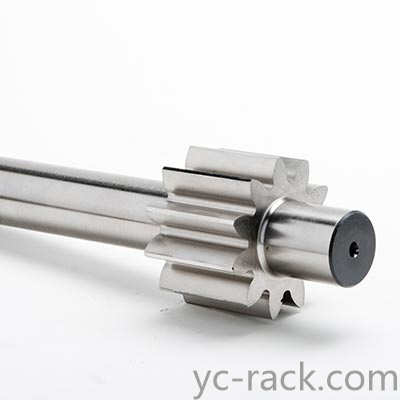
The conversion of rotary motion into precise linear movement is fundamental to many industrial machines, particularly automated equipment that depends on repeatable positioning. Within these systems, Helical Gear Rack designs can support controlled engagement when the component is manufactured with suitable attention to geometry, material behavior, surface condition, and alignment. The final performance is therefore closely connected to the manufacturing process and the way the component is integrated into the complete mechanical system.
Material engineering is one of the first considerations in production. Transmission components operate under repeated mechanical interaction, which places demands on the selected material. Strength and toughness are important, but machinability and dimensional stability are equally relevant because the material must remain predictable through cutting, heat treatment, and finishing. Zhejiang Yuchen Transmission Technology Co., Ltd. considers these factors as part of a coordinated manufacturing strategy rather than treating material selection as an independent step.
The tooth profile is central to the function of a rack-and-gear transmission. Tooth spacing, profile accuracy, orientation, and alignment all contribute to the way mechanical forces are transferred. Consistent geometry helps maintain predictable engagement between mating components. In automated machinery, where movement may be repeated continuously, manufacturing variations can have a greater effect over time. Precision production and systematic inspection are therefore essential.
Modern machining technologies provide manufacturers with greater control over complex transmission geometry. CNC equipment can follow digitally defined tool paths with high repeatability, while computer-aided manufacturing connects engineering models with production operations. Nevertheless, manufacturing quality still depends on the complete process. Tool wear, workpiece positioning, fixture stability, cutting conditions, and material characteristics must all be controlled to maintain consistency.
Grinding and surface finishing provide further refinement after initial machining. Working surfaces experience repeated contact during operation, so their condition can influence friction, wear behavior, and smoothness of engagement. Precision finishing can help reduce surface irregularities and improve the consistency of the tooth surfaces. For this reason, surface treatment should be integrated into the overall manufacturing plan instead of being considered merely a final cosmetic process.
Thermal processing may also be incorporated to modify material characteristics. Heat treatment can influence hardness, wear resistance, and structural behavior, depending on the material and manufacturing requirements. However, thermal processes may introduce dimensional changes that must be addressed through production planning. Machining allowances, post-treatment finishing, and inspection should be coordinated so that the final component retains its intended geometry.
Inspection is essential for verifying production consistency. Depending on the application, manufacturers may evaluate tooth dimensions, pitch relationships, straightness, surface condition, and alignment. Measurement data can be used not only to accept or reject finished components but also to improve manufacturing processes. Identifying recurring deviations helps engineers determine whether adjustments are needed in machining, thermal treatment, finishing, or fixture control.
Transmission components also depend heavily on correct system integration. A rack works together with gears, motors, guides, bearings, couplings, and control systems. Alignment between these elements determines how forces are distributed during operation. If installation creates uneven contact, the resulting behavior may differ from what was expected from the individual component design. Engineers should therefore consider the entire motion system when selecting transmission components.
Vibration and operating noise are additional engineering considerations. Uneven tooth contact can introduce fluctuations in transmitted mechanical forces, particularly in equipment involving frequent starts, stops, or positioning changes. Accurate tooth geometry and controlled surface finishing can support more consistent engagement. Correct lubrication and installation further contribute to stable mechanical interaction.
Digital engineering tools can improve development efficiency and manufacturing coordination. Three-dimensional models allow designers to examine interfaces and clearances, while simulation can help evaluate movement relationships before physical production. Digital manufacturing systems can then translate approved designs into machining operations. Measurement technologies provide another digital feedback loop by supplying structured information about finished components. Together, these methods create a more connected development and quality-control process.
For automated machinery, such manufacturing discipline can be particularly valuable. Packaging systems, robotic equipment, material-handling machines, machining centers, and industrial positioning platforms all depend on predictable movement. A transmission component must therefore be evaluated according to its role within the machine, including its relationship with motors, guides, control systems, and mating gears.
Zhejiang Yuchen Transmission Technology Co., Ltd. integrates engineering considerations across material preparation, machining, finishing, and quality inspection. This approach allows transmission components to be developed with greater attention to the complete production cycle rather than focusing on a single manufacturing operation. It also provides a practical foundation for serving different industrial applications where accurate and repeatable linear motion is required.
Maintenance and installation remain important after manufacturing. Proper alignment, suitable lubrication, contamination control, and regular inspection can help preserve the intended contact relationship between transmission surfaces. Preventive maintenance can also identify abnormal wear early and reduce the possibility of wider mechanical problems. Good system design should therefore include both component manufacturing and service considerations.
For industrial buyers comparing transmission suppliers, production consistency should be evaluated alongside machining capability, material management, finishing technology, inspection procedures, engineering experience, and application support. A comprehensive approach helps connect component quality with actual machine requirements. Zhejiang Yuchen Transmission Technology Co., Ltd. follows this engineering-oriented approach, and customers can review https://www.yc-rack.com/product/spur-gear-rack/ for additional information when considering Helical Gear Rack applications in industrial linear transmission.

 Arabic
 French
 Spanish
 Portuguese
 Deutsch
 Turkish
 Dutch
Dutch
 Italiano
 Russian
 Romaian
 Portuguese (Brazil)
 Greek
Greek
 Bengali