


From Traditional SEO to AI Search: What Businesses Need to Know
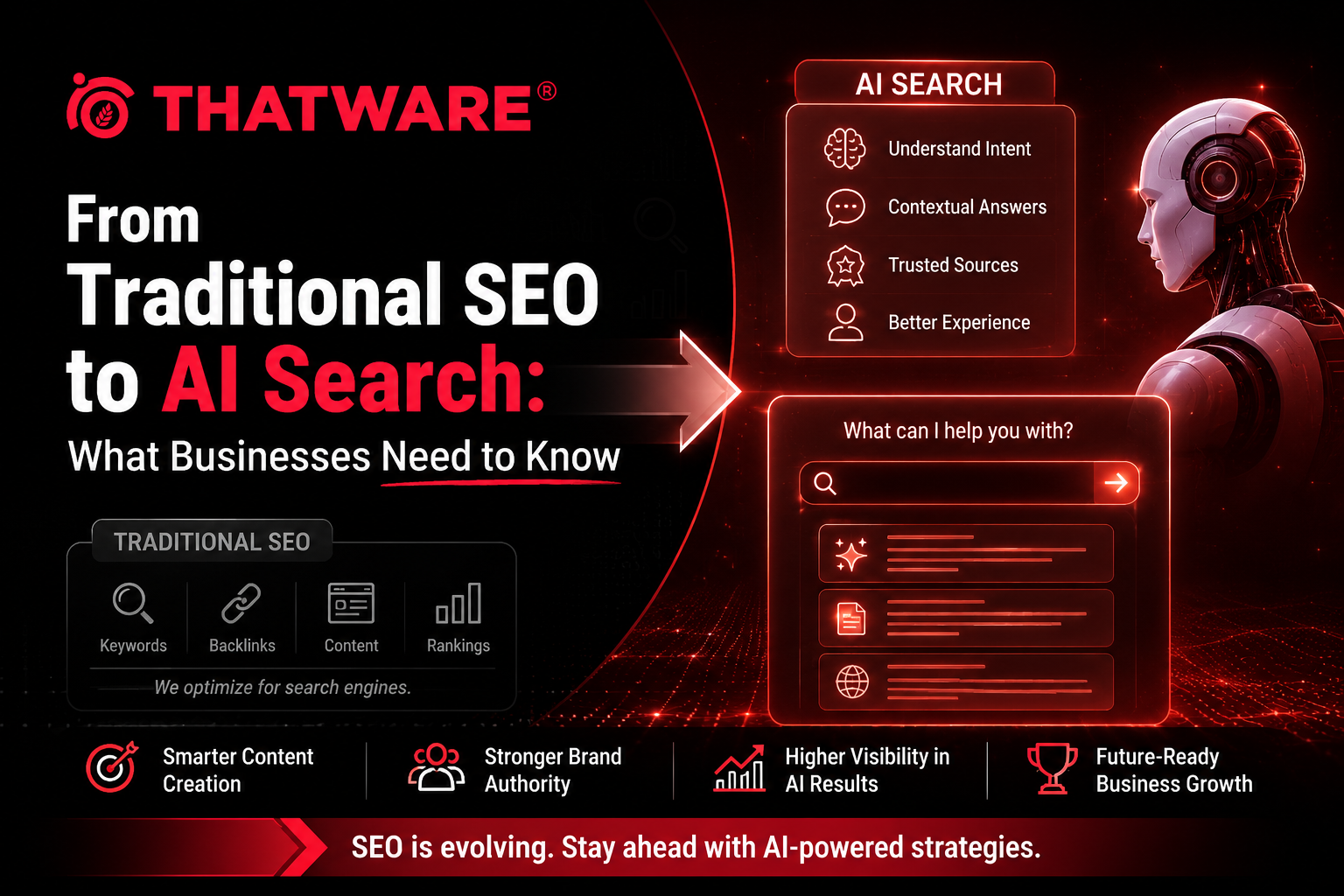
Search has always been closely connected to how people make buying decisions. A customer searches for a product, reads a few pages, compares alternatives and eventually decides whom to contact.
That journey is changing.
Today, someone looking for a business may ask Google an extended question, use an AI Overview, open ChatGPT, compare recommendations from an AI assistant, or move between several platforms before making a decision. The search process is becoming more conversational, more comparative and, in many cases, less dependent on clicking through a list of ten blue links.
For businesses, this raises an important issue: Can potential customers find and understand your brand when AI becomes part of the search journey?
That question does not make traditional SEO irrelevant. Instead, it expands the role of search optimization.
Search Is Moving From Keywords to Questions
Traditional SEO was largely built around keywords. A business identified the phrases its customers searched for, created useful pages around those terms, improved technical performance and worked to build authority.
Those fundamentals still matter.
What has changed is the way people express their needs.
A customer may no longer search only for:
"enterprise SEO agency"
They might instead ask:
"Which SEO agencies can help a global B2B company improve Google rankings and visibility in AI search?"
That second query contains much more context. It communicates the user's industry, intent, requirements and expectations in one sentence.
AI-powered search systems are designed to interpret that context. They can connect concepts, identify entities, compare information and produce an answer rather than simply returning a collection of webpages.
This means businesses need to make their expertise understandable at more than a keyword level.
Why Business Visibility Now Depends on More Than Rankings
A first-page ranking remains valuable. Organic traffic still matters. Technical SEO, backlinks, content quality and user experience remain important parts of a healthy search strategy.
However, ranking is only one part of modern discovery.
Imagine a software company that ranks well for several competitive keywords but has very little authoritative information explaining its products, leadership, industry expertise and differentiators.
A human visitor may eventually discover the company.
An AI system, however, may struggle to build a complete picture of the organization.
This is where the emerging relationship between SEO, AEO, GEO and LLM optimization becomes important.
ThatWare, for example, positions AI search visibility as an extension of conventional search optimization rather than a replacement for it. Its current service ecosystem combines technical SEO with AI search optimization, AEO, GEO, semantic SEO and LLM-focused strategies.
SEO, AEO and GEO Have Different Jobs
It is easy to treat every new search acronym as another version of SEO. That can create confusion.
The better approach is to understand what each discipline contributes.
Search Engine Optimization (SEO) helps websites become discoverable, crawlable and competitive in conventional search results. It covers areas such as technical health, content, internal linking, authority and search intent.
Answer Engine Optimization (AEO) focuses on making information easier to use in systems that provide direct answers. Clear explanations, question-based content and well-structured information can become particularly useful here.
Generative Engine Optimization (GEO) focuses on visibility in search experiences where AI generates responses by synthesizing information from different sources.
LLM SEO goes further into the challenge of helping large language model-driven systems understand a brand, its expertise, services and relationships.
These approaches overlap, but they are not identical. A strong strategy connects them instead of treating them as separate marketing projects.
The Rise of the AI SEO Company
The role of an AI SEO company is therefore becoming broader.
The objective is not simply to make a webpage rank for a keyword. It is to improve how a business is discovered, interpreted and represented across different search environments.
That requires looking at questions such as:
- What does the company actually specialize in?
- Which entities are associated with the brand?
- Are its services explained clearly?
- Can search engines crawl and interpret its website?
- Is important information supported by credible sources?
- Are brand details consistent across the web?
- Does the content answer the questions potential buyers are asking?
- Can AI systems distinguish the business from competitors?
This is particularly important for B2B and enterprise organizations, where purchasing decisions can involve lengthy research and several stakeholders.
What an AI Search Optimization Company Should Actually Do
When choosing an AI search optimization company, businesses should look beyond promises about appearing in ChatGPT or other AI platforms.
No responsible agency can guarantee that an AI model will recommend a particular company. AI-generated responses depend on many factors, including available sources, context, model behavior and the information retrieved at the time.
A better strategy is to improve the signals that make a company easier to understand and verify.
That can include:
1. Strengthening technical foundations
A website still needs to be accessible to search engines.
Crawlability, indexation, site architecture, internal links, structured data, page performance and content accessibility remain important. AI optimization does not eliminate technical SEO.
In fact, weak technical foundations can undermine everything built on top of them.
2. Building useful, specific content
Generic content is unlikely to communicate meaningful expertise.
Businesses should create pages that answer real customer questions, explain complicated subjects and demonstrate practical knowledge.
For example, instead of publishing another generic article about digital marketing, an agency could explain how AI search affects enterprise procurement, how businesses can evaluate AI visibility or what evidence should support an AI search strategy.
Specificity gives both readers and machines more useful information to work with.
3. Developing stronger entity signals
Modern search increasingly involves entities and relationships.
A business is not simply a website URL. It can be connected to founders, employees, products, services, locations, publications, awards, research and industry expertise.
The stronger and more consistent those relationships are, the easier it becomes for systems to understand the organization.
This is one reason semantic SEO and entity optimization are becoming increasingly relevant to AI-driven discovery.
4. Making important information easy to interpret
AI systems work with information from many sources.
Businesses should therefore avoid making essential information difficult to find or interpret.
Service descriptions, company expertise, leadership information, product details, locations, research and supporting evidence should be presented clearly.
Structured content can also help communicate relationships between different pieces of information.
Where AEO Fits Into the New Search Journey
Businesses interested in AEO services should think about the questions their customers ask before making a purchase.
A good AEO strategy is not simply about adding a large FAQ section.
It is about understanding the information needs behind the search.
A potential customer may want to know:
- Which provider is suitable for a particular industry?
- How does one service compare with another?
- What should a buyer look for before choosing an agency?
- What does a particular technology actually do?
- Which solution is appropriate for a specific business problem?
Answering those questions clearly can make a website more useful throughout the research journey.
For larger organizations, this can involve creating interconnected knowledge hubs, comparison pages, expert resources, FAQs and detailed service content.
Why LLM SEO Requires a Different Mindset
An LLM SEO company should understand that optimizing for large language models is not about manipulating a model into mentioning a brand.
The more sustainable objective is to build a reliable information environment around the business.
That includes authoritative first-party content, consistent entity information, useful explanations, structured data, credible external references and strong topical coverage.
ThatWare's LLM SEO services describe this approach in terms of helping AI systems better understand, retrieve, summarize and represent information about a brand.
The distinction matters.
Instead of asking, "How can we force an AI platform to mention us?" businesses should ask, "Have we given search systems enough accurate, useful and credible information to understand why our company belongs in this conversation?"
That is a much more sustainable question.
Measurement Needs to Evolve Too
Traditional SEO reporting often revolves around rankings, impressions, clicks, organic sessions and conversions.
Those metrics are not going away.
But AI search introduces additional questions.
For example:
Is the brand appearing in relevant AI-generated answers?
Are competitors being mentioned instead?
Is the company's expertise being described accurately?
Are important products or services being recognized?
Does the brand appear when customers ask high-intent questions?
These questions can reveal visibility gaps that traditional ranking reports may miss.
ThatWare has developed proprietary frameworks such as its AI Visibility Metrics and Vector Entity Model to examine aspects of brand visibility and entity representation in AI-driven discovery. Its broader framework library also includes approaches covering AI SEO, semantic SEO, entity mapping and AEO/GEO.
For businesses, the larger lesson is simple: measurement should follow the way customers actually discover information.
The Next Phase of Search Is About Being Understood
The shift toward AI search does not mean businesses should abandon everything they have learned about SEO.
Quite the opposite.
Technical SEO still matters. Helpful content still matters. Authority still matters. A strong website still matters.
What is changing is the environment in which those assets are being evaluated.
Customers are increasingly asking complete questions instead of entering isolated keywords. AI systems are increasingly helping people compare options and interpret information. Search is becoming more conversational, while brand discovery is becoming more dependent on context.
That makes the transition from traditional SEO to AI search less about replacing one discipline with another and more about expanding the definition of visibility.
For businesses exploring this shift, a useful starting point is the broader discussion covered in Transition from traditional SEO to AI search, which examines how companies are adapting to AEO, GEO and LLM optimization as AI becomes part of the buying journey.
The central question for a business is no longer simply whether its website can rank.
It is whether the business can be found, understood and accurately represented wherever potential customers are looking for answers.
That is where the next generation of search strategy is likely to be won.

 Arabic
 French
 Spanish
 Portuguese
 Deutsch
 Turkish
 Dutch
Dutch
 Italiano
 Russian
 Romaian
 Portuguese (Brazil)
 Greek
Greek
 Bengali