


Nutritionist Keyword Research: What Are Potential Clients Searching For?
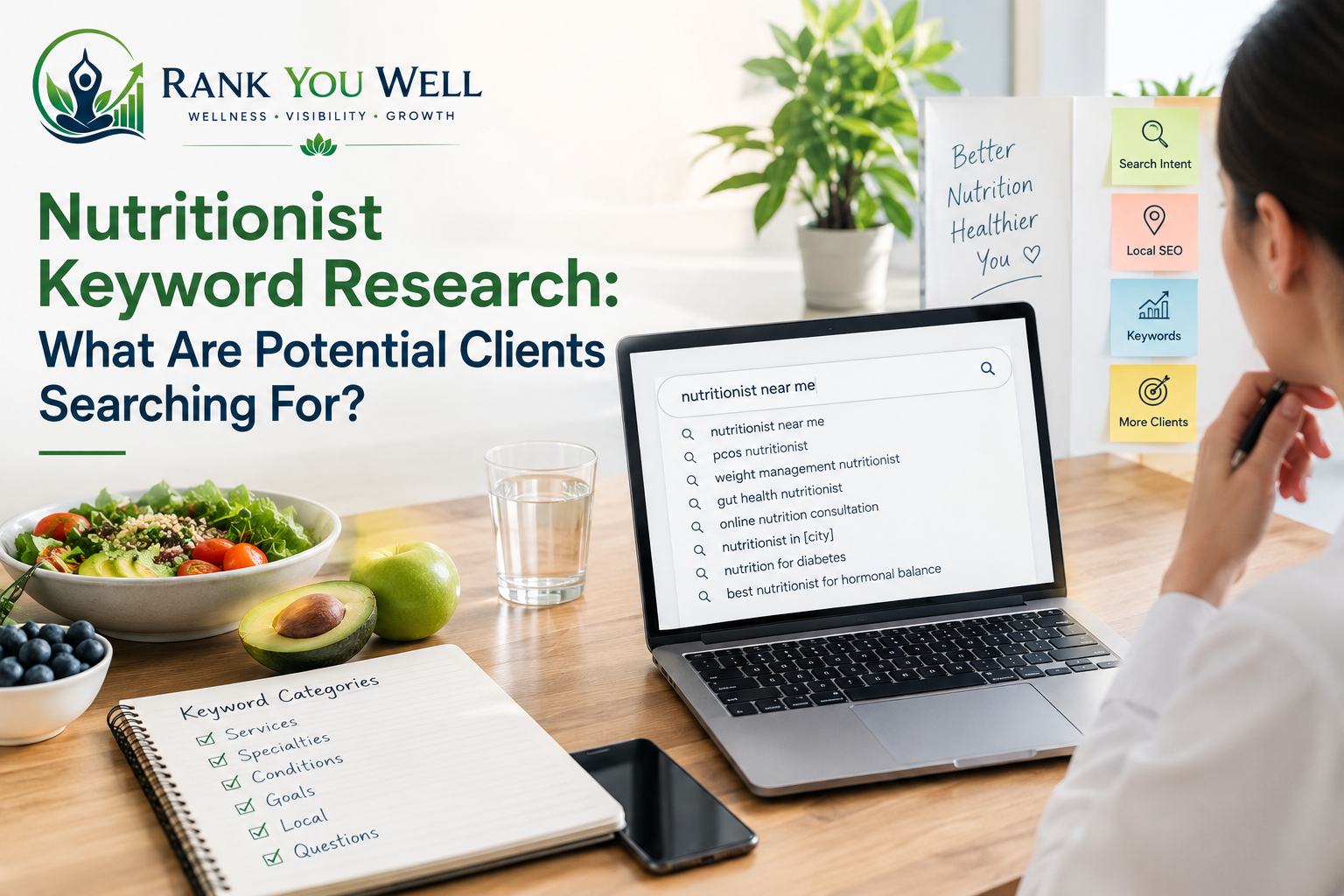
Potential clients don't always search for a nutritionist using the word "nutritionist." More often, they search around a specific condition, health goal, service, location, or question they have.
That's why nutritionist keyword research should start with the client's actual need, not a list of high-volume terms. The goal is to identify searches relevant to the practice's services and connect each one to the page best equipped to answer it.
This kind of research sits at the foundation of any real Nutritionist SEO Services strategy — because visibility only pays off when it's built around what people are genuinely searching for, not guesswork.
What Is Keyword Research for a Nutritionist?
Keyword research means identifying the words and phrases people use when searching for nutrition services, information, and practitioners. For a nutritionist, these searches usually fall into a few groups: service, specialty, condition-based, goal-based, local, practitioner, and informational questions. A keyword's value depends on more than volume — relevance and intent determine whether it leads to a genuine enquiry.
What Do People Search for When Looking for a Nutritionist?
Service-based searches: signal someone wants a specific offering — "nutrition consultation," "online nutrition consultation," "weight management nutritionist." These often connect directly to service pages.
Specialty-based searches: show someone already knows what kind of support they want — "PCOS nutritionist," "gut health nutritionist," "pediatric nutritionist." These tend to indicate a strong match with a practitioner's focus area.
Condition-based searches: happen before someone has settled on seeking a professional — "nutrition for PCOS," "dietitian for diabetes," "nutritionist for IBS." Some people want information first; others are ready to book.
Goal-based searches: aren't tied to a medical condition at all — think "nutrition for muscle gain" or "healthy eating guidance." These can reveal opportunities you might not have considered.
Local searches: like "nutritionist near me" or "dietitian in [city]" matter most for practices serving a specific area, and should sit alongside Google Business Profile optimization.
 What Are High-Intent Keywords for Nutritionists?
A high-intent keyword suggests someone is closer to taking action. "What does a nutritionist do?" is mostly informational, while "PCOS nutritionist near me" combines a specific need with local intent — and "nutrition consultation online" points toward someone looking for a service, not just research. The goal isn't to ignore informational searches, but to understand where each one sits in the client's journey.
How Should Nutritionists Group Keywords?
Rather than building a long spreadsheet of disconnected phrases, group keywords by the need behind them:
|
Search |
Intent |
Best Page |
|
Nutritionist near me |
Local/service |
Local or service page |
|
PCOS nutritionist |
Specialty |
PCOS specialty page |
|
Nutritionist for IBS |
Condition |
Relevant specialty page |
|
What does a nutritionist do? |
Informational |
Educational article |
|
Book nutrition consultation |
Transactional |
Booking page |
This keeps every keyword from defaulting to the homepage.
Should a Nutritionist Target "Nutritionist" as a Keyword?
Yes — but not as the only target. "Nutritionist" is broad enough to mean many different things: someone might want to understand the profession, find a local practitioner, or compare providers. A stronger strategy builds a network of more specific searches around that core term — services, specialties, conditions, goals, locations, and questions — giving the site relevance across every way people actually search.
How Do You Find the Right Keywords?
A few reliable sources work together here. Search results for important queries reveal whether a search is informational, local, or transactional. Autocomplete and related searches show how people naturally phrase things. Search Console data, if you already have a site, surfaces real queries generating clicks. And competitor pages can highlight needs that aren't being served well — not to copy, but to do better.
How Many Keywords Should One Page Target?
A single page doesn't need to chase one exact phrase. A well-focused page on PCOS nutrition can naturally cover "PCOS nutritionist," "PCOS dietitian," and "nutrition for PCOS" if they share the same intent. Separate pages only make sense when the intent is genuinely different.
Keyword vs. Search Intent
A keyword is what someone types. Search intent is what they're actually trying to accomplish. "Best foods for PCOS" suggests someone wants information; "PCOS nutritionist near me" suggests they want a provider. Building around intent clusters, rather than exact-match phrases, is what makes the strategy work.
How Keyword Research Shapes the Whole Website
Good keyword research doesn't just inform blog topics — it shapes which services need dedicated pages, which specialties deserve their own space, which locations need local content, and which searches should lead straight to booking. The result is a site where every meaningful search has a clear destination.
Frequently Asked Questions
What keywords should a nutritionist target?
Service, specialty, condition, goal, location, practitioner, and question-based searches that genuinely reflect what you offer.
What are high-intent nutritionist keywords?
Searches combining a service, specialty, or location with clear action — like "PCOS nutritionist," "nutritionist near me," or "online nutrition consultation."
Should nutritionists use local keywords?
Yes, if you serve a specific area. Online-only practices may need a broader geographic approach instead.
Should every keyword have its own page?
No — closely related keywords with the same intent can usually share one strong page. Separate pages make sense only when the intent genuinely differs.
Is search volume the most important keyword metric?
No. Relevance, intent, competition, and how well you can actually satisfy the search matter just as much.
Conclusion
Effective nutritionist keyword research starts with one question: what is the potential client actually trying to find? From there, searches can be organized around services, specialties, conditions, goals, locations, and questions — each connected to the page best suited to answer it. At Rank You Well, this same thinking anchors every Nutritionist SEO Services strategy we build — turning a keyword list into a real search-to-page framework that helps your practice show up for the needs you're genuinely equipped to serve.

 English
 Arabic
 French
 Spanish
 Portuguese
 Deutsch
 Dutch
Dutch
 Italiano
 Russian
 Romaian
 Portuguese (Brazil)
 Greek
Greek
 Bengali