


Recombinant Protein and Peptide Synthesis: Building Blocks for Protein Research
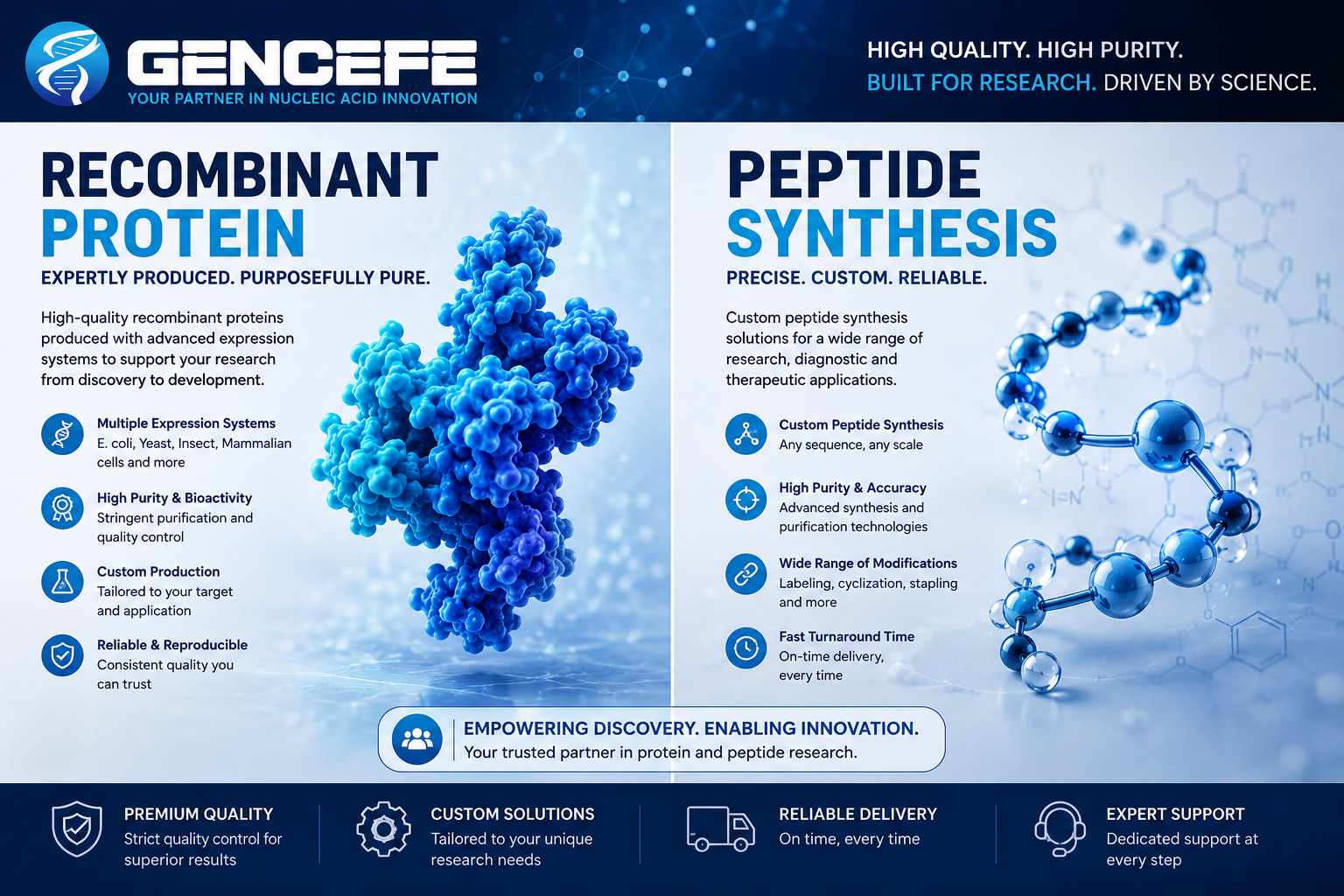
Proteins and peptides are central to biological research. Scientists study them to understand cellular mechanisms, investigate molecular interactions, develop assays, and explore potential therapeutic or diagnostic applications. Two important technologies used in these areas are recombinant protein production and peptide synthesis.
While proteins and peptides differ in size and structure, both can serve as valuable research tools when produced with appropriate specifications.
What Is a Recombinant Protein?
A recombinant protein is a protein produced using recombinant DNA technology. A DNA sequence encoding the desired protein is introduced into a suitable expression system, which then produces the protein.
Common expression hosts can include bacterial, yeast, insect, or mammalian systems, depending on the protein and its required characteristics.
Why Expression Systems Matter
Different proteins behave differently during production. Some may require specific folding mechanisms or post-translational modifications that certain expression systems cannot efficiently provide.
Therefore, choosing the right host is an important part of recombinant protein development.
Researchers may need to consider:
-
Protein size
-
Folding requirements
-
Solubility
-
Post-translational modifications
-
Expression level
-
Purification strategy
-
Intended application
Applications of Recombinant Proteins
Recombinant proteins can be used for:
-
Structural studies
-
Biochemical assays
-
Antibody research
-
Enzyme studies
-
Protein interaction analysis
-
Immunology research
-
Drug discovery
-
Diagnostic development
The required purity and formulation depend on the application.
Understanding Peptide Synthesis
Peptides are shorter chains of amino acids. Researchers can obtain them through controlled synthesis according to a defined sequence.
Peptides are particularly useful when researchers want to investigate a specific portion of a larger protein or create a molecule with a defined sequence.
Advantages of Synthetic Peptides
Peptide synthesis provides flexibility in designing research materials.
Researchers can specify:
-
Amino acid sequence
-
Length
-
Quantity
-
Purity
-
Modifications
-
Terminal chemistry
This makes peptides useful for many targeted research applications.
Protein and Peptide Research Together
A recombinant protein may represent the complete or functional protein target, while a peptide can represent a particular region.
Using both approaches can help researchers study protein structure, interactions, recognition, and function from different perspectives.
For example, a peptide corresponding to a protein domain may be used in an assay, while the corresponding recombinant protein is used in a separate biochemical experiment.
Quality Control
Protein and peptide quality can influence experimental outcomes. Researchers should consider analytical characterization appropriate to the material.
Depending on the project, quality evaluation may include identity confirmation, purity assessment, concentration measurement, aggregation analysis, or other relevant testing.
Selecting a Production Partner
Before starting a project, researchers should communicate their intended use and technical requirements.
Important considerations include:
-
Production scale
-
Purity
-
Expression platform
-
Sequence complexity
-
Modification requirements
-
Purification
-
Analytical testing
-
Storage
-
Documentation
A technically capable provider can help identify production challenges before manufacturing begins.
Storage Considerations
Proteins and peptides may have different stability characteristics. Factors such as temperature, concentration, formulation, pH, and repeated freeze-thaw cycles can affect stability.
Researchers should follow product-specific storage instructions rather than applying the same conditions to every biomolecule.
Applications Across Scientific Fields
Protein and peptide materials support research in:
-
Biochemistry
-
Molecular biology
-
Immunology
-
Drug discovery
-
Proteomics
-
Structural biology
-
Cell biology
-
Biotechnology
Their versatility makes them valuable across both academic and commercial research environments.
Frequently Asked Questions
What is a recombinant protein?
It is a protein produced from recombinant genetic material using an appropriate biological expression system.
What is peptide synthesis?
It is the controlled production of a peptide according to a defined amino acid sequence.
Can recombinant proteins and peptides be used together?
Yes. They can provide complementary tools for studying protein structure, interactions, and biological functions.
What affects recombinant protein production?
Expression host, sequence, protein structure, folding, solubility, and purification strategy can all influence production.
What should I specify when ordering a peptide?
Provide the sequence, desired quantity, purity, modifications, intended use, and analytical requirements.
Supporting Protein Science
Reliable molecular materials are fundamental to successful biological research. Recombinant protein technology provides access to defined proteins produced through engineered expression systems, while peptide synthesis allows researchers to obtain sequence-specific shorter molecules.
When production strategies are matched to the scientific objective and supported by appropriate quality control, these technologies can provide dependable tools for protein-focused research.

 Arabic
 French
 Spanish
 Portuguese
 Deutsch
 Turkish
 Dutch
Dutch
 Italiano
 Russian
 Romaian
 Portuguese (Brazil)
 Greek
Greek
 Bengali