


What Makes Hospital Linen and Airline Textiles Different from Standard Hotel Linen?
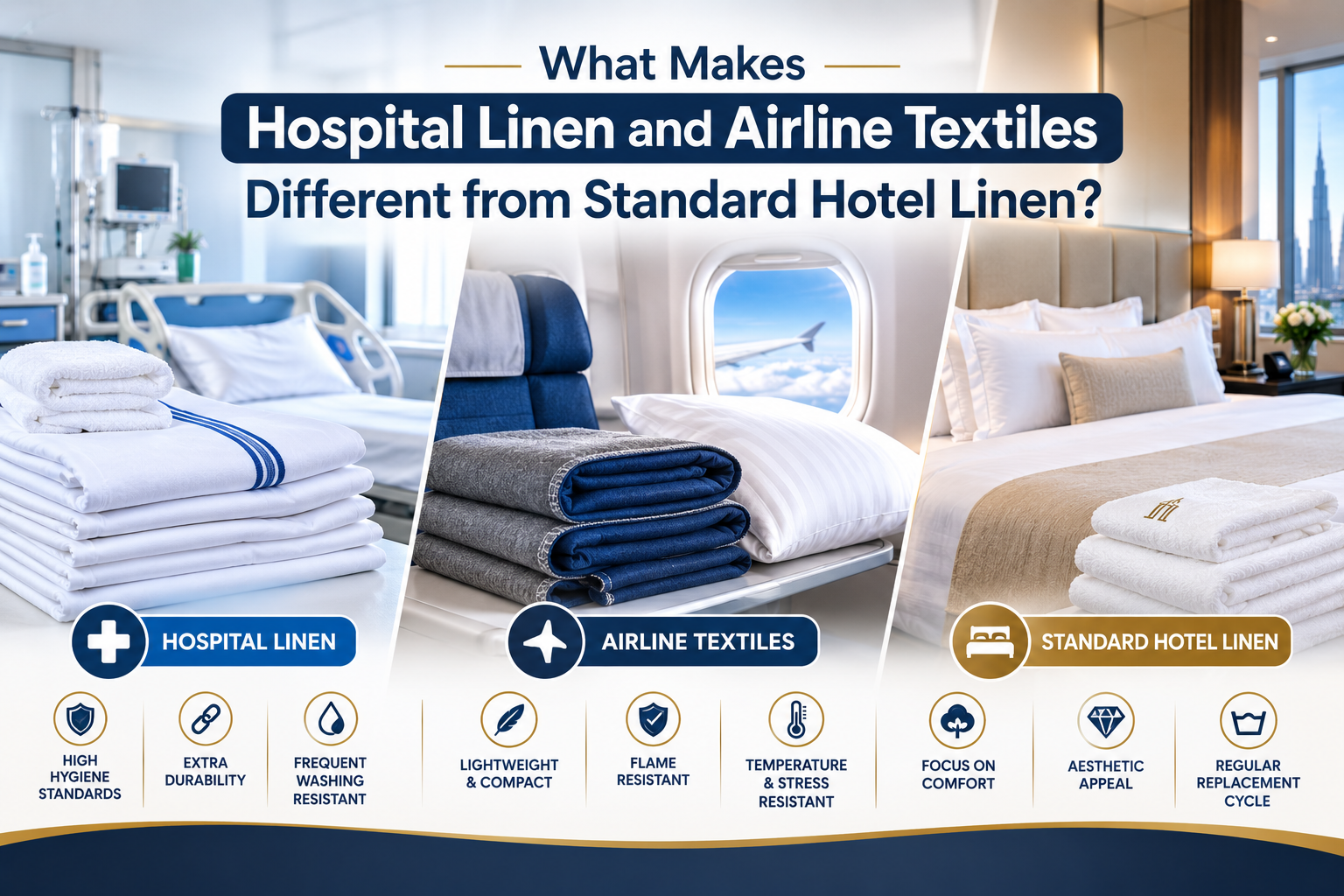
Not all commercial linen serves the same purpose, and treating hospital linen or airline textiles as simply a variation of hotel linen overlooks requirements that are far stricter and, in some cases, legally mandated rather than optional. Hospitals need fabric that withstands sterilization without degrading, while airlines need textiles that meet fire-safety and weight regulations most hospitality buyers never have to consider. For procurement teams branching beyond hotel and restaurant linen into hospital linen or airline textiles, understanding these differences prevents sourcing mistakes that could create compliance or safety issues rather than just aesthetic ones. This guide breaks down what sets these product categories apart.
Why Hospital Linen Operates Under Stricter Standards
Hospital linen exists primarily to support infection control, which shapes nearly every specification differently than hotel linen. Fabric must withstand repeated high-temperature sterilization cycles and frequent bleaching without breaking down, since inconsistent sterilization creates genuine patient safety risk rather than just a cosmetic problem. This is why hospital-grade cotton and cotton-polyester blends are typically woven more tightly and with more durable dye processes than standard hotel linen, allowing fabric to survive far harsher, more frequent laundering without significant fiber loss.
Color coding also plays a functional role in healthcare settings that has no real equivalent in hospitality. Many hospitals use distinct colors or patterns to separate linen by department, patient risk level, or intended use — isolation ward linen might be color-coded differently from general ward linen, for instance, helping staff instantly identify appropriate stock without checking labels during time-sensitive situations. This level of standardized color coding is a healthcare-specific requirement rather than a hotel branding choice.
Fabric Choices Suited to Medical Environments
Hospital linen often needs to balance patient comfort with practical hygiene demands in ways that differ from hotel priorities. Bedding must resist staining from bodily fluids and clean effectively even after significant soiling, which points many facilities toward tightly woven, easy-to-bleach cotton or cotton-polyester blends rather than the softer, higher-thread-count fabrics hotels might prioritize for guest comfort alone. Some healthcare linen also incorporates fluid-resistant treatments on specific items like mattress protectors or surgical drapes, a specification that simply doesn't apply to standard hotel bedding.
Buyers sourcing for clinics or hospitals should also confirm a supplier's understanding of relevant hygiene certifications and washing protocols specific to healthcare settings, since a supplier experienced primarily in hospitality linen may not automatically account for these additional infection-control requirements without being asked directly.
Why Airline Textiles Follow an Entirely Different Rulebook
Airline textiles operate under a completely different set of constraints, driven primarily by aviation safety regulations rather than hygiene alone. Fire retardancy is often the single most important specification for in-flight textiles — blankets, seat covers, and headrest linens used on aircraft typically must meet strict flammability standards set by aviation safety authorities, since fabric behavior during an onboard fire poses a fundamentally different risk than it would in a hotel room.
Weight is another factor almost unique to airline textiles. Every kilogram added to an aircraft affects fuel consumption, so airlines and their linen suppliers pay close attention to fabric weight in ways hotel buyers rarely need to consider. This sometimes means airlines favor lighter-weight, tightly woven fabrics engineered to meet fire-safety standards while minimizing added weight across an entire fleet's worth of textiles — a genuinely different engineering problem than simply choosing a soft, absorbent hotel towel.
Durability Requirements Under Extreme Turnover
Airline textiles face turnover schedules that would be unusual even in high-occupancy hotels. Blankets and headrest covers on short-haul routes may be used and laundered multiple times within a single day across a fleet, requiring fabric that holds up to extremely frequent industrial laundering without degrading in ways that would be noticeable to passengers on a tight turnaround schedule. Suppliers serving this category need production and laundering guidance specifically suited to this pace, which differs substantially from even the busiest hotel laundry operation.
Hospital linen faces a related but distinct durability challenge — while turnover frequency is high, the greater stress comes from the intensity of sterilization processes rather than sheer volume alone, meaning fabric needs to survive extreme heat and chemical exposure repeatedly rather than simply frequent standard washing.
What Buyers Should Ask Before Sourcing These Specialized Categories
Procurement teams moving into hospital linen or airline textiles for the first time should ask suppliers directly about relevant compliance documentation — fire-retardancy certificates for airline textiles, and hygiene or sterilization-compatibility testing for hospital linen — rather than assuming general commercial-grade quality automatically meets these more specific regulatory requirements. Requesting sample batches to test under the facility's actual sterilization or laundering conditions before committing to a full order remains just as valuable in these categories as it is for hotel linen, if not more so, given the higher stakes involved in compliance failures.
Frequently Asked Questions
1. Why does hospital linen need to withstand more intense laundering than hotel linen? Hospital linen must survive frequent high-temperature sterilization and bleaching cycles that support infection control, which places far greater stress on fabric than the standard commercial laundering hotel linen typically undergoes.
2. Is color coding in hospital linen just for organization, or does it serve a safety purpose? It serves both — color coding helps staff quickly identify appropriate linen for specific departments, patient risk levels, or usage types, which supports faster, safer decision-making in time-sensitive healthcare settings.
3. Why is fire retardancy such a critical specification for airline textiles? Fabric behavior during an onboard fire presents a unique safety risk specific to aviation, which is why airline textiles are typically required to meet strict flammability standards that don't apply to standard hotel or hospital linen.
4. Does fabric weight really matter for airline blankets and textiles? Yes — added weight across an entire fleet's worth of textiles affects fuel consumption, so airlines often prioritize lighter-weight fabrics engineered to still meet fire-safety requirements.
5. Can a supplier that specializes in hotel linen also supply hospital or airline textiles? Some can, but buyers should confirm the supplier has specific experience and compliance documentation for these categories, since hospitality-focused expertise doesn't automatically translate to healthcare or aviation regulatory requirements.
6. What should buyers request before placing a large order for hospital or airline linen? Requesting relevant compliance certificates and a sample batch tested under actual sterilization or laundering conditions helps confirm the product meets requirements before committing to a full-scale order.
Final Thoughts
Hospital linen and airline textiles share some surface similarities with hotel linen — durability, consistent laundering performance, and quality construction all matter across every category. But the underlying requirements diverge significantly, driven by infection control in healthcare and aviation safety regulations in air travel rather than guest comfort alone. Buyers entering these specialized categories for the first time benefit from treating them as distinct sourcing challenges, with their own compliance questions and testing steps, rather than assuming general commercial linen experience automatically covers these more regulated product lines.

 Arabic
 French
 Spanish
 Portuguese
 Deutsch
 Turkish
 Dutch
Dutch
 Italiano
 Russian
 Romaian
 Portuguese (Brazil)
 Greek
Greek
 Bengali