


The Real Opportunity in Flower Delivery App Development Isn't Selling More Flowers
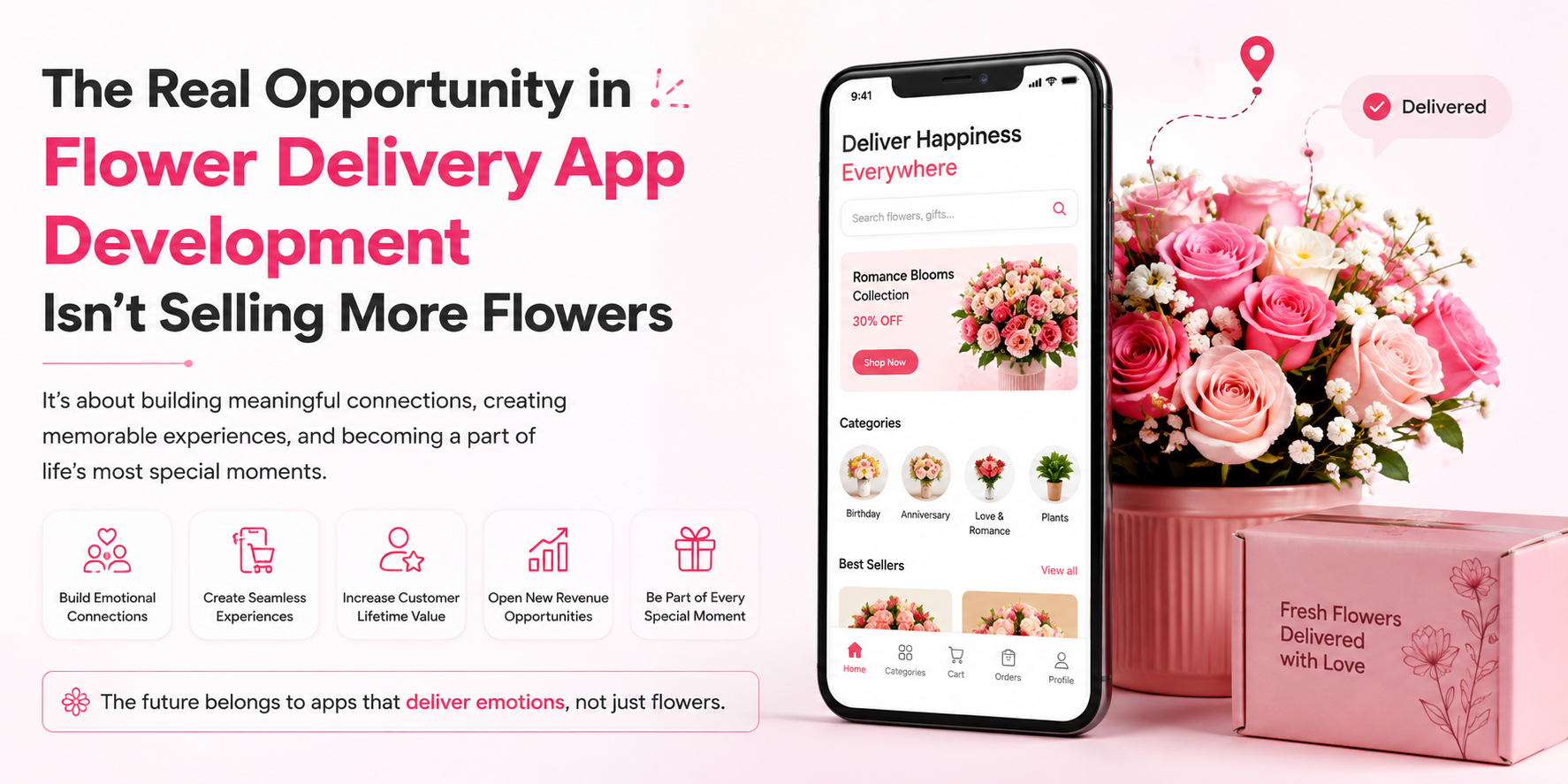
A flower business has an unusual advantage—and an unusual constraint.
Demand can be highly emotional and time-sensitive, while inventory has a limited shelf life.
A customer may urgently need roses for an anniversary tonight, while a florist may already have inventory that needs to be sold before it loses value. Traditional ordering channels don't always connect these two sides quickly enough.
This is where flower delivery app development becomes more than an online ordering project.
It can become a way to connect demand, inventory, occasions, and delivery capacity in real time.
Turn Occasions Into Predictable Demand
Most flower purchases are linked to moments.
Birthdays.
Anniversaries.
Weddings.
Corporate events.
Festivals.
Romantic occasions.
Instead of waiting for customers to search for flowers when an occasion arrives, an app can build recurring engagement through saved recipient details, occasion calendars, reminders, personalized recommendations, and scheduled orders.
The business shifts from simply capturing demand to anticipating it.
Make Perishable Inventory Work Harder
Flowers cannot sit in inventory indefinitely.
An app can connect product availability with customer demand, allowing florists to update stock, promote available arrangements, and manage orders based on what is actually available.
This becomes particularly valuable for a marketplace connecting multiple florists. Customers can discover nearby arrangements while businesses gain another digital channel for moving inventory. SpotnEats' flower delivery solution supports florist listings, product availability, ordering, delivery coordination, and marketplace management.
Don't Treat Every Flower Order the Same
A bouquet needed for an anniversary tonight is different from flowers ordered for a wedding next month.
Your platform can support different fulfillment models:
Express orders — For urgent gifting.
Scheduled orders — For birthdays, anniversaries, and planned occasions.
Bulk orders — For weddings, events, hotels, and corporate requirements.
Recurring orders — For offices, restaurants, hotels, and homes.
This flexibility allows entrepreneurs to serve both spontaneous B2C purchases and more predictable B2B demand.
Make Personalization Part of the Product
Flowers are inherently personal.
Customers may want a specific flower, color, arrangement size, message, packaging style, or combination of gifts.
A digital platform can turn these preferences into structured order options rather than relying entirely on phone conversations.
Flower delivery platforms can also use previous purchases and occasion information to make more relevant recommendations, helping customers choose faster while creating opportunities for higher-value orders.
Build a Marketplace That Gets Smarter With Every Order
For entrepreneurs, a multi-florist model can create an important advantage.
More florists mean:
More inventory → More locations → More product variety → Better availability → More customer choices
At the same time, every transaction generates operational data around demand, popular products, locations, delivery times, and purchasing behavior.
That information can help entrepreneurs determine which neighborhoods need more florist coverage, which products perform best, and where additional delivery capacity could create growth.
Turn One-Time Buyers Into Recurring Revenue
The most interesting revenue opportunity may not come from occasional gifting.
Flower subscriptions can create recurring orders for homes, offices, hotels, restaurants, reception areas, and corporate clients. Recent industry discussions also highlight subscriptions as a way to create more predictable demand and retention.
An app can manage subscription frequency, delivery schedules, customer preferences, recurring payments, pauses, and renewals.
That gives entrepreneurs a way to build predictable revenue alongside occasion-driven sales.
Build Your Flower Delivery Platform With SpotnEats
SpotnEats provides a customizable foundation for entrepreneurs developing an on-demand flower delivery business. Its flower delivery model can connect customers, florists, delivery partners, and administrators through dedicated interfaces while supporting product catalogs, customized orders, scheduled delivery, GPS tracking, delivery management, payments, and marketplace operations.
The opportunity isn't simply to create an app where customers order flowers online.
It's to build a digital system that helps businesses understand demand, move time-sensitive inventory, coordinate multiple florists, create recurring orders, and deliver memorable experiences on the occasions that matter most.
In flower delivery, the winning platform may not be the one with the biggest catalog. It may be the one that knows what customers want, where it is available, and when it needs to arrive.

 Arabic
 French
 Spanish
 Portuguese
 Deutsch
 Turkish
 Dutch
Dutch
 Italiano
 Russian
 Romaian
 Portuguese (Brazil)
 Greek
Greek
 Bengali