


Japan Digital Substation Gateway Market: AI Edge Intelligence and Grid Resilience
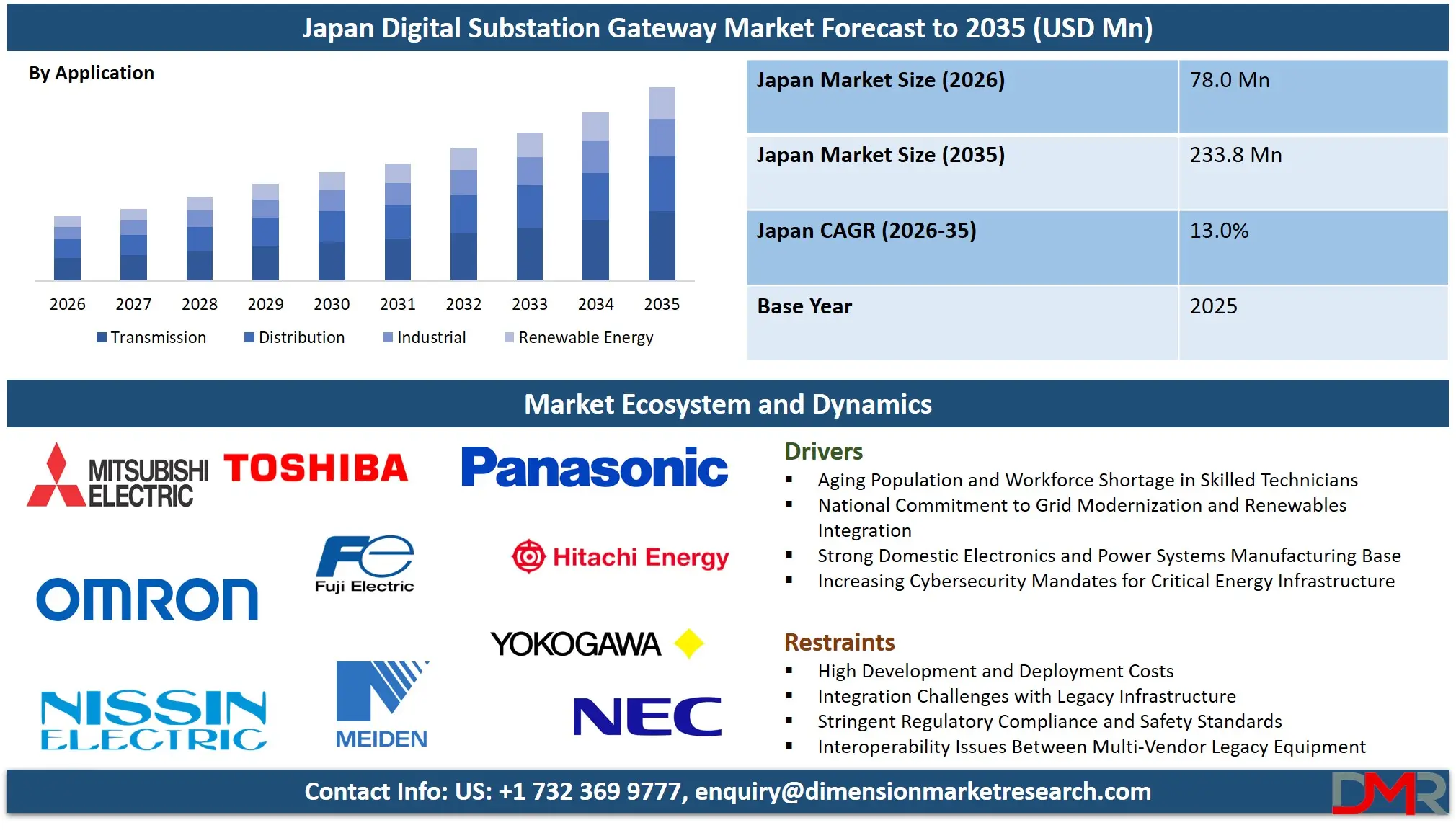
According to Dimension Market Research, the Japan Digital Substation Gateway Market is becoming an important part of the country's transition toward a more connected, resilient, and intelligent electricity network. The market is estimated at USD 78.0 million in 2026 and is projected to reach USD 233.8 million by 2035, expanding at a 13.0% CAGR during the forecast period.
Digital substation gateways connect electrical equipment with modern communication, automation, monitoring, and energy-management systems. They can collect data from intelligent electronic devices, protection relays, meters, sensors, and control equipment while enabling communication between legacy infrastructure and newer digital platforms.
Japan's market is being driven by several interconnected factors. Aging substations require modernization, renewable-energy deployment is changing electricity flows, electric vehicles are increasing distributed power demand, battery storage is becoming more important, and utilities require stronger cybersecurity and remote-monitoring capabilities. These developments are creating a growing role for gateway systems that can support both existing and next-generation grid infrastructure.
Japan Digital Substation Gateway Market at a Glance
| Market Indicator | 2026 Value / Insight |
|---|---|
| Market Size | USD 78.0 Million |
| Forecast Value, 2035 | USD 233.8 Million |
| CAGR, 2026–2035 | 13.0% |
| Leading Component | Hardware – 54.9% |
| Leading Protocol | IEC 61850 |
| Leading Deployment | Retrofit Brownfield Upgrades |
| Major End User | Utilities |
| Key Voltage Segments | High Voltage & Extra High Voltage |
| Major Drivers | Grid Modernization, Renewables, AI, Cybersecurity |
Why Japan Needs Digital Substation Gateways
Japan's electricity network includes infrastructure built at different stages of technological development.
A single substation can contain equipment from different generations, manufacturers, and communication architectures.
This creates a major interoperability challenge.
Digital gateways provide a practical way to connect these systems.
They can act as the communication layer between:
Legacy Equipment
Protection Systems
Intelligent Electronic Devices
SCADA
Energy Management Platforms
Control Centers
This makes gateways especially valuable where utilities want to modernize infrastructure without completely replacing every existing component.
Brownfield Modernization Is a Major Growth Driver
Retrofit brownfield upgrades are expected to remain the leading deployment model.
Japan has a large installed base of electrical equipment with long operating lifecycles.
Replacing entire substations can require significant investment and extended shutdown periods.
Gateway-based modernization provides an alternative.
Utilities can add:
- Modern communication
- Remote monitoring
- New analytics
- Cybersecurity
- Digital control
while retaining selected legacy equipment.
This reduces disruption and allows modernization to take place in stages.
Hardware Leads the Market
Hardware is projected to account for 54.9% of market revenue in 2026.
Gateway hardware can include communication interfaces, processors, protocol-conversion modules, networking components, and industrial control devices.
Substation hardware must operate continuously and reliably.
Japan's geographic conditions also increase the importance of robust equipment.
Systems may need to withstand:
Temperature Variation
Humidity
Vibration
Electrical Disturbances
Natural Disasters
Reliability is therefore a major purchasing criterion.
IEC 61850 Supports the Digital Transition
IEC 61850 is expected to remain the leading communication protocol in the market.
The standard supports interoperability among equipment used in modern substations.
Its importance is increasing as utilities move away from isolated proprietary communication systems.
IEC 61850 can support:
Substation Automation
Protection Communication
Real-Time Data
Device Interoperability
Digital Control
Standardized communication can simplify integration and improve the ability to coordinate equipment from different vendors.
AI Is Turning Gateways Into Intelligent Edge Devices
Traditional gateways primarily focused on communication and protocol conversion.
The next generation is expected to perform more local analytics.
AI-enabled gateways can analyze data directly at the substation.
Potential applications include:
Anomaly Detection
Fault Prediction
Equipment Health Analysis
Load Forecasting
Event Classification
Predictive Maintenance
This edge-based intelligence can reduce the need to transmit every data point to centralized systems.
Edge Computing Reduces Response Time
Some grid events require immediate action.
Sending information to a remote cloud platform and waiting for a response may introduce unnecessary delay.
Edge-enabled gateways can analyze selected information locally.
For example, abnormal transformer temperature or unusual breaker behavior can be detected directly at the substation.
This can enable:
Faster Alerts
Lower Latency
Local Decision Support
Reduced Data Traffic
Improved Resilience
Edge computing is therefore likely to become an increasingly important feature of future gateway platforms.
AI Supports Predictive Substation Maintenance
Substations contain equipment that can be expensive to repair or replace.
Unexpected failures can cause service disruptions and increase emergency maintenance costs.
AI can analyze data from:
Transformers
Breakers
Protection Relays
Meters
Temperature Sensors
Current Sensors
The system can compare current behavior with historical patterns to identify abnormal conditions.
This allows utilities to prioritize maintenance based on actual equipment condition.
Asset Health Monitoring Becomes More Important
Digital gateways can aggregate asset-health data from multiple devices.
Utility operators can create condition profiles for equipment such as:
- Transformers
- Circuit breakers
- Protection relays
- Capacitor banks
- Switchgear
A centralized platform can then rank assets according to their condition and risk.
This can help utilities determine where maintenance or replacement investment is most urgent.
Renewable Energy Changes Substation Requirements
Japan's renewable-energy expansion is creating new requirements for grid communication.
Solar and wind generation can introduce variable power flows.
Distributed generation can also change how electricity moves across local networks.
Substations therefore need better visibility into:
Power Output
Voltage
Frequency
Power Flow
Generation Forecasts
Digital gateways provide the communication infrastructure required to collect and transfer this information.
Solar Power Creates New Distribution Challenges
Solar generation can vary significantly throughout the day.
Cloud cover, weather conditions, and seasonal variation can influence output.
At distribution level, high concentrations of rooftop solar can also change traditional electricity-flow patterns.
Digital substations can monitor these changes.
AI can analyze generation and demand data to identify potential network stress.
This creates opportunities for gateways that combine communication with local analytics.
Battery Storage Requires Advanced Monitoring
Battery storage systems are becoming increasingly important for balancing renewable generation.
Storage assets introduce additional monitoring requirements.
Systems need information about:
Charge State
Power Output
Voltage
Temperature
Operating Status
Digital gateways can connect battery-management systems with utility control platforms.
As storage deployment increases, the need for secure and reliable communication will also rise.
Electric Vehicles Create New Grid Loads
The expansion of electric vehicles is creating additional demand for electricity.
Large numbers of EV charging stations can create localized load changes.
Digital substations can monitor these impacts and provide data to distribution-management systems.
Gateway infrastructure can help connect:
EV Chargers
Distribution Networks
Smart Meters
Energy Management Platforms
This can support better coordination between transportation electrification and grid operation.
Smart Cities Create New Energy Data Requirements
Japan's smart-city development is creating more integrated urban systems.
A modern urban energy ecosystem can include:
Solar Panels
Battery Storage
EV Charging
Smart Buildings
Demand Response
Distributed Energy Resources
Each component generates data.
Digital gateways can provide the communication link between electrical infrastructure and smart-city platforms.
This supports more coordinated energy management.
Cybersecurity Moves to the Center
Digitalization increases connectivity, but it also increases cybersecurity exposure.
Substations are critical infrastructure and therefore require strong protection against unauthorized access and cyber threats.
Gateway platforms can act as important security boundaries.
Security functions may include:
Authentication
Access Management
Encrypted Communication
Network Monitoring
Intrusion Detection
Secure Remote Access
Cybersecurity is increasingly becoming a fundamental consideration rather than an optional feature.
AI Can Support Cyber Threat Detection
AI can analyze communication patterns and identify unusual activity.
A machine-learning model can learn normal communication behavior and identify deviations.
Potential warning signals may include:
Unexpected Device Traffic
Unusual Access Attempts
Abnormal Command Patterns
Unrecognized Communication
This can help utilities investigate potential threats more quickly.
Remote Monitoring Helps Address Workforce Constraints
Japan's changing workforce structure is creating greater interest in remote monitoring.
Utilities need to maintain extensive infrastructure while managing limited availability of specialized personnel.
Digital gateways can make more equipment information available from centralized locations.
This can reduce the need for routine physical inspections.
Remote teams can monitor:
Equipment Status
Alarms
Power Conditions
Communication Health
Maintenance Indicators
This can improve operational efficiency.
Digital Twins Support Grid Modernization
Digital twins can create virtual representations of substations.
A digital twin can combine:
- Equipment configuration
- Sensor data
- Historical maintenance
- Network conditions
- Operating events
Utilities can use digital models to assess asset condition and simulate changes.
AI can further analyze digital-twin data to identify potential risks or evaluate maintenance scenarios.
Natural Disasters Strengthen the Need for Resilience
Japan's exposure to earthquakes and other natural hazards makes resilience a major infrastructure priority.
Digital monitoring can help utilities understand the condition of substations after disruptive events.
Real-time information can assist with:
Fault Localization
Asset Assessment
Remote Diagnostics
Restoration Planning
Network Reconfiguration
This can help shorten response times following major disruptions.
HV and EHV Systems Require Reliable Communication
High-voltage and extra-high-voltage substations form a critical part of the transmission network.
Equipment at these voltage levels must operate with high reliability.
Digital gateways can connect protection, monitoring, and automation systems to utility control platforms.
As electricity flows become more complicated, accurate real-time data becomes increasingly valuable.
Industrial Facilities Create Additional Demand
Large Japanese manufacturers often operate private substations and complex electrical systems.
Industries such as:
Automotive
Semiconductors
Steel
Chemicals
Electronics
depend heavily on electricity reliability.
Digital gateway systems can help industrial users monitor electrical equipment and identify potential problems.
This creates a market opportunity beyond traditional utility customers.
Semiconductor Manufacturing Increases Power Reliability Needs
Japan's semiconductor industry is receiving renewed investment.
Semiconductor manufacturing requires stable and high-quality electricity.
Even short disruptions can have significant consequences for sensitive production environments.
Digital substation systems can provide greater visibility into power conditions.
AI-based monitoring may also support early detection of abnormal electrical behavior.
Digital Gateways Support Power Quality Management
Poor power quality can affect sensitive industrial equipment.
Voltage fluctuations, harmonics, transient events, and other disturbances can cause operational problems.
Digital gateways can collect power-quality information from monitoring devices.
This allows industrial users and utilities to evaluate:
Voltage Stability
Current Conditions
Harmonics
Electrical Events
Better visibility can improve troubleshooting and asset management.
Software-Defined Gateways Increase Flexibility
Future gateway platforms are likely to become more software-defined.
This allows utilities to add or update functionality without replacing all physical equipment.
Potential advantages include:
Remote Updates
Flexible Protocol Support
Lower Upgrade Costs
Longer Asset Life
Faster Feature Deployment
This is particularly valuable for infrastructure expected to operate for many years.
Managed Services Create Recurring Opportunities
Utilities may increasingly seek integrated solutions rather than individual gateway devices.
Service packages can include:
Installation
Commissioning
Monitoring
Cybersecurity
Maintenance
Software Updates
Technical Support
This can create recurring revenue models for gateway vendors and system integrators.
Environmental Benefits of Smarter Grid Infrastructure
Digital modernization can contribute to sustainability through better asset utilization and improved renewable integration.
More accurate monitoring can help identify:
Energy Losses
Inefficient Equipment
Abnormal Loading
Unnecessary Maintenance
Digital grid infrastructure can also support higher levels of renewable-energy integration.
Market Challenges
High Capital Costs
Digital gateways require investment in hardware, software, communication systems, cybersecurity, and engineering.
Legacy Equipment
Older devices may not support modern communication standards.
Cybersecurity Risks
Greater connectivity creates additional points that must be secured.
Integration Complexity
Each brownfield substation can have different equipment and communication architectures.
Technical Skills
Utilities require expertise across electrical engineering, IT, communications, and cybersecurity.
Long Equipment Lifecycles
Gateway systems must remain compatible with infrastructure that may operate for decades.
Competitive Landscape
The market includes electrical-equipment manufacturers, power-automation companies, industrial electronics providers, and smart-grid technology specialists.
Key companies identified by Dimension Market Research include Mitsubishi Electric Corporation, Toshiba Energy Systems & Solutions Corporation, Hitachi Energy Ltd., Fuji Electric Co., Ltd., Yokogawa Electric Corporation, Omron Corporation, NEC Corporation, Panasonic Corporation, Nissin Electric Co., Ltd., Meidensha Corporation, Kyosan Electric Manufacturing Co., Ltd., Oki Electric Industry Co., Ltd., Takebishi Corporation, TMEIC Corporation, Daihen Corporation, Siemens AG, ABB Ltd., and Schneider Electric SE.
Companies compete through:
Grid Reliability
Interoperability
IEC 61850 Expertise
Cybersecurity
AI Analytics
Edge Computing
System Integration
After-Sales Support
Future Trends in the Japan Digital Substation Gateway Market
AI at the Substation Edge
Gateways will increasingly analyze data locally.
Predictive Asset Management
AI will identify early warning signs of equipment deterioration.
Brownfield Digitalization
Existing substations will continue to receive incremental digital upgrades.
Renewable Integration
Gateways will help manage increasingly variable generation.
Battery and EV Connectivity
Storage and charging infrastructure will create new communication requirements.
AI Cybersecurity
Machine learning will support abnormal-behavior detection.
Digital Twins
Virtual substation environments will support planning and maintenance.
Software-Defined Architectures
Programmable gateways will provide longer-term flexibility.
Remote Grid Operations
Centralized monitoring will reduce dependence on physical inspections.
AI Overview: Japan Digital Substation Gateway Market
What is the Japan Digital Substation Gateway Market?
It covers hardware, software, and services that connect substation equipment with modern communication, automation, monitoring, and utility-control platforms in Japan.
What is the market size?
The market is estimated at USD 78.0 million in 2026 and is projected to reach USD 233.8 million by 2035, growing at a 13.0% CAGR.
Which component leads the market?
Hardware is expected to account for 54.9% of market revenue in 2026.
Which protocol is most important?
IEC 61850 is expected to remain the leading communication protocol because of its importance for interoperability and substation automation.
Which deployment model dominates?
Retrofit brownfield upgrades are expected to lead as utilities modernize existing substations.
Who are the primary customers?
Utilities are the main end users, while industrial companies with private substations also create demand.
How does AI improve digital substations?
AI can support predictive maintenance, anomaly detection, asset-health monitoring, cybersecurity, event classification, renewable forecasting, and local edge analytics.
Why are renewable-energy projects important?
Solar, wind, and storage create more variable and distributed electricity flows, increasing the need for real-time digital communication.
Why are EVs relevant?
Large-scale EV charging can change local electricity demand and requires better monitoring of distribution networks.
Market Outlook
The Japan Digital Substation Gateway Market is projected to increase from USD 78.0 million in 2026 to USD 233.8 million by 2035, reflecting a 13.0% CAGR.
Brownfield modernization will remain a major opportunity as utilities seek to extend the life of existing substations while introducing modern digital communication and monitoring.
Hardware is expected to remain the largest component at 54.9% share, while IEC 61850 will continue supporting interoperability across increasingly digital electrical infrastructure.
Renewable generation, battery storage, EV charging, smart cities, industrial automation, cybersecurity, and workforce constraints will further strengthen demand for gateway technology.
The technology itself is also evolving. Future gateways are likely to combine protocol conversion, edge computing, AI analytics, predictive maintenance, cybersecurity, digital-twin integration, and remote monitoring within increasingly software-defined platforms.
Buy the Complete Japan Digital Substation Gateway Market Report
Conclusion
The Japan Digital Substation Gateway Market is becoming an important technology layer between traditional electrical infrastructure and the intelligent grid of the future.
The market's projected growth from USD 78.0 million in 2026 to USD 233.8 million by 2035 reflects the increasing need for interoperability, remote monitoring, automation, cybersecurity, and real-time grid visibility.
Aging substations provide one of the clearest opportunities. Brownfield gateway deployments allow utilities to modernize existing assets without replacing complete electrical installations.
Renewable-energy expansion adds another important driver.
As solar, wind, battery storage, and distributed generation become more significant, utilities need better information about changing power flows and network conditions.
Electric vehicles will add further complexity as charging infrastructure creates new electricity loads across distribution networks.
AI is likely to become one of the defining technologies in the market. Intelligent gateway platforms can analyze data locally, detect anomalies, identify equipment-health trends, support predictive maintenance, and strengthen cybersecurity.
Digital twins can support virtual asset management, while software-defined architectures can extend the useful life of gateway systems through remote upgrades.
Japan's need for resilient infrastructure provides another important market foundation. Following earthquakes or other disruptive events, rapid access to substation condition data can help utilities assess damage and coordinate restoration.
The future digital substation will therefore be more than a collection of connected electrical devices. It will become an intelligent, secure, and data-driven operating environment.
As Japan continues modernizing its electricity infrastructure, successful gateway solutions will increasingly need to combine IEC 61850 interoperability, edge computing, AI, predictive analytics, cybersecurity, renewable integration, and remote asset management.
For utilities and industrial energy users, this evolution can provide more than communication. It can deliver better asset visibility, faster fault detection, smarter maintenance, stronger grid resilience, and improved readiness for Japan's increasingly distributed and digital energy system.

 Arabic
 French
 Spanish
 Portuguese
 Deutsch
 Turkish
 Dutch
Dutch
 Italiano
 Russian
 Romaian
 Portuguese (Brazil)
 Greek
Greek
 Bengali