


Preschool Curriculum Company and Preschool Curriculum for Schools: Creating Better Early Learning Experiences
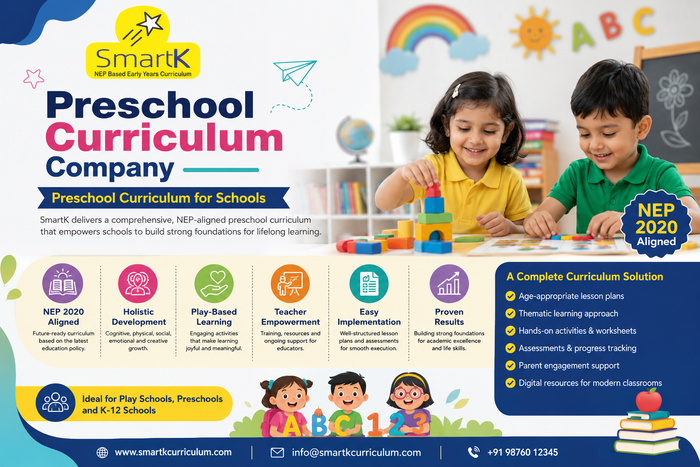
Running a successful preschool requires more than attractive classrooms and enthusiastic teachers. Schools need a structured educational approach that defines learning objectives, classroom activities, developmental milestones, and teaching strategies. A professional preschool curriculum company can help educational institutions create this structure while giving teachers practical resources for everyday classroom use.
A strong curriculum should make learning enjoyable for children while giving educators the direction they need.
Why Schools Need a Structured Curriculum
Without a clear educational framework, different classrooms may follow completely different approaches. One teacher might focus heavily on academic worksheets, while another may emphasize play without clearly defined learning goals.
A structured curriculum creates consistency. Teachers know what skills children should gradually develop, while schools can monitor whether learning objectives are being addressed.
At the same time, structure should not mean rigidity. Preschool educators need freedom to adapt activities based on children's interests and developmental levels.
Designing Preschool Curriculum for Schools
A quality preschool curriculum for schools should be practical, flexible, and easy to implement. It should provide educators with clear objectives while offering multiple ways to achieve them.
Core learning areas can include:
-
Language and communication
-
Early mathematical concepts
-
Creative expression
-
Physical development
-
Social and emotional learning
-
Environmental awareness
-
General knowledge
-
Practical life skills
These areas can be integrated through stories, songs, games, art projects, experiments, outdoor activities, and classroom conversations.
Making Learning Age Appropriate
Preschool children have rapidly developing abilities, but they do not all develop at exactly the same pace. Therefore, activities should be designed with flexibility.
A task that is suitable for one age group may be too easy or too challenging for another. Teachers should have access to differentiated activities that can be adjusted according to children's abilities.
This helps prevent children from feeling overwhelmed while ensuring that more advanced learners remain engaged.
Technology as a Supporting Tool
Technology can be useful in early education when used thoughtfully. Interactive digital resources, educational videos, audio activities, and digital storytelling can complement classroom learning.
However, technology should not replace hands-on interaction. Children still need opportunities to draw, build, move, communicate, explore objects, and interact with teachers and classmates.
Assessment Without Pressure
Preschool assessment should primarily help teachers understand children's development. It does not need to feel like formal examination.
Observation, classroom participation, project work, conversations, and activity performance can provide valuable information about a child's progress.
Teachers can use these observations to identify areas where additional support may be helpful.
The Role of Parents
Parents are an important part of early learning. Schools can strengthen the learning experience by communicating with families about children's progress and suggesting simple activities that can continue at home.
When school and home work together, children receive more consistent support.
FAQ
Q1. Why should a school use a structured curriculum?
A structured curriculum provides consistency, clear learning goals, and practical guidance for teachers.
Q2. What subjects should preschoolers learn?
Preschool education can cover language, early numeracy, creativity, physical development, social-emotional learning, and environmental awareness.
Q3. Should technology be part of preschool education?
Technology can be used as a supporting resource, but it should complement rather than replace hands-on learning.
Q4. How should preschool children be assessed?
Observation, activities, projects, conversations, and classroom participation can provide meaningful insights into development.
CTA
Schools can create stronger learning environments when educators have the right structure, resources, and support.
Choose a curriculum approach that empowers teachers, engages children, and gives schools a reliable foundation for quality early education.

 Arabic
 French
 Spanish
 Portuguese
 Deutsch
 Turkish
 Dutch
Dutch
 Italiano
 Russian
 Romaian
 Portuguese (Brazil)
 Greek
Greek
 Bengali