


United States Real Estate Market Size, Share, Growth, Trends Analysis, Report 2026-2034
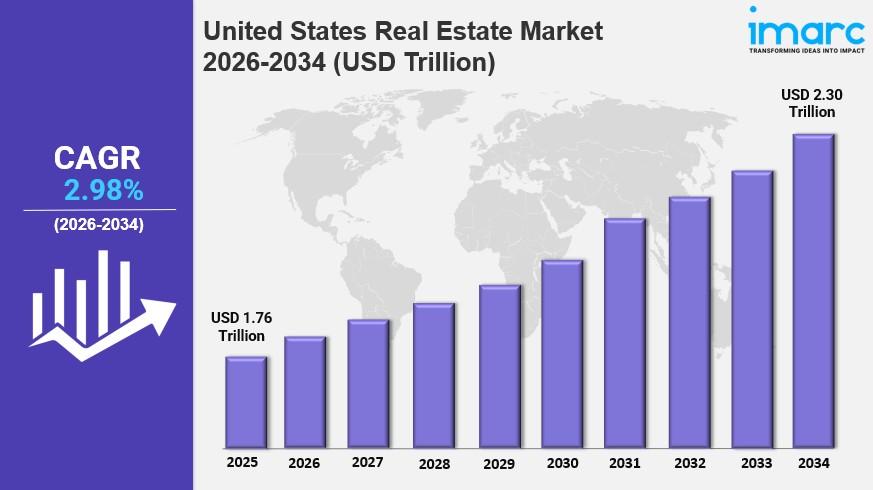
IMARC Group has recently released a new research study titled "United States Real Estate Market Size, Share, Trends and Forecast by Property, Business, Mode, and Region, 2026-2034", offering a detailed analysis of the market drivers, segmentation, growth opportunities, trends, and competitive landscape to understand the current and future market scenarios.
United States Real Estate Market Size & Share 2026-2034
The United States real estate market size was valued at USD 1.76 Trillion in 2025 and is projected to reach USD 2.30 Trillion by 2034, exhibiting a CAGR of 2.98% during 2026-2034. Rising adaptive reuse of commercial properties, rapid expansion of single-family build-to-rent communities, and deep integration of artificial intelligence across property operations are together driving United States real estate market growth.
Sales transactions dominate with a 62.8% share in 2025, while the offline mode of engagement accounts for 71.5% of the national market. The South region leads with a 38.9% share in 2025, supported by strong in-migration and pro-business policy environments.
Key Market Statistics at a Glance
- Base Year: 2025
- Historical Years: 2020-2025
- Forecast Period: 2026-2034
- Market Size (2025): USD 1.76 Trillion
- Projected Market Size (2034): USD 2.30 Trillion
- Growth Rate: CAGR of 2.98% (2026-2034)
Explore Opportunities in the United States Real Estate Market: Download the IMARC Sample Report: https://www.imarcgroup.com/united-states-real-estate-market/requestsample
Key Growth Drivers and Trends in the United States Real Estate Market
Growth in the United States real estate market is being driven by adaptive reuse and office-to-residential conversions, as office-to-residential conversions accelerate due to remote work trends. CBRE Group reports a growing pipeline of conversion projects, with a majority focused on multifamily housing, having identified 68 mixed-use districts across 19 U.S. markets in May 2024, highlighting significant volumes of underutilized office space with strong potential for conversion amid evolving office demand trends.
One of the leading United States real estate market trends is single-family build-to-rent community expansion, as institutional investment in build-to-rent (BTR) housing expands across U.S. Sun Belt markets, driven by affordability constraints and rental demand. BTR communities now represent one of the fastest-growing housing categories, with institutional players like Invesco, Hunt Companies, and AVANTA actively capitalizing communities across Texas, Arizona, Georgia, and the Carolinas to serve priced-out renters seeking suburban lifestyles.
Another key factor supporting United States real estate market growth is AI and PropTech integration, as adoption of AI, automated valuation models, and digital platforms improves real estate decision-making. Firms like CoreLogic provide nationwide property intelligence solutions, while platforms such as Realeflow enhance lead generation, predictive analytics, and operational efficiency across brokerage and investment decision-making processes, with virtual tours, e-signing, and digital closings now standard across major brokerages including Zillow, Redfin, and Compass.
United States Real Estate Industry Segmentation Insights
Breakup by Property:
- Residential: Represents a core property category driven by household formation, Sun Belt migration, and build-to-rent community expansion.
- Commercial: Covers office, retail, and mixed-use assets undergoing adaptive reuse and repositioning amid evolving workplace trends.
- Industrial: Supports logistics and warehouse demand driven by e-commerce growth and supply chain expansion.
- Land: Includes undeveloped land supporting future residential, commercial, and industrial development.
Breakup by Business:
- Sales: Holds a 62.8% share in 2025, driven by residential turnover and investment activity, with existing home sales rising by 1.7% to an annualized rate of 4.09 million in February 2026 and approximately 668,000 new homes sold.
- Rental: Accounts for 37.2% in 2025, supported by elevated mortgage costs keeping more households in lease arrangements, with professionally managed multifamily and single-family build-to-rent communities expanding fastest.
Breakup by Mode:
- Offline: Dominates with a 71.5% share in 2025, reflecting continued reliance on agent-led processes, physical inspections, and legal documentation, with most U.S. home purchases still involving in-person interactions.
- Online: Holds 28.5% in 2025 and is the fastest-growing mode, driven by platforms like Zillow, Redfin, and Realtor.com, with increasing adoption of virtual tours, digital mortgages, and e-closings expanding online transactions.
Breakup by Region:
- South: Leads with a 38.9% share in 2025, supported by strong population inflows to Texas, Florida, and Georgia, pro-business tax regimes, and Sun Belt build-to-rent expansion.
- West: Holds 24.6% in 2025, anchored by California's economy and industrial logistics demand around Los Angeles and Long Beach ports.
- Northeast: Represents 20.3% share, leaning on New York, Boston, and Philadelphia corporate density plus adaptive reuse momentum.
- Midwest: Accounts for 16.2% share, offering affordability-driven multifamily and industrial opportunities across Chicago, Columbus, and Minneapolis.
Key Challenges and Growth Opportunities in the United States Real Estate Market
The United States real estate market faces challenges including elevated mortgage rates and affordability gaps reducing purchasing power, inventory shortages and construction constraints from labor shortages and zoning limits, and regulatory complexity across jurisdictions extending project timelines. Commercial office distress, with national office vacancy hovering near 19% through 2024 and over USD 1.5 Trillion in commercial real estate loan maturities by end of 2026, alongside climate risk and rising insurance costs, further pressure the market.
Despite these challenges, the market offers considerable growth opportunities driven by Sun Belt migration and secondary city expansion into markets like Nashville, Austin, and Raleigh-Durham, rising senior housing demand with occupancy reaching 86.5% in Q3 2024, and tokenization and fractional real estate investment expanding access through blockchain-based platforms. Continued institutional capital allocation toward real estate debt and infrastructure-like assets such as data centers is expected to create substantial opportunities for long-term growth in the United States real estate market.
Competitive Landscape
The United States real estate market remains competitive and fragmented, with the top five brokerages accounting for a meaningful but modest share of total transaction volume. CBRE, Compass, Anywhere, Keller Williams Realty, LLC, and RE/MAX, LLC. lead the competitive landscape, with CBRE reporting approximately USD 40.6 billion in revenue in FY2025, reinforcing its global leadership across brokerage, capital markets, and investment management services. Residential brokerage remains highly fragmented, with over 1.5 million licensed agents operating across franchise and independent models, while consolidation is accelerating through strategic partnerships.
Recent Developments in the United States Real Estate Market
- May 2024: CBRE identified 68 mixed-use districts across 19 U.S. markets, highlighting significant volumes of underutilized office space with strong potential for conversion into residential and other uses amid evolving office demand trends.
- December 2024: Compass agreed to combine with Christie's International Real Estate and @properties in a deal valued at about USD 444 million, linking a major U.S. brokerage with a global luxury network of 100+ affiliates across nearly 50 countries.
- 2024: Anywhere Real Estate strengthened its digital ecosystem by deploying AI-driven tools across its brands to improve agent productivity and streamline transactions, while Sotheby's International Realty expanded globally to support growth in the luxury residential segment.
Author IMARC Group
IMARC Group is a leading global market research company providing data-driven insights and expert consulting services to businesses seeking to achieve their strategic objectives. With a multidisciplinary team of industry experts, IMARC delivers reliable market intelligence across sectors including Chemicals and Materials, Healthcare, Technology, Agriculture, and Retail.
Contact Us:
IMARC Group
Email: sales@imarcgroup.com
United States: +1-201-971-6302

 English
 Arabic
 French
 Spanish
 Portuguese
 Deutsch
 Turkish
 Dutch
Dutch
 Italiano
 Russian
 Romaian
 Portuguese (Brazil)
 Bengali