


Blood Purification Equipment Market Size, Growth, Key Players, Analysis and Forecast 2026-2034
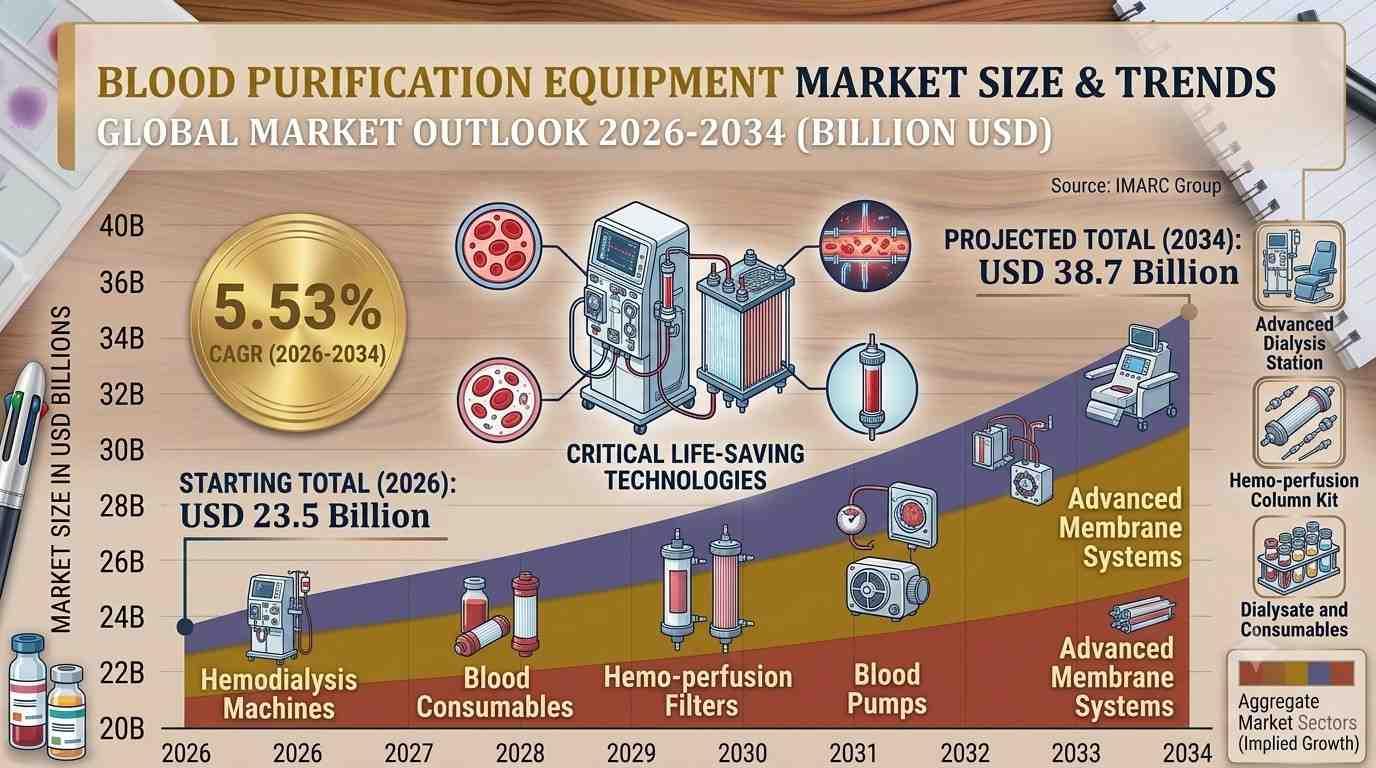
According to IMARC Group, the global Blood Purification Equipment Market Size reached USD 23.5 Billion in 2025 and is projected to reach USD 38.7 Billion by 2034, expanding at a CAGR of 5.53% during 2026–2034. This steady growth trajectory is being driven by the rising global burden of chronic kidney disease, growing demand for intensive and critical care services, continuous innovation in filtration and adsorption technologies, and the accelerating shift toward portable, home-based treatment devices.
Blood Purification Equipment Industry Overview
Blood purification equipment encompasses a broad category of medical devices designed to remove toxins, excess fluids, immune complexes, and metabolic waste products from the bloodstream. These systems range from stationary, hospital-grade dialysis machines to compact, portable units suited for home and point-of-care use. By combining membrane filtration, adsorption cartridges, and increasingly sophisticated monitoring electronics, modern equipment delivers safer and more precise treatment for a widening set of clinical indications.
Blood purification technology is deployed across several major clinical use cases:
- Renal replacement therapy: Hemodialysis and hemofiltration systems supporting patients with chronic kidney disease (CKD) and end-stage renal disease (ESRD)
- Critical and intensive care: Extracorporeal blood purification for sepsis, multi-organ dysfunction, and severe inflammatory response in ICU settings
- Home-based and portable therapy: Compact, lightweight devices enabling dialysis and filtration outside traditional hospital environments
- Hemoperfusion and adsorption therapy: Cartridge-based systems used to remove toxins, cytokines, and inflammatory mediators from circulating blood
- Specialty applications: Treatment support for liver failure, autoimmune conditions, and drug or toxin overdose management
Global Blood Purification Equipment Market Size & Key Statistics
Below are the key Blood Purification Equipment Market Size statistics drawn from IMARC Group's comprehensive market analysis:
|
Report Attribute |
Key Statistics |
|
Base Year |
2025 |
|
Historical Period |
2020–2025 |
|
Forecast Period |
2026–2034 |
|
Market Size in 2025 |
USD 23.5 Billion |
|
Market Forecast in 2034 |
USD 38.7 Billion |
|
Market Growth Rate (2026–2034) |
5.53% CAGR |
|
Largest Region |
Asia-Pacific |
|
Leading Product Type Segment |
Portable |
|
Leading Indication Segment |
Renal Diseases |
|
Leading End-Use Segment |
Dialysis Centers |
Request for a Sample Report for Detailed Blood Purification Equipment Market Share Evaluation: https://www.imarcgroup.com/blood-purification-equipment-market/requestsample
Key Market Drivers & Blood Purification Equipment Market Trends in 2025
Several powerful forces are shaping Blood Purification Equipment Market Trends and fuelling sustained growth expectations across global healthcare and critical-care infrastructure:
1. Rising Global Burden of Chronic Kidney Disease
The surge in demand for blood purification equipment is primarily driven by the growing prevalence of chronic kidney disease (CKD) and end-stage renal disease (ESRD). Global CKD incidence and prevalence have risen by approximately 40% over the last three decades, pushing more patients toward dialysis and related blood-cleansing therapies. Expanding dialysis infrastructure across both developed and developing markets is bringing this equipment to a wider patient base, reinforcing a positive long-term market outlook.
2. Technological Advancements in Filtration and Adsorption
Advancements in filtration and adsorption technologies are significantly improving the removal of toxins, immune complexes, and metabolic waste from the bloodstream. Modern systems such as high-flux dialyzers and next-generation hemoperfusion cartridges are improving outcomes for patients with sepsis, autoimmune disorders, and multi-organ dysfunction. The World Health Organization estimates that sepsis contributed to nearly 48.9 million cases and 11 million deaths globally in 2020 — around 20% of all recorded deaths — underscoring the clinical urgency behind these innovations.
3. Growing Demand for Portable and Home-Based Devices
The market is seeing a steady shift toward compact, portable devices as patients and providers prioritize home-based treatment and flexible care options for chronic illness. Portable units offer faster setup and greater comfort, particularly for elderly patients or those requiring frequent sessions. Newer lightweight models feature real-time monitoring, improved battery life, and remote support through connected apps, reducing dependence on in-hospital supervision.
4. Expansion of Critical Care and ICU Capacity
Rising demand for intensive care services — fuelled by an aging population and life-threatening conditions such as sepsis and organ failure — is a major growth driver. Individuals aged 65 and older account for nearly 60% of ICU admissions in developed nations, and global demand for critical care services has grown by an estimated 30–40% in recent years. The COVID-19 pandemic further validated the role of extracorporeal blood purification in managing severe complications, encouraging continued public healthcare investment in advanced ICU purification systems.
5. Integration of AI, IoT, and Connected Monitoring
Manufacturers, particularly in the United States, are embedding AI-powered diagnostics, improved membrane technologies, and automated controls into next-generation devices. AI-assisted systems that adapt purification cycles based on real-time patient vitals are entering the market, alongside cloud-based data tracking that allows clinicians to manage device performance and patient records remotely — a capability increasingly valuable as telehealth adoption expands.
6. Healthcare Infrastructure Expansion Across Emerging Markets
Government-backed healthcare investment and the build-out of dialysis centers in semi-urban and rural regions are widening access to blood purification therapy. Rising insurance coverage, updated clinical guidelines, and public screening programs are drawing more CKD and ESRD patients into continuous treatment cycles, supporting sustained demand across both hospital and dialysis-center settings.
Key Market Segmentation
By Product Type
Portable — Largest Segment: Portable devices led the market in 2025, driven by growing demand for home-based and point-of-care treatment among patients with chronic illness. Device miniaturization, improved battery efficiency, and telehealth integration have made compact machines a practical alternative to bulkier, stationary systems, particularly for elderly and mobility-restricted patients.
Stationary: Stationary systems remain the backbone of high-throughput hospital and dialysis-center operations, supporting the volume and consistency required for centralized renal replacement therapy and critical-care filtration.
By Indication
Renal Diseases — Largest Segment: The renal diseases segment led the market in 2025, driven by the rising global burden of CKD, diabetes, and hypertension-related complications. Growing numbers of patients progressing to ESRD require long-term therapies such as hemodialysis and hemofiltration, while early diagnosis programs and expanding insurance coverage are drawing more patients into continuous treatment.
Sepsis: Sepsis-related blood purification is a fast-growing indication, reflecting the scale of the global sepsis burden and the clinical need for rapid toxin and cytokine removal in critically ill patients.
Others: This category includes liver failure support, autoimmune disease management, and toxin or drug-overdose treatment.
By End User
Dialysis Centers — Largest Segment: Dialysis centers led end-user demand in 2025, supported by rising investment in outpatient infrastructure, centralized management of chronic kidney treatment, and scalable, cost-efficient care models. Higher patient throughput compared with home-care settings has encouraged bulk procurement and long-term service agreements.
Hospitals and Clinics: Hospitals and clinics remain essential for acute and critical-care blood purification, particularly for sepsis and multi-organ dysfunction cases requiring immediate intervention.
Others: Includes home-care settings and specialty treatment centers increasingly adopting portable purification equipment.
Regional Blood Purification Equipment Market Analysis
|
Region |
Key Highlights |
|
Asia-Pacific — Largest & Fastest Growing |
China, India, Japan, South Korea, Australia, Indonesia; rising CKD burden, expanding dialysis infrastructure, government healthcare investment, growing medical tourism, competitive domestic manufacturing |
|
North America |
United States & Canada; rapid adoption of AI-assisted and connected devices, high kidney-failure prevalence, strong reimbursement frameworks, advanced hospital infrastructure |
|
Europe |
Germany, France, UK, Italy, Spain, Russia; aging population driving chronic disease burden, growing preference for less-invasive, biocompatible technologies, rising sepsis caseloads |
|
Latin America |
Brazil, Mexico; rising CKD and renal failure cases, expanding government healthcare investment, improving service accessibility |
|
Middle East & Africa |
UAE, Saudi Arabia, South Africa; healthcare modernization programs, rising CKD prevalence, expanding access in underserved areas |
Asia-Pacific dominates the global Blood Purification Equipment Market Share, underpinned by fast-paced urban development, a rising burden of chronic kidney and metabolic disorders, expanding healthcare infrastructure, and growing exports of affordable medical devices from regional manufacturers. North America follows closely, driven by the United States' advanced clinical infrastructure and rapid adoption of AI-enabled, connected purification systems.
Connect for Detailed Blood Purification Equipment Market Share Segmentation Analysis — Speak to an Analyst: https://www.imarcgroup.com/request?type=report&id=3937&flag=C
Leading Players in the Global Blood Purification Equipment Industry
The global blood purification equipment market features a mix of diversified medical device multinationals and specialized critical-care technology firms. Key companies covered in the IMARC Group report include:
- Aethlon Medical Inc.
- Asahi Kasei Corporation
- B. Braun Melsungen AG
- Baxter International Inc.
- Cerus Corporation
- CytoSorbents Corporation
- Fresenius SE & Co. KGaA
- Healthwell Medical Tech. Co. Ltd.
- Jafron Biomedical Co. Ltd.
- Kaneka Corporation
- Medtronic plc
- Nikkiso Co Ltd.
- Spectral Medical Inc.
Latest Blood Purification Equipment Market Industry Developments
February 2025 — Oneject: Launched Indonesia's first locally manufactured blood bag (OneBag) and hemodialysis machine, reducing import dependence and strengthening the country's domestic medical device manufacturing base.
February 2025 — Tianyi Medical: Completed its acquisition of Nikkiso's CRRT business, expanding its global footprint and accelerating R&D for next-generation Aquarius continuous renal replacement therapy devices.
January 2025 — Haemonetics: Completed the sale of its whole blood assets to GVS S.p.A. for up to USD 67.8 Million, allowing the company to sharpen its focus on apheresis solutions.
September 2024 — Argon Medical Devices: Launched the CLEANER Vac Thrombectomy System in the US, a large-bore aspiration device designed to remove blood clots from peripheral veins with greater physician control.
June 2024 — CytoSorbents: Launched the PuriFi blood pump in the EU, enabling faster and easier use of its CytoSorb blood purification cartridge for critically ill patients.
About Us
IMARC Group is a leading global market research company providing data-driven insights and expert consulting services to businesses seeking to achieve their strategic objectives. With a multi-disciplinary team of industry experts, IMARC delivers thorough, reliable market intelligence across sectors including Healthcare, Technology, Chemicals, Energy, Food & Beverages, and more.
Contact Us
IMARC Group
United States: +1-201-971-6302
India: +91-120-433-0800
United Kingdom: +44-753-714-6104

 English
 Arabic
 French
 Portuguese
 Deutsch
 Turkish
 Dutch
Dutch
 Italiano
 Russian
 Romaian
 Portuguese (Brazil)
 Greek
Greek
 Bengali