


Australia University Visa Risk Ratings: What Students Should Know
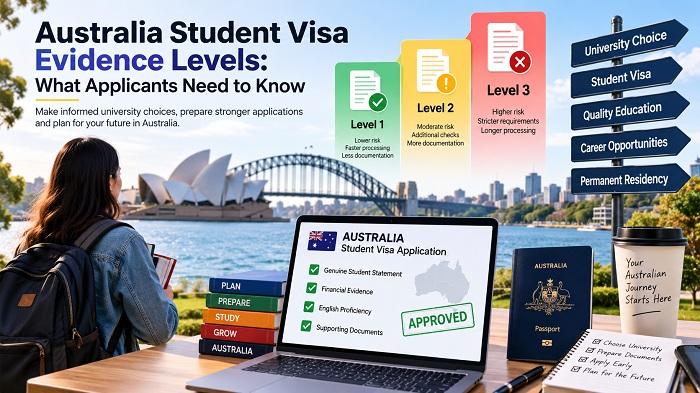
An Australian university’s visa risk rating can influence how much evidence an international student needs to provide. But it should not be mistaken for a measure of academic quality.
That distinction matters in 2026 as Australia reviews its evidence levels following a sharp increase in student visa refusals. The research paper behind the September 2026 review reports that one in three student visa applications to Australian universities was refused in February. That was the highest monthly refusal rate recorded in 21 years of tracking.
For students choosing where to study, the situation creates an obvious question: should a university with a stricter visa risk classification be avoided?
The answer is not necessarily.
Evidence levels measure visa-related risk. They do not tell students whether a university has strong teaching, good facilities or valuable qualifications.
Visa Risk Is Not the Same as University Quality
Australia's Simplified Student Visa Framework assigns education providers and source countries an evidence level from 1 to 3. Lower levels generally involve lighter documentation, while higher levels can mean more supporting evidence and closer scrutiny.
The system uses previous visa outcomes when assessing risk. According to the research paper, refusal outcomes make up roughly half of an institution's risk score.
That creates an important distinction between the university itself and the students it attracts.
A university may have excellent academic programs but recruit heavily from countries experiencing higher visa refusal rates. Its evidence level can therefore become stricter without any decline in teaching quality.
The 2026 figures illustrate the issue. Chinese student demand fell by around 39% year-on-year in February. At the same time, Australian institutions relied more heavily on South Asian markets.
The reported refusal rates were considerably higher in several of those markets: 65% for Nepal, 51% for Bangladesh, 40% for India, 38% for Sri Lanka and 36% for Bhutan.
For an applicant, this means a university's visa environment can reflect broader market patterns.
It is similar to judging a busy airport during a period of increased security checks. Longer screening does not necessarily mean the airport has become worse. It means the surrounding risk assessment has changed.
Students need to make the same distinction when evaluating Australian universities.
What a Stricter Evidence Level Can Mean
A change in evidence level can have practical consequences for applicants.
If a university moves into a stricter category, students may need to provide more detailed financial evidence, demonstrate their study intentions more clearly and prepare for additional scrutiny. Processing can also take longer when applications require more manual assessment.
The September 2026 review is therefore important because institutions could see their classifications change after the latest refusal data is assessed.
Industry bodies have raised concerns about this possibility. The International Education Association of Australia has called for a freeze on evidence-level changes, arguing that temporary market shifts should not automatically create longer-term consequences for institutions. Universities Australia has also urged the government to publish more frequent refusal data.
Students cannot decide how the evidence-level formula works. They can, however, prepare for the possibility that requirements may become stricter.
The first step is to avoid leaving documentation until the final stage of the application. Financial records, academic documents and Genuine Student material should be organised early.
The second is to build some time into the application schedule. If additional information is requested, an applicant who has applied well before the course start date has more room to respond.
The third is to keep the application internally consistent. The chosen course, previous education, financial circumstances and future plans should support one clear explanation.
Strong Academic Preparation Still Has a Role
Visa preparation often takes place at the same time as academic work. Students may be completing research assignments, preparing applications and meeting university deadlines while gathering immigration documents.
That combination can create unnecessary pressure.
Students who need additional assistance with complex academic projects can use resources such as Expertsmind.com’s dissertation writing support to get subject-focused academic help while keeping their wider study plans organised.
This type of support does not determine visa eligibility. Its value lies in helping students manage the academic side of their education while they deal with other responsibilities.
That matters because a student should not allow uncertainty around visa processing to disrupt preparation for university itself.
At the same time, students should remember that a Level 2 or Level 3 evidence classification does not automatically indicate a poor institution. The research explicitly separates visa risk from teaching quality and academic value.
The better question is whether the course remains a good academic and professional fit.
Think About the Next Step After Graduation
International students should also look beyond the immediate visa application.
Someone choosing a university in Australia may spend several years completing a qualification. If that student hopes to remain in Australia after graduation, the relationship between their course, career plans and possible future migration options deserves attention from the beginning.
A student visa is not itself a guarantee of permanent residency. Understanding potential post-study pathways can therefore help students make better-informed education decisions.
Students exploring this issue can refer to the guide on moving from a student visa to permanent residency in Australia as part of their longer-term planning.
That does not mean migration outcomes should become the only reason for selecting a course. University reputation, course content, career prospects, costs and location still matter.
The key is to consider all of these factors together rather than treating the evidence level as a simple pass-or-fail signal.
Australia's September 2026 review shows how quickly visa conditions can change when international student markets shift. Universities that recruit from markets with higher refusal rates may face stricter classifications even when their academic offering remains strong.
For students, the most useful response is not to panic about risk ratings. It is to understand what those ratings actually measure.
Choose a university because its course fits your goals. Check how visa requirements may affect your application. Prepare financial and Genuine Student evidence carefully. Leave enough time to respond if additional documents are requested.
The evidence level may change, but the quality of your preparation remains in your hands.
The smartest Australian university choice is therefore not simply the one with the lowest perceived visa risk. It is the institution and course that make sense for your education, career plans and long-term goals — backed by an application that can stand up to scrutiny.

 Arabic
 French
 Spanish
 Portuguese
 Deutsch
 Turkish
 Dutch
Dutch
 Italiano
 Russian
 Romaian
 Portuguese (Brazil)
 Greek
Greek
 Bengali