


How Automated Inventory Tracking Can Improve Grocery Retail Operations
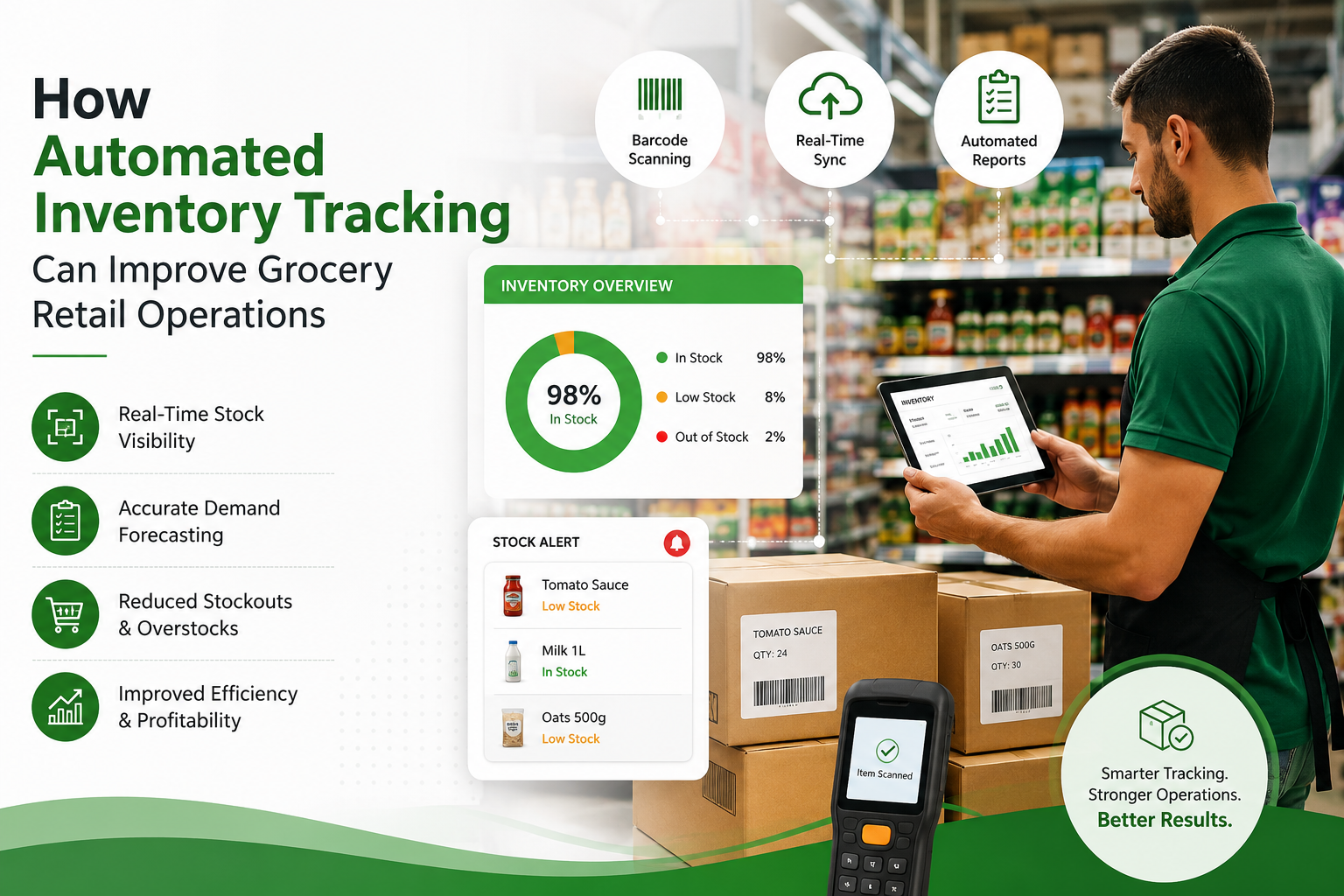
Managing inventory is one of the most important and challenging parts of running a grocery business. Unlike many other retail products, groceries include perishable items, fast-moving products, seasonal goods, and thousands of individual SKUs. Even a small inventory error can result in stockouts, overstocking, food waste, or unhappy customers.
Traditional inventory management methods that depend heavily on spreadsheets, manual counting, and periodic stock checks are becoming difficult to maintain as grocery businesses grow. Automated inventory tracking provides a smarter alternative by allowing retailers to monitor stock levels, sales activity, product movement, and replenishment requirements in real time.
With technologies such as barcode scanning, cloud computing, IoT sensors, artificial intelligence, and data analytics, grocery retailers can build more accurate and responsive inventory operations.
What Is Automated Inventory Tracking?
Automated inventory tracking is a technology-driven approach that monitors products throughout the inventory lifecycle with minimal manual intervention.
Instead of employees regularly counting products and updating inventory records, an automated system can capture inventory changes whenever products are received, sold, returned, moved, or discarded.
For example, when a customer purchases a product through a physical store or digital platform, the inventory system can automatically reduce the available quantity. When new stock arrives at the warehouse, the system can update inventory levels accordingly.
This creates a centralized and continuously updated view of available products.
Why Inventory Management Matters in Grocery Retail
Inventory management directly affects profitability and customer satisfaction. Grocery retailers need to maintain enough stock to meet demand without purchasing more products than they can sell.
Poor inventory management can create several problems:
-
Frequent stockouts
-
Excess inventory
-
Product expiry
-
Food waste
-
Incorrect stock information
-
Delayed order fulfillment
-
Higher storage costs
-
Poor customer experiences
-
Unnecessary procurement expenses
Automated tracking helps businesses address these challenges by replacing assumptions with accurate, real-time inventory information.
How Automated Inventory Tracking Improves Grocery Operations
1. Provides Real-Time Inventory Visibility
One of the biggest advantages of automation is real-time visibility into inventory.
Retailers can see how many units are currently available, which products are selling quickly, and which items are approaching their minimum stock levels. This information can be accessed through centralized dashboards connected to stores, warehouses, and digital sales channels.
Real-time visibility also helps prevent situations where an item appears available online but is actually out of stock.
For businesses operating across multiple locations, centralized inventory information can make it easier to identify where products are available and where replenishment is required.
2. Reduces Human Errors
Manual inventory updates are vulnerable to mistakes. Employees may enter incorrect quantities, forget to update records, or accidentally duplicate information.
Automated systems reduce these errors by capturing inventory changes through technologies such as barcode scanners, RFID, POS integrations, and automated order management systems.
More accurate inventory records help businesses make better purchasing and fulfillment decisions.
3. Helps Prevent Stockouts
Stockouts can negatively affect both revenue and customer loyalty. If customers repeatedly find their preferred products unavailable, they may choose another retailer.
Automated inventory systems can monitor predefined stock thresholds and notify staff when a product reaches its reorder point.
For example, if a grocery store normally sells 100 units of a product each week, the system can identify when available inventory is becoming insufficient and trigger a replenishment workflow.
This allows retailers to respond before shelves become empty.
4. Controls Overstocking
Keeping too much inventory can be just as problematic as having too little.
Excess grocery inventory occupies valuable storage space and increases the risk of products expiring before they are sold. Automated tracking gives retailers better insight into product movement and helps them identify slow-moving items.
Businesses can then adjust purchasing quantities, create promotions, or redistribute products between locations.
5. Reduces Food Waste
Food waste is a major concern for grocery retailers, particularly when managing fresh produce, dairy products, meat, bakery products, and other items with limited shelf lives.
Automated systems can track product quantities and, when integrated with suitable inventory workflows, monitor expiry dates and batch information.
Retailers can use this information to prioritize products approaching expiration and develop targeted discounting or redistribution strategies.
This can reduce unnecessary waste while helping businesses recover revenue from products that might otherwise remain unsold.
6. Improves Demand Forecasting
Inventory tracking becomes even more valuable when combined with analytics and machine learning.
Historical sales data can reveal purchasing patterns based on:
-
Day of the week
-
Season
-
Holidays
-
Promotions
-
Weather conditions
-
Local demand
-
Product categories
-
Customer behavior
Businesses can use these insights to estimate future demand and make more informed purchasing decisions.
For example, demand for beverages may increase during hot weather, while certain food categories may experience higher sales during holidays. Automated systems can help retailers identify these patterns and prepare inventory accordingly.
7. Makes Reordering More Efficient
Automated inventory tracking can simplify the procurement process.
Instead of manually checking stock levels across hundreds or thousands of products, employees can use automated reorder alerts. Depending on the system, purchase orders can also be generated when inventory reaches predetermined thresholds.
This saves time for purchasing teams and reduces the risk of forgetting to replenish important products.
Businesses can also establish different reorder points for different products based on sales velocity, supplier lead times, and demand patterns.
8. Improves Order Fulfillment
For online grocery businesses, accurate inventory data is essential for successful order fulfillment.
When customers place orders through an online grocery platform, the system needs to know whether the requested products are actually available.
Automated inventory synchronization can help ensure that product availability is updated across digital channels.
This can reduce:
-
Order cancellations
-
Product substitutions
-
Customer complaints
-
Fulfillment delays
-
Refund requests
Accurate inventory data therefore supports a smoother shopping experience from product discovery to delivery.
9. Supports Multiple Store Locations
Grocery businesses with multiple branches often face difficulties maintaining consistent inventory information.
An automated cloud-based inventory platform can provide a centralized view of stock across different locations.
Managers can compare inventory levels, identify high-demand stores, and transfer products between locations when necessary.
For example, if one branch has excess stock while another is experiencing a shortage, the retailer may be able to redistribute products instead of placing a new supplier order.
10. Improves Warehouse Management
Inventory automation is not limited to retail shelves. It can also improve warehouse operations.
Warehouse teams can use automated tracking to monitor product receiving, storage, picking, packing, and dispatch activities.
When inventory data is connected with order management systems, employees can identify where products are stored and determine which items need to be picked for incoming orders.
This can improve warehouse efficiency and reduce unnecessary movement.
Role of Automated Inventory Tracking in Grocery Apps
Digital grocery platforms depend heavily on accurate inventory information. A customer expects an item shown as available in an app to actually be available for purchase.
A retailer working with a grocery delivery app development company can design an application that connects customers, store employees, delivery teams, warehouses, and administrators through a centralized technology ecosystem.
The inventory module can synchronize product availability with the customer-facing application. When an item sells out, its status can automatically change rather than relying on employees to manually update the application.
Businesses looking for grocery delivery app development services can also incorporate features such as stock alerts, product availability management, purchase order tracking, warehouse synchronization, and inventory reporting.
Similarly, modern grocery app development services can include integrations with POS systems, ERP platforms, warehouse management systems, payment gateways, and analytics tools.
How On-Demand Grocery Platforms Benefit
The demand for fast grocery delivery has increased the importance of accurate inventory management.
An on-demand grocery delivery app needs to process orders quickly while maintaining accurate product availability. If the platform accepts an order for an unavailable item, the retailer may need to contact the customer, substitute the product, or cancel the order.
For businesses planning on-demand grocery delivery app development, inventory automation can become a core part of the technology architecture rather than an additional feature added later.
The platform can connect inventory data with order processing, store management, delivery operations, and customer notifications.
Technologies Used for Automated Inventory Tracking
Several technologies can support automated grocery inventory management.
Barcode Scanning
Barcode systems allow employees to quickly identify products and update stock records during receiving, sales, and warehouse operations.
RFID
RFID technology can identify and track products using radio-frequency signals. It can be useful for businesses looking for faster and more automated inventory monitoring.
IoT Sensors
IoT devices can collect information from storage environments. In appropriate use cases, sensors can monitor conditions such as temperature and humidity, which can be particularly valuable for sensitive grocery products.
Cloud Computing
Cloud-based inventory systems allow authorized users to access centralized inventory information from different stores, warehouses, and operational locations.
Artificial Intelligence
AI can analyze historical sales and inventory data to identify patterns, forecast demand, and support purchasing decisions.
Data Analytics
Analytics dashboards can transform inventory information into actionable insights, helping managers understand product performance, stock movement, and operational trends.
Challenges to Consider
Although automated inventory tracking provides significant benefits, implementation requires careful planning.
Integration With Existing Systems
Many grocery retailers already use POS, ERP, accounting, warehouse, and e-commerce systems. The new inventory platform needs to exchange data reliably with these systems.
Data Accuracy
Automation cannot completely solve poor-quality data. Incorrect product information, duplicate SKUs, or outdated supplier records can still affect inventory accuracy.
Employee Training
Employees need appropriate training to use scanners, dashboards, warehouse tools, and inventory workflows effectively.
Initial Investment
Hardware, software, integrations, cloud infrastructure, and implementation can create an upfront investment. Businesses should evaluate the expected operational savings and long-term benefits before selecting a solution.
Scalability
The system should be able to support increasing products, orders, customers, locations, and transactions as the business grows.
The Future of Grocery Inventory Management
Inventory management is moving from periodic stock counting toward continuous, intelligent monitoring.
Future grocery systems are likely to combine AI, computer vision, IoT devices, robotics, predictive analytics, and cloud platforms to create increasingly automated operations.
Computer vision, for example, could help identify products on shelves, while predictive systems could anticipate demand before inventory shortages occur. IoT technologies may provide continuous information about storage environments, while centralized platforms can connect inventory information across stores and fulfillment centers.
Conclusion
Automated inventory tracking can transform grocery retail operations by improving stock visibility, reducing manual errors, minimizing waste, supporting accurate forecasting, and making replenishment more efficient.
For online grocery businesses, accurate inventory data is especially important because customer orders, product availability, fulfillment, and delivery operations are closely connected.
As grocery businesses expand their digital presence, integrating automated inventory management with mobile apps, e-commerce platforms, POS systems, warehouses, and analytics tools can create a more connected retail ecosystem.
The goal is not simply to automate inventory counting. It is to build an intelligent system that helps retailers make faster, more accurate decisions while delivering a better shopping experience to customers.

 Arabic
 French
 Spanish
 Portuguese
 Deutsch
 Turkish
 Dutch
Dutch
 Italiano
 Russian
 Romaian
 Portuguese (Brazil)
 Greek
Greek
 Bengali