


MEE, MVR and ATFD Roles in ZLD Plants Explained
Industrial wastewater management becomes increasingly complex when wastewater contains high levels of dissolved salts and contaminants. A Zero Liquid Discharge Plant Manufacturer typically designs systems that combine evaporation, concentration, and crystallization technologies to recover usable water while minimizing liquid waste. Among the most important technologies used in these systems are Multiple Effect Evaporators (MEE), Mechanical Vapor Recompression (MVR), and Agitated Thin Film Dryers (ATFD).
Understanding how these technologies work together can help industries choose the right wastewater treatment approach and improve overall plant efficiency.
What Is the Role of MEE in ZLD Plants?
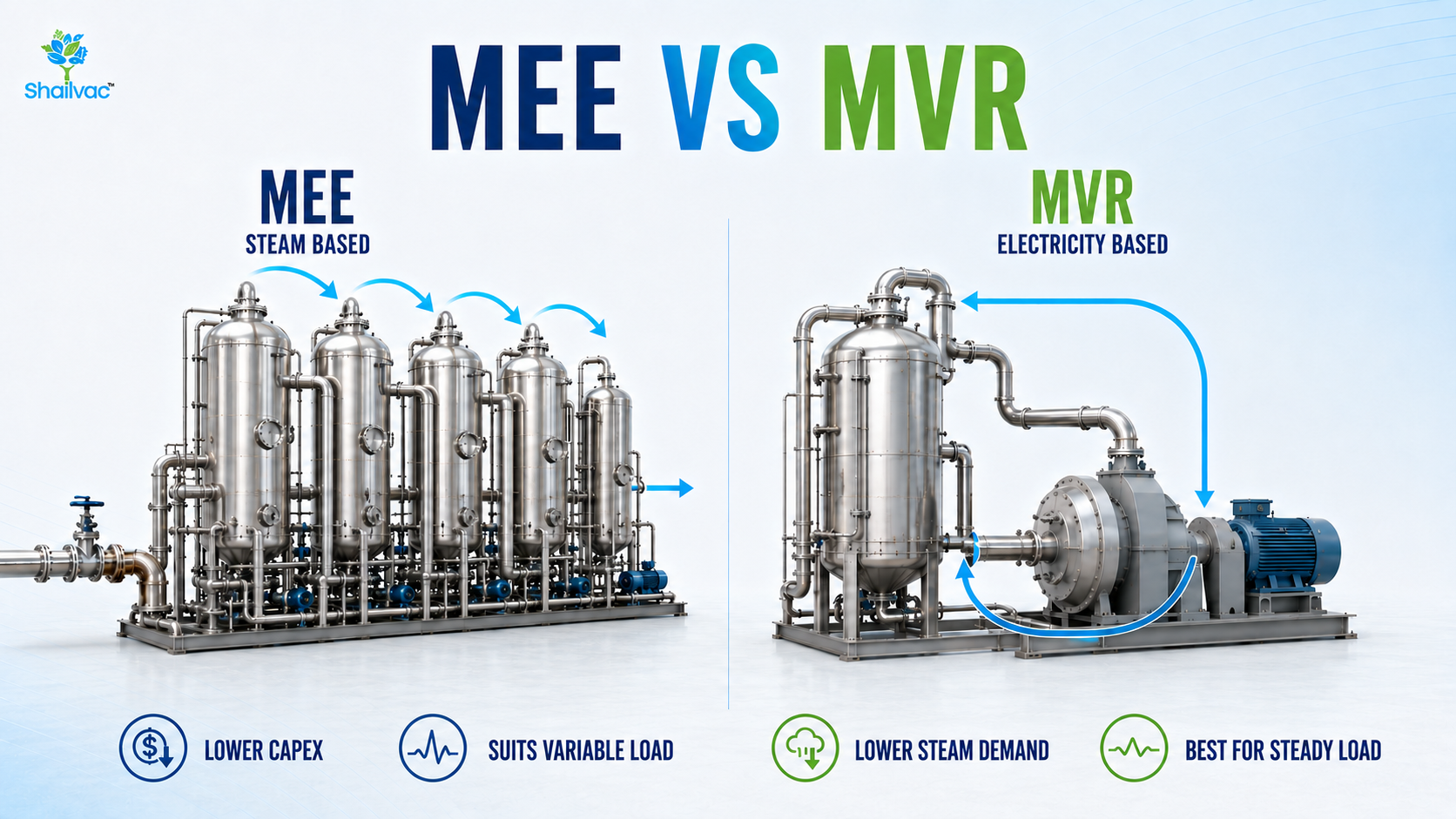
A Multiple Effect Evaporator is one of the primary components used for concentrating wastewater in a ZLD system. The basic principle is to remove water from wastewater through evaporation while retaining dissolved salts and other non-volatile substances in the concentrated stream.
Multiple Effect Evaporator for ZLD
An MEE consists of multiple evaporation stages, or effects. The vapor produced in one effect can be used as a heating source for the next effect. This arrangement reduces the amount of fresh steam required compared with a single-stage evaporation process.
For industries producing large volumes of wastewater, multiple effect evaporators for ZLD applications can provide an effective way to concentrate streams before they move toward the final treatment stage.
MEE systems are commonly considered for industries such as chemicals, textiles, pharmaceuticals, food processing, and other manufacturing operations where wastewater contains significant dissolved solids.
How Does MVR Technology Support ZLD?
Mechanical Vapor Recompression, or MVR, takes the evaporation process a step further by improving energy utilization. Instead of allowing generated vapor to go to waste, an MVR system compresses the vapor mechanically and increases its pressure and temperature.
The recovered vapor can then be reused as a heating medium within the evaporator.
Mechanical Vapor Recompression System
A mechanical vapor recompression system can significantly reduce dependence on external steam in suitable applications. This makes MVR particularly useful where energy consumption is a major operating concern.
MVR technology for ZLD can be integrated into evaporation systems depending on wastewater characteristics, required evaporation capacity, operating conditions, and energy costs.
While MVR can require a higher initial investment, its ability to recycle vapor can contribute to lower ongoing steam consumption. The actual benefit depends on the plant design and operating conditions.
Why Is ATFD Used in ZLD Plants?
After wastewater passes through the evaporation stage, the remaining concentrate contains a much higher concentration of dissolved solids. This concentrated stream requires further treatment before the ZLD process can be completed.
This is where an Agitated Thin Film Dryer, or ATFD, becomes important.
ATFD System for Final Concentration
An ATFD spreads the concentrated liquid into a thin film over a heated surface. Mechanical agitation helps maintain the film and improves heat transfer while moisture is removed through evaporation.
The process leaves behind a dry or semi-dry solid residue, depending on the feed characteristics and system configuration.
For facilities handling highly concentrated streams, an ATFD system manufacturer can design equipment according to factors such as feed concentration, solids content, viscosity, evaporation capacity, and desired final moisture level.
How MEE, MVR and ATFD Work Together
The real value of these technologies becomes clearer when they are viewed as parts of one integrated system rather than separate machines.
A typical ZLD process may follow this sequence:
- Pre-treatment: Wastewater is treated to remove suspended solids and substances that could interfere with evaporation.
- MEE concentration: The Multiple Effect Evaporator removes a significant portion of the water and concentrates dissolved solids.
- MVR integration: Where suitable, vapor recompression helps recycle evaporation energy and reduce external steam requirements.
- Further concentration: The concentrated stream is processed until it reaches the required solids level.
- ATFD treatment: The remaining concentrate is dried to produce a solid residue.
- Water recovery: Condensed vapor can be collected and treated for reuse, depending on quality requirements.
This integrated approach allows industries to recover water while reducing the amount of liquid waste requiring disposal.
Choosing the Right ZLD Evaporation Systems
Not every industrial facility requires the same ZLD configuration. Wastewater composition, flow rate, temperature, total dissolved solids, scaling potential, available utilities, and desired water recovery all influence equipment selection.
A reliable MEE plant manufacturer will evaluate these parameters before determining the appropriate evaporation arrangement. Similarly, selecting an experienced ATFD system manufacturer is important when the process involves high-viscosity concentrates or substantial solids.
Other considerations include maintenance requirements, automation, energy consumption, footprint, and long-term operating costs.
Where ZLD Technology Delivers the Most Value
ZLD plant technology is particularly valuable for industries where wastewater disposal is difficult, water reuse is important, or regulations require tighter control over liquid discharge.
Modern industrial evaporation solutions can help companies reduce freshwater demand and improve wastewater management. Depending on the application, ZLD evaporation systems may also incorporate crystallizers or other technologies to handle salt recovery and solid waste.
ZLD crystallization technology becomes especially relevant when the objective extends beyond water recovery to managing or recovering dissolved salts from the concentrated stream.
For companies evaluating these systems, working with an experienced Zero Liquid Discharge Plant Manufacturer can help ensure that the MEE, MVR, ATFD, and supporting treatment stages are designed as one coordinated process.
Building a More Efficient Wastewater Treatment Strategy
MEE, MVR, and ATFD each perform a different function, but their combined application can create a practical solution for challenging industrial wastewater streams. MEE focuses on concentration, MVR improves energy recovery, and ATFD handles the final concentrated residue.
When properly designed around the wastewater characteristics, these technologies can support high water recovery and significantly reduce liquid waste. Businesses looking for wastewater evaporation systems should therefore evaluate the complete process rather than selecting individual equipment based only on capacity or purchase price.
A well-engineered ZLD system is ultimately about finding the right balance between water recovery, energy consumption, operating reliability, and waste handling. For industries facing complex wastewater challenges, understanding the role of each stage is the first step toward making a better treatment decision.

 Arabic
 French
 Spanish
 Portuguese
 Deutsch
 Turkish
 Dutch
Dutch
 Italiano
 Russian
 Romaian
 Portuguese (Brazil)
 Greek
Greek
 Bengali