


Complete Guide to Paver Block Testing at a NABL Approved Testing Laboratory Delhi
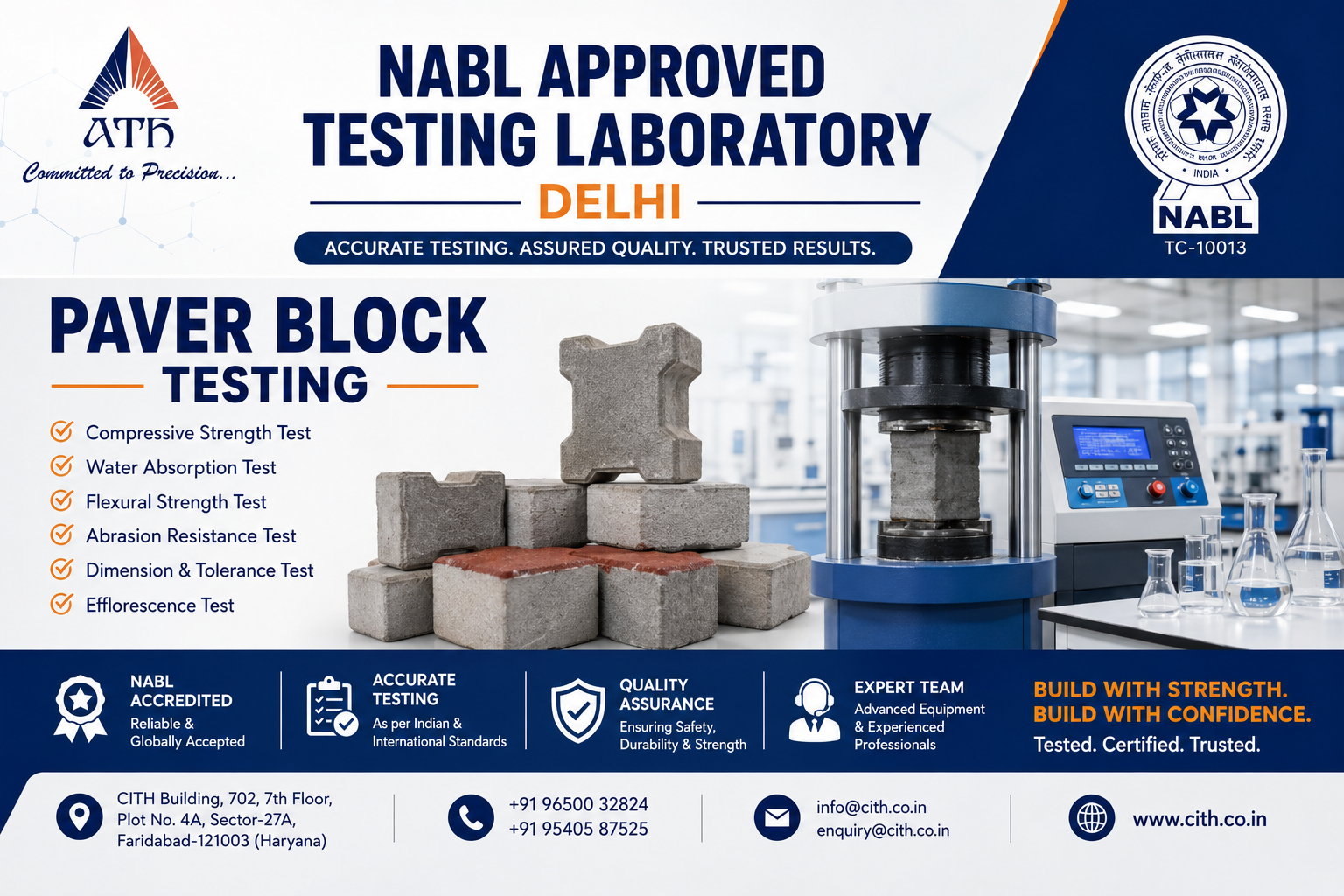
Selecting quality paving materials is an important decision for construction projects. Whether paver blocks are being used for a residential driveway or a large commercial development, their performance can influence the safety, appearance, and durability of the finished surface.
This makes Paver Block Testing an important part of construction-material quality assessment. A NABL Approved Testing Laboratory Delhi can conduct applicable tests within its accredited scope and provide technical results for manufacturers, contractors, purchasers, and project consultants.
What Is Paver Block Testing?
Paver Block Testing refers to laboratory evaluation of concrete paving blocks. The testing process examines selected characteristics according to relevant standards and project specifications.
IS 15658 provides requirements and methods for testing concrete paving blocks. Its 2021 version identifies water absorption, compressive strength, abrasion resistance, tensile splitting strength, flexural strength, and freeze-thaw durability among relevant characteristics.
Why Manufacturers Need Testing
Manufacturing quality can change due to raw materials, cement content, aggregate characteristics, water-cement ratio, compaction, curing conditions, and production equipment.
Regular testing provides measurable evidence of these variations.
If test results begin to change over time, manufacturers can investigate the production process before a major quality issue occurs.
Compressive Strength Evaluation
Compressive strength is a central mechanical property for concrete paver blocks.
The laboratory subjects test specimens to controlled compressive loading. Results are recorded and evaluated according to the applicable standard.
The BIS product manual for IS 15658 includes compressive strength within its specified product-control requirements.
Water Absorption Evaluation
Water absorption testing determines the amount of water taken up by the paver specimen under prescribed conditions.
The IS 15658:2021 requirements specify maximum values for individual and average water absorption.
Abrasion Resistance
Abrasion resistance is relevant when pavers are exposed to repeated movement and surface wear.
Testing can include dry and wet conditions as specified by the standard.
Dimensional Checks
Dimensions are important for proper installation. Laboratory checks can identify deviations in length, width, thickness, squareness, and related characteristics where required.
Other Mechanical Tests
Depending on the project, additional tests may include tensile splitting strength and flexural strength.
These provide additional insight into how the paver behaves under different types of mechanical stress.
Importance of Testing Standards
A test result is most meaningful when it is connected to a defined method and acceptance criterion.
For this reason, laboratories should clearly identify the standard and test method used.
What Makes a Good Testing Laboratory?
When selecting a NABL Approved Testing Laboratory Delhi, evaluate:
-
Current accreditation
-
Test scope
-
Qualified technical personnel
-
Laboratory equipment
-
Standardized procedures
-
Sample handling
-
Reporting system
-
Traceability
Do not assume that every test offered by a laboratory is automatically covered by its accreditation. Confirm the relevant scope.
Paver Testing for Quality Assurance
Testing can be integrated into a broader quality-control program. Manufacturers may test regular production batches, while purchasers may conduct independent tests before accepting large consignments.
This creates a documented quality trail.
Frequently Asked Questions
How often should paver blocks be tested?
The frequency depends on the applicable product-control requirements, project specifications, production volume, and purchaser requirements. BIS documentation provides specific control frequencies for several tests under its product manual.
Can old paver blocks be tested?
Testing may be possible depending on the purpose and condition of the samples. Discuss sample suitability with the laboratory beforehand.
What information should accompany samples?
Provide product identification, grade, dimensions, batch information, age, requested tests, and any relevant project requirements.
Does NABL accreditation cover all laboratory tests?
No. Accreditation applies to the laboratory's defined scope. Always verify that the requested test is included.
CTA
For dependable construction-material evaluation, choose a competent NABL Approved Testing Laboratory Delhi and arrange appropriate Paver Block Testing. Submit representative samples and discuss the applicable standard, parameters, and reporting requirements with the laboratory before testing begins.

 English
 Arabic
 Spanish
 Portuguese
 Deutsch
 Turkish
 Dutch
Dutch
 Italiano
 Russian
 Romaian
 Portuguese (Brazil)
 Greek
Greek
 Bengali