


The Trade-Offs Between Account-Based and Guest-Access Invoicing Tools
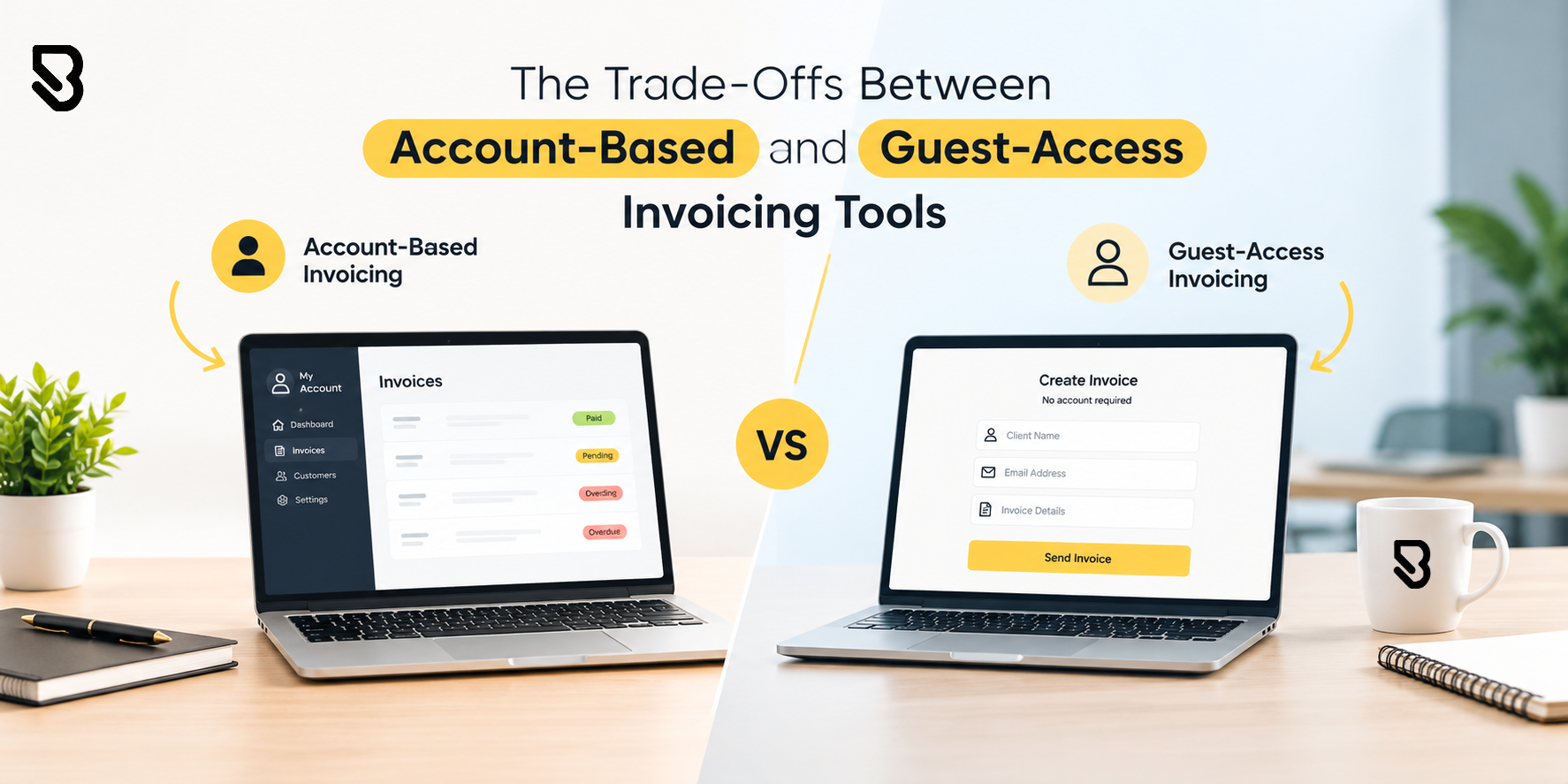
When you first search for a way to create an invoice online, you'll notice tools split into two distinct approaches: some ask you to create an account before you can do anything, while others let you build and download an invoice as a guest, no signup required. Neither approach is a mistake on the tool's part, they're built for genuinely different use cases, and picking the wrong one for your situation is where the friction comes from.
What account-based tools offer
Creating an account means the tool can save your business details, client list, and past invoices, so every new invoice starts from what you've already entered rather than a blank form. Over time, this becomes the main advantage: your third invoice takes a fraction of the time your first one did, because your business name, logo, and returning clients are already on file.
An account also typically means access from any device, since your data lives with the service rather than on the one computer you happened to be using. If you invoice regularly, lose that history and you're rebuilding client records from memory or old email threads.
What guest-access tools offer
A guest-access invoice generator skips all of that. You fill in the details, generate the invoice, and download or send it, without a login, a password, or a saved profile anywhere. For someone who needs to send a single invoice, or does so rarely enough that reusing saved data isn't worth much, this removes the entire signup step, which is often the main source of friction in getting a simple task done.
There's also a privacy angle some people specifically prefer: no account means no stored data sitting on a third-party server, no password to manage, and nothing to worry about if the service changes hands or shuts down. What you download is what you have, and that's the end of the tool's involvement.
Where each approach actually wins
The honest comparison isn't about which model is more "professional," it's about invoice frequency and whether repetition is actually happening. If you invoice the same handful of clients every month, an account-based tool pays for itself in time saved almost immediately, since you're not retyping the same business details over and over.
If you invoice occasionally, for a one-off freelance project or an irregular side gig, a guest-access tool matches that pattern far better. There's no benefit to a saved client list you'll only use once, and the absence of a signup step means you can go from "I need an invoice" to a finished document in a couple of minutes.
A middle ground worth knowing about
Some tools blur this line by offering guest access with an optional account: you can create and download an invoice without signing up, but you're given the choice to save your details afterward if you plan to come back. This tends to be the most flexible arrangement, since it doesn't force a decision upfront based on a guess about how often you'll actually need the tool again.
The practical takeaway
Neither model is objectively better, they're solving for different frequencies of use. A quick, honest question, "will I be sending another invoice through this tool next month," is usually enough to tell you which type actually fits, rather than defaulting to whichever one you happened to click on first.
Billaze offers exactly this kind of flexibility, letting you create a professional invoice as a guest when you just need one done, with the option to save your details if you find yourself coming back to invoice again.

 English
 Arabic
 French
 Spanish
 Portuguese
 Deutsch
 Turkish
 Dutch
Dutch
 Italiano
 Russian
 Portuguese (Brazil)
 Greek
Greek
 Bengali