


How 7-OH Vape Formulations Differ From Traditional Kratom
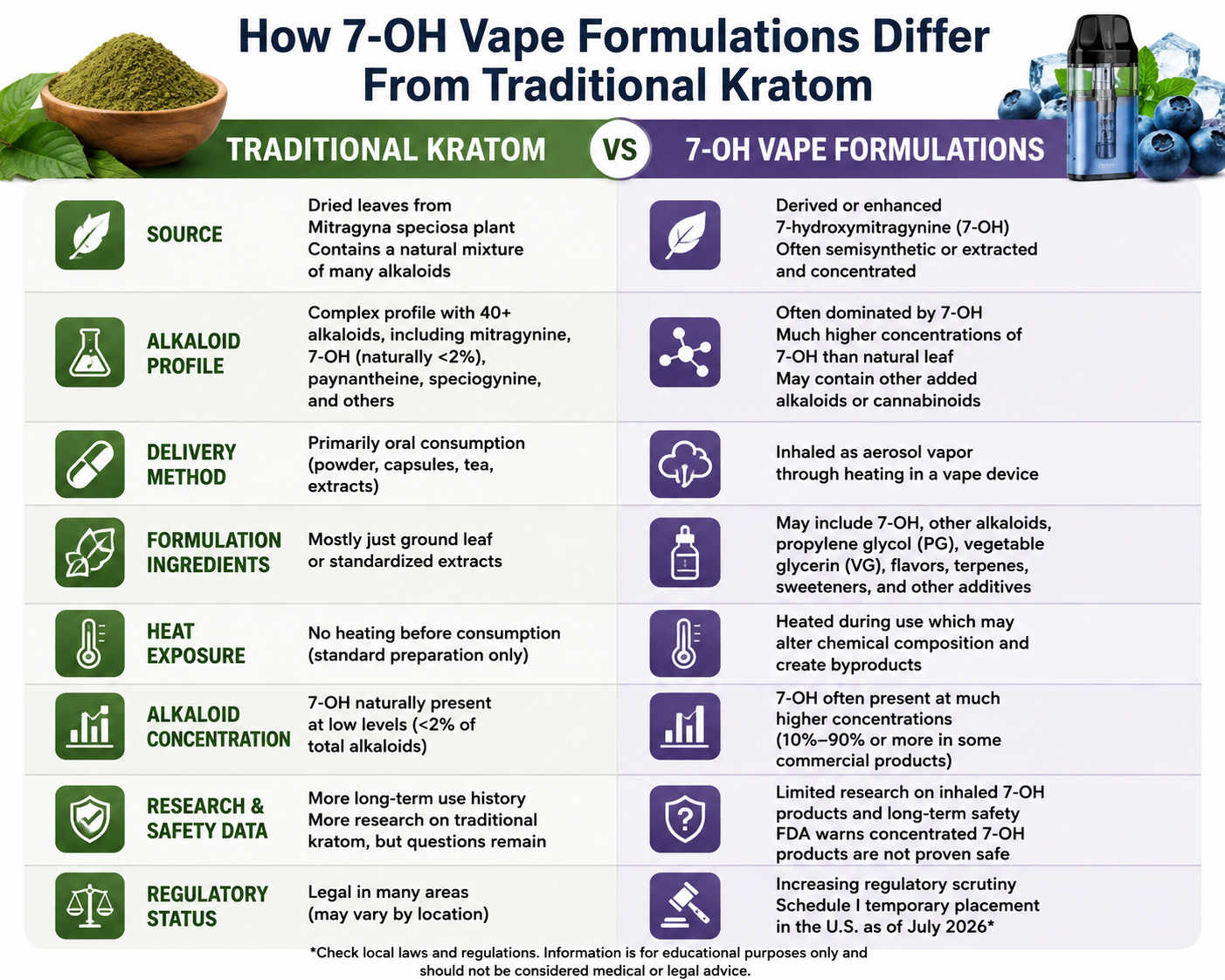
Kratom (Mitragyna speciosa) is a plant containing numerous naturally occurring alkaloids, with mitragynine and 7-hydroxymitragynine (7-OH) among the most extensively studied. Traditional kratom is usually encountered as dried leaf, powder, tea, capsules, or botanical extracts.
7-OH vape formulations represent a substantially different product format. They combine a concentrated alkaloid or alkaloid-containing extract with a formulation designed to generate an inhalable aerosol. Understanding the distinction requires looking at chemistry, concentration, delivery method, and research evidence.
Traditional Kratom Has a Complex Alkaloid Profile
Natural kratom leaf contains a mixture of alkaloids rather than a single isolated compound.
Mitragynine is generally the dominant alkaloid, while 7-OH occurs naturally at much lower concentrations. Other identified compounds include paynantheine, speciogynine, speciociliatine, and several additional minor alkaloids.
The proportions can vary according to plant genetics, geographic origin, growing conditions, maturity, harvesting, drying, and processing. As a result, two botanical kratom samples can have noticeably different chemical profiles.
7-OH Products Are More Concentrated
One of the biggest differences between traditional kratom and modern 7-OH formulations is concentration.
The FDA describes naturally occurring 7-OH as a minor constituent of kratom, generally representing less than 2% of the total alkaloid content of natural leaf material. Some commercial products, however, are specifically formulated to contain substantially higher concentrations.
This means a concentrated 7-OH product should not be assumed to have the same chemical profile as traditional kratom leaf.
Recent analytical research has also identified commercial products with 7-OH concentrations substantially above those expected in natural kratom.
The Delivery Method Is Different
Traditional kratom products are generally consumed orally.
Vape formulations use a completely different delivery route. A formulation is heated to generate an aerosol that is then inhaled.
This creates several variables that do not apply in the same way to powdered or encapsulated kratom, including:
-
Heating temperature
-
Heating duration
-
Device design
-
Aerosol formation
-
Particle characteristics
-
Thermal degradation
-
Inhaled exposure
Consequently, research on oral kratom cannot automatically be applied to inhaled 7-OH.
Formulation Ingredients Add Another Layer
Traditional powdered kratom primarily consists of processed plant material. A vape formulation, by contrast, may contain multiple ingredients selected to create a suitable liquid or aerosol.
Depending on the individual product, these can include 7-OH, other alkaloids, carrier materials, flavoring compounds, and additional active ingredients.
The composition is not necessarily standardized across manufacturers or product types.
A recent study examining commercially available nonswallowed kratom products found that vaping products could contain combinations of 7-OH, mitragynine extracts, mitragynine pseudoindoxyl, and intoxicating hemp cannabinoids.
This illustrates why the product label alone may not provide a complete chemical profile.
Heating Can Change the Chemistry
Another important difference involves thermal exposure.
Traditional kratom powder does not undergo the same rapid heating process immediately before consumption. Vape formulations are exposed to elevated temperatures that can potentially alter individual ingredients.
Researchers therefore need to investigate whether 7-OH remains stable during aerosol generation and whether other compounds appear after heating.
Studies of vaping chemistry more broadly have demonstrated that some ingredients can undergo thermal reactions and generate degradation products. However, results from other vaping systems should not automatically be interpreted as evidence that every 7-OH vape produces the same compounds.
Product-specific aerosol testing is needed.
Alkaloid Profiles Can Be Very Different
Traditional kratom contains a broad mixture of naturally occurring alkaloids.
A concentrated 7-OH formulation may instead emphasize one particular compound, producing a much narrower or substantially altered alkaloid profile.
This difference is scientifically important because the biological properties of a botanical mixture cannot necessarily be predicted from the behavior of one isolated alkaloid.
For example, 7-OH has demonstrated substantially greater activity at the mu-opioid receptor than mitragynine in laboratory research.
Therefore, traditional kratom research should not automatically be used to characterize concentrated 7-OH products.
Analytical Testing Becomes Particularly Important
Chemical analysis can help researchers determine what a formulation actually contains.
Common analytical techniques include HPLC, LC-MS, and mass spectrometry. These methods can identify and quantify individual alkaloids and potentially detect contaminants or degradation products.
Recent research has found inconsistencies between labeled and measured 7-OH concentrations in some commercial products. Researchers have also identified additional compounds that may result from chemical modification or oxidation.
These findings demonstrate why batch-specific testing can be useful when evaluating concentrated formulations.
Research on Safety Is Not Equivalent
The available research also differs between traditional kratom and concentrated 7-OH products.
Kratom has been studied for decades, although important questions about long-term effects and safety remain. Concentrated 7-OH products are a much newer development, and research specifically examining their formulation and inhaled exposure is more limited.
The FDA has expressed significant concerns about concentrated 7-OH products and states that they have not been demonstrated to be safe or effective for any use.
Vaping introduces additional uncertainty because inhalation can expose the respiratory system to both the active compound and other components of the aerosol.
Regulatory Differences
Regulatory treatment can also differ between traditional kratom and concentrated 7-OH products.
In July 2026, the FDA reported that the DEA had initiated a temporary scheduling process involving 7-OH above a proposed concentration threshold, alongside several synthetic kratom-related compounds.
Because laws and regulations can vary between jurisdictions and may change over time, the legal status of a particular product should be checked using current official sources.
Final Thoughts
The main difference between traditional kratom and 7-OH vape formulations is that they are not simply two versions of the same product.
Traditional kratom is a botanical material containing a diverse mixture of naturally occurring alkaloids. A 7-OH vape may contain a concentrated amount of a particular alkaloid alongside carrier materials, flavoring compounds, and other ingredients, and it introduces an inhalation route that involves heating.
These differences affect how researchers should evaluate the products.
Rather than assuming that findings from traditional kratom apply directly to 7-OH vaping, researchers need to consider alkaloid concentration, formulation chemistry, device characteristics, aerosol composition, exposure route, and available toxicological evidence.
As research develops, product-specific analytical testing and controlled studies will be essential for understanding how these increasingly distinct kratom-related formats compare.

 Arabic
 French
 Spanish
 Portuguese
 Deutsch
 Turkish
 Dutch
Dutch
 Italiano
 Russian
 Romaian
 Portuguese (Brazil)
 Greek
Greek
 Bengali