


The Critical Role of Experienced M&A Advisors During Due Diligence
Mergers and acquisitions involve far more than agreeing on a purchase price. Once a buyer and seller move forward with a potential transaction, one of the most important stages begins: due diligence.
Due diligence is the process of reviewing a company's financial, operational, legal, and commercial information before a transaction is completed. For business owners, this stage can be demanding, time-consuming, and sometimes stressful. Buyers want to understand exactly what they are acquiring, while sellers want to maintain momentum and protect the value they have built.
This is where experienced M&A Advisors can play a critical role.
From preparing documentation to managing communication between parties, M&A advisors help organize the process and address issues that could potentially delay or disrupt a transaction.
Understanding the Due Diligence Process
Due diligence allows a buyer to evaluate the risks and opportunities associated with a business.
Depending on the transaction, buyers may review:
-
Financial statements and tax records
-
Revenue and profitability trends
-
Customer and supplier agreements
-
Employee information
-
Legal contracts
-
Intellectual property
-
Operational processes
-
Technology systems
-
Market and competitive information
The level of detail can be significant. Buyers may ask hundreds of questions and request large amounts of supporting documentation.
Without proper organization, responding to these requests can become overwhelming for business owners and management teams.
Preparing the Business Before Due Diligence
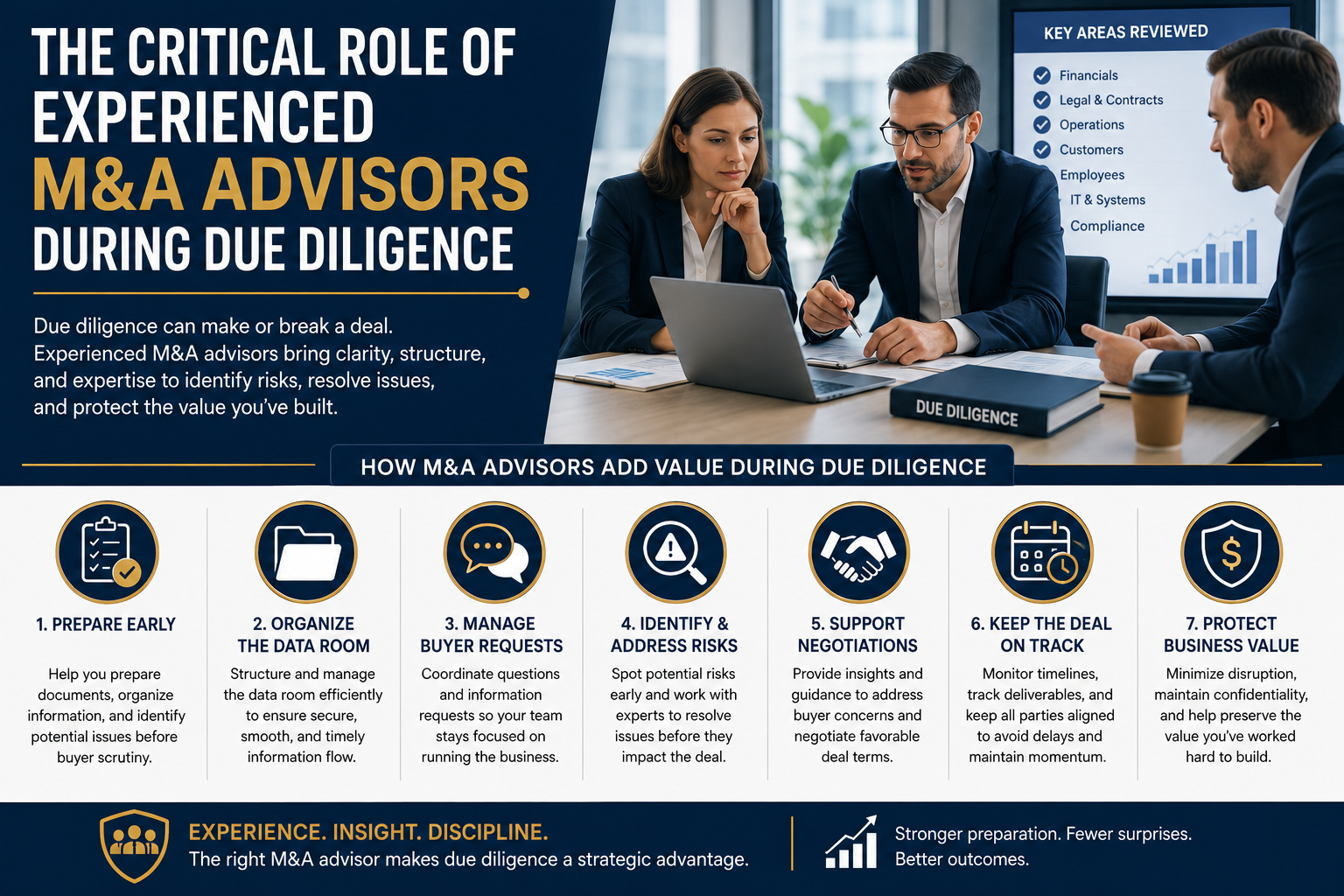
One of the most valuable contributions of experienced M&A Advisors is helping businesses prepare before the due diligence process begins.
Preparation may involve reviewing financial information, organizing important documents, identifying potential risks, and ensuring that key information is available when requested.
A well-prepared business can often respond more efficiently to buyer requests. This helps maintain momentum and demonstrates professionalism.
Preparation can also reduce the likelihood of unexpected issues appearing late in the transaction.
For example, if inconsistencies exist in financial reporting or important contracts are missing, identifying these issues early provides an opportunity to address them before they become major concerns for a buyer.
Organizing the Data Room
Most modern M&A transactions use a secure virtual data room to organize and share confidential information.
The data room may contain financial statements, legal documents, contracts, operational information, employee records, and other important materials.
M&A advisors can help structure the information in a logical way, making it easier for authorized buyers and their advisors to review.
A well-organized data room can improve efficiency and reduce confusion during the transaction.
It also helps sellers maintain greater control over sensitive information.
Managing Buyer Requests
During due diligence, buyer questions can arrive quickly and frequently.
Management teams may need to provide explanations, supporting documents, and detailed information about business operations.
Experienced advisors help coordinate these requests and establish a structured process for responding.
Instead of allowing requests to interrupt the daily operations of the business, advisors can prioritize questions and coordinate with the appropriate members of the management team.
This allows business owners to remain focused on running the company while the transaction process continues.
Identifying and Addressing Potential Risks
Due diligence is designed to uncover potential risks.
These risks may involve customer concentration, legal disputes, financial reporting, employee retention, contracts, or operational dependencies.
Discovering a problem does not necessarily mean a transaction will fail. However, how the issue is handled can significantly affect the outcome.
Experienced M&A advisors help business owners understand the importance of identified issues and work with other professionals, such as attorneys and accountants, to develop appropriate responses.
Proactively addressing concerns can help maintain buyer confidence and reduce the risk of last-minute surprises.
Supporting Communication and Negotiations
Due diligence often leads to additional negotiations.
A buyer may discover information that affects their view of valuation or deal structure. They may request changes to the purchase agreement, working capital adjustments, or other transaction terms.
M&A advisors provide guidance during these discussions and help business owners evaluate the potential impact of proposed changes.
Their experience can be particularly valuable when complex issues arise.
By acting as a central point of coordination, advisors help maintain communication between the buyer, seller, attorneys, accountants, and other professionals involved in the transaction.
Keeping the Transaction on Track
A successful transaction requires careful management of deadlines and responsibilities.
Due diligence can involve multiple teams working simultaneously, each with different requests and timelines.
M&A advisors help create structure around the process by tracking outstanding requests, coordinating responses, and monitoring progress toward important milestones.
This project-management role can be essential for keeping the transaction moving toward closing.
Delays can create uncertainty and potentially increase the risk of losing momentum. A well-managed process helps both parties stay focused on completing the transaction.
Protecting Business Value During the Process
One of the biggest concerns for sellers is protecting the value of their business throughout due diligence.
A company's financial performance can change during the sale process. If management becomes distracted by transaction-related demands, business operations may suffer.
Experienced advisors help reduce this pressure by managing many aspects of the process and allowing leadership teams to remain focused on customers, employees, and day-to-day operations.
Maintaining strong business performance during due diligence can reinforce buyer confidence and support the value of the transaction.
Conclusion
Due diligence is one of the most important and challenging stages of any merger or acquisition. It requires detailed preparation, organized communication, and careful management of confidential information.
Experienced M&A Advisors help business owners navigate this process by preparing documentation, organizing data rooms, managing buyer requests, identifying potential risks, and coordinating communication between all parties.
Their role extends beyond financial advice. They help bring structure and discipline to a complex process while allowing business owners to remain focused on running their companies.
For any business entering a merger or acquisition transaction, strong preparation and experienced advisory support can make due diligence more efficient, reduce unnecessary surprises, and help keep the deal moving toward a successful closing.
For more details visit site - http://www.plainsamericacapital.com/

 English
 Arabic
 French
 Spanish
 Portuguese
 Deutsch
 Turkish
 Dutch
Dutch
 Italiano
 Russian
 Romaian
 Greek
Greek
 Bengali