


Can You Use Text Messages as Evidence in a Texas Family Court?
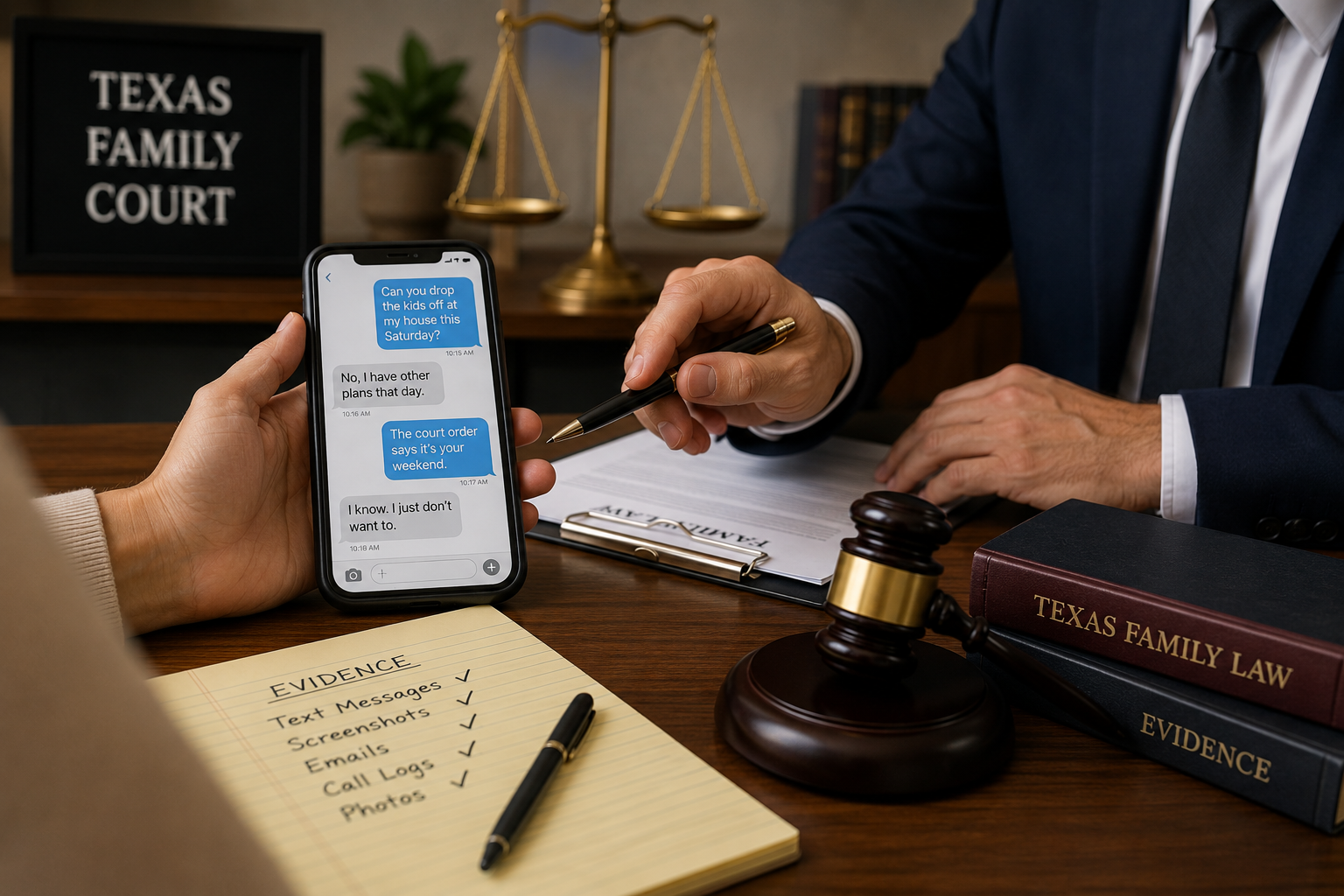
If you are wondering if you can use text messages as evidence in a Texas family court, the answer is potentially yes. Text messages, emails, social media messages, and other electronic communications may be relevant in divorce, child custody, child support, and enforcement cases. A San Antonio family law attorney can help determine whether your messages are relevant, authentic, complete, and appropriate to present to the court.
Texas family courts may consider many types of evidence when deciding disputes involving children, finances, parenting arrangements, and compliance with court orders. However, simply having a screenshot does not automatically mean the message will be admitted or given significant weight.
Are Text Messages Admissible in Texas Family Court?
Text messages can potentially be admitted as evidence if they satisfy the applicable rules of evidence.
Under Texas Rule of Evidence 901, evidence generally must be authenticated before it can be admitted. The person offering the evidence must provide enough information to support a finding that the item is what the person claims it is. The rule provides several examples of ways evidence may be authenticated, including testimony from someone with knowledge and distinctive characteristics of the evidence.
For text messages, this can mean showing that:
-
The message actually came from the person identified as the sender
-
The phone number or account belongs to that person
-
The conversation has not been altered
-
The message is relevant to an issue in the case
-
The evidence is presented in an appropriate form
Therefore, a text message can be useful evidence, but its authenticity and context matter.
What Types of Text Messages Can Be Relevant?
The usefulness of a text message depends on the facts of the case.
In a child custody case, relevant messages might discuss:
-
Missed visitation
-
Pickup and drop-off arrangements
-
Parenting schedules
-
School-related decisions
-
Medical appointments
-
Communication about the child's needs
-
Threats or inappropriate behavior
-
Refusal to follow a custody order
In a divorce case, messages might concern:
-
Property division
-
Financial accounts
-
Marital debts
-
Hidden assets
-
Business interests
-
Agreements between spouses
-
Spousal support
Text messages may also become relevant in child support enforcement or other post-divorce proceedings when they help establish what occurred or what a parent agreed to do.
Are Screenshots of Text Messages Enough?
Not always.
A screenshot may show the contents of a conversation, but opposing counsel may question whether it is complete, authentic, or accurately represents the original conversation.
For example, a screenshot could potentially leave out:
-
Earlier messages
-
Later responses
-
The identity of the sender
-
The date or time
-
Relevant attachments
-
The surrounding conversation
A complete conversation can provide much more context than a single isolated message.
This is why you should preserve the original messages whenever possible rather than relying exclusively on screenshots.
How Do You Authenticate Text Messages?
Authentication is one of the most important considerations when using electronic communications as evidence.
Texas Rule of Evidence 901 requires evidence sufficient to support a finding that the item is what the party claims it is. The rule allows authentication through testimony from a witness with knowledge, among other methods.
Depending on the circumstances, authentication of text messages could involve evidence such as:
-
The recipient's testimony
-
The sender's phone number
-
The sender's admissions
-
Information contained in the conversation
-
Circumstances connecting the message to the alleged sender
-
Other evidence establishing who created or sent the communication
The appropriate method depends on the specific circumstances of the case.
Why Context Matters With Text Messages
A single text message can be misleading if it is taken out of context.
For example, imagine a parent sends:
“Fine, you can keep him this weekend.”
Without the earlier messages, the statement could be interpreted in several ways.
Perhaps the parent was responding to an emergency. Maybe the message referred only to one weekend. Or perhaps the parents had already agreed to a schedule change.
A complete conversation may provide important context.
For this reason, avoid selecting only the messages that support your position while ignoring messages that provide additional context. Your attorney can help determine which portions of a conversation may be relevant.
Can Text Messages Help in a Child Custody Case?
Yes, potentially.
Child custody disputes often involve disagreements about parenting responsibilities, communication, possession and access, and the child's best interests.
Text messages may help establish a pattern of conduct when they contain direct statements about relevant events.
For example, messages might document:
-
A parent refusing scheduled possession
-
Repeated late pickups
-
Changes to agreed parenting arrangements
-
Discussions about school or medical care
-
A parent's willingness or refusal to cooperate
-
Statements concerning the child's living arrangements
Espronceda Law handles child custody disputes, including modification and enforcement of existing custody orders, and emphasizes presenting evidence and motions on behalf of clients.
However, text messages are only one type of evidence. The court may consider other relevant evidence and the overall circumstances of the case.
Can Text Messages Prove a Custody Order Violation?
They potentially can help document a violation, but a message alone does not automatically prove that a violation occurred.
Suppose a custody order requires a child to be returned at a particular time. If one parent sends a message saying, “I'm not bringing her back tonight,” that communication could potentially be relevant to an enforcement proceeding.
Texas law also specifically addresses preservation of electronic information in divorce proceedings. Temporary orders may prohibit parties from destroying, disposing of, or altering relevant emails, text messages, video messages, chat messages, or other electronically stored information.
This makes it important to preserve potentially relevant communications rather than deleting them.
Can You Use Text Messages in a Divorce Property Dispute?
Text messages can also be relevant to financial disputes.
For example, a conversation might contain statements about:
-
A bank account
-
A business
-
A property transfer
-
A debt
-
A financial agreement
-
A purchase
-
Money transferred to another person
However, a text message does not necessarily establish ownership or entitlement to property by itself.
Financial records, account statements, deeds, tax documents, business records, and other evidence may be necessary to establish the larger financial picture.
What If Your Ex Deletes the Messages?
Do not panic if a relevant conversation has been deleted from your phone.
Depending on the circumstances, other copies or forms of evidence may exist. The other person may still possess the conversation, or the information may exist through another device, account, backup, or discovery process.
The appropriate method for obtaining the information depends on the case and the applicable procedural rules.
Importantly, do not attempt to access your ex's phone, email, cloud account, or private messages without authorization. Instead, tell your attorney what happened and allow them to determine what lawful discovery options may be available.
Should You Save Text Messages Before Going to Court?
Yes, if you believe the communications may be relevant.
Consider preserving:
-
The complete conversation
-
The phone number or contact information
-
Dates and times
-
Relevant attachments or photographs
-
Related emails or communications
-
The original messages on your device
-
A chronological record explaining the circumstances
Avoid editing or altering the original messages.
It can also be helpful to maintain a written timeline explaining what happened before and after important communications.
Can You Use Text Messages Without a Lawyer?
You may be able to present evidence without an attorney, but family-law evidence can become complicated when the other side challenges authenticity, relevance, completeness, or admissibility.
A lawyer can help determine:
-
Which messages are relevant
-
How the messages should be preserved
-
Whether additional evidence is necessary
-
How the messages may be authenticated
-
Whether discovery is appropriate
-
How the evidence supports your legal position
Espronceda Law handles divorce, child custody, child support, property division, enforcement, mediation, and litigation in San Antonio.
What Should You Avoid Doing With Text Evidence?
If you plan to use text messages in a family-law case, avoid:
-
Deleting relevant messages
-
Altering screenshots
-
Editing conversations
-
Taking messages out of context
-
Creating misleading screenshots
-
Accessing another person's private account without permission
-
Sending threatening messages to your ex
-
Encouraging your children to create messages for court
Continue communicating appropriately and assume that communications may eventually become part of the case.
Frequently Asked Questions
1. Can text messages be used in a Texas custody case?
Potentially. Relevant text messages may be considered if they satisfy applicable evidentiary requirements, including authentication. Their relevance and context can also affect how useful they are.
2. Are screenshots of texts admissible in Texas family court?
They may be, but a screenshot is not automatically admissible simply because it exists. The party offering it may need to establish authenticity and address questions about completeness and context. Texas Rule of Evidence 901 governs authentication.
3. Can deleted text messages be recovered for a family court case?
Sometimes relevant communications may still exist through other devices, backups, accounts, or lawful discovery. Do not attempt unauthorized access to another person's electronic accounts.
4. Can text messages prove parental alienation?
Text messages may provide evidence relevant to a parent's conduct or communications, but a court generally evaluates the broader facts and evidence rather than relying automatically on one message or screenshot.
5. Should I show my lawyer all my text messages?
If the messages may be relevant, preserving the complete conversation and providing it to your attorney can help them evaluate the evidence. Do not selectively delete or alter messages that could be relevant to the case.
Final Thoughts
Text messages can be valuable evidence in a Texas family-law case, particularly when they document communications about custody, visitation, child support, finances, or compliance with court orders. However, relevance alone does not guarantee admissibility. Authentication, completeness, context, and the applicable Texas Rules of Evidence can all matter.
If you are involved in a custody or divorce dispute in San Antonio, preserving potentially relevant electronic communications and discussing them with an experienced family-law attorney can help you understand how they may fit into your case. Espronceda Law provides family-law representation involving divorce, child custody, child support, enforcement, and related disputes in San Antonio.

 English
 Arabic
 French
 Spanish
 Portuguese
 Deutsch
 Turkish
 Dutch
Dutch
 Russian
 Romaian
 Portuguese (Brazil)
 Greek
Greek
 Bengali