


EPCG Scheme and GST Planning for Machinery Investment: What Manufacturers Should Know
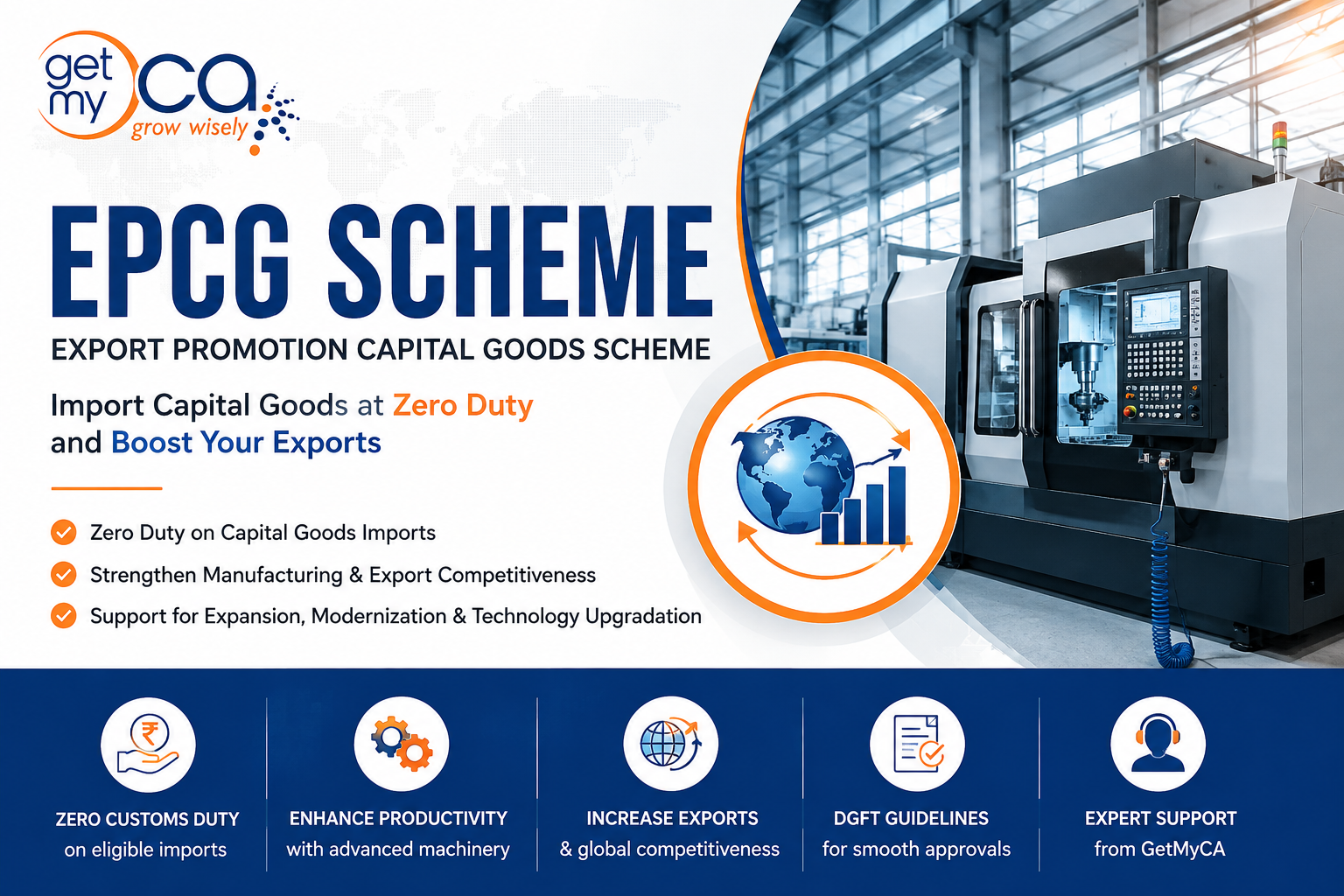
Machinery investment is an important part of manufacturing growth. Businesses may purchase new equipment to increase production capacity, improve automation, upgrade technology, or manufacture products that meet international market requirements.
For export-oriented manufacturers, the EPCG Scheme may be relevant when planning eligible capital goods procurement. At the same time, GST implications connected with machinery purchases and business transactions should be reviewed separately under the applicable GST framework.
Why EPCG Planning Matters Before Machinery Purchase
EPCG should ideally be evaluated before a manufacturer completes a major machinery transaction.
Important areas to review may include:
- Type and specification of machinery
- Capital goods eligibility
- Procurement structure
- Applicable DGFT procedure
- Expected customs duty benefit
- Existing export performance
- Future export projections
- Export obligation requirements
- Installation and documentation requirements
Early assessment helps businesses understand both the potential benefit and the compliance responsibility attached to the authorization.
EPCG Is More Than a Duty Benefit
One common mistake is to evaluate EPCG only on the basis of immediate customs duty savings.
Manufacturers should also assess whether their business has sufficient export potential to meet the applicable export obligation. Future production capacity, overseas demand, existing customers, product competitiveness, and export timelines should therefore form part of the decision.
A machinery investment should remain commercially sensible even after considering the compliance responsibilities associated with the scheme.
GST Treatment Should Be Reviewed Separately
GST and EPCG operate under different regulatory frameworks.
The GST impact of a machinery purchase may depend on factors such as input tax credit eligibility, the nature of outward supplies, transaction structure, and the relevant provisions applicable to the business.
Businesses researching a GST Refund should not assume that an EPCG transaction automatically results in a GST refund. Refund eligibility needs to be evaluated independently according to the applicable GST provisions and the specific facts of the transaction.
Importance of Input Tax Credit Review
When machinery is purchased domestically or GST is otherwise involved in the transaction, businesses should verify the tax treatment carefully.
A GST review may include:
- Tax invoice accuracy
- Input tax credit eligibility
- Supplier reporting
- GST return reconciliation
- Nature of business supplies
- Export and domestic turnover
- Applicable refund category, if any
Input tax credit and cash refund are separate concepts, so the availability of credit should not automatically be interpreted as refund eligibility.
Documentation for Machinery Transactions
Large capital investments usually involve multiple documents. Maintaining proper records from the beginning can make future compliance easier.
Businesses may need to maintain:
- EPCG authorization records
- Machinery purchase orders
- Supplier invoices
- Import documentation
- Customs records
- GST invoices
- Payment proofs
- Installation documents
- Export invoices
- Shipping records
- Relevant DGFT filings
- GST reconciliation records
The exact documents required will depend on the nature of the machinery transaction and applicable compliance process.
How Export Performance Affects EPCG Planning
Before using EPCG, businesses should prepare realistic export projections.
Manufacturers can consider:
- Previous export turnover
- Current international orders
- New overseas markets
- Production capacity after machinery installation
- Expected product demand
- Export realization timelines
Overestimating future exports can create unnecessary compliance pressure. Conservative and realistic planning is generally more useful than relying on aggressive projections.
Machinery Modernization and Business Growth
Advanced machinery can contribute to several operational improvements, including:
- Higher production capacity
- Better automation
- Improved product consistency
- Reduced manufacturing time
- Technology modernization
- Better ability to serve export markets
However, tax or duty benefits should support the investment decision rather than becoming the only reason for purchasing machinery.
Common Mistakes to Avoid
Manufacturers should avoid:
- Finalizing machinery before reviewing EPCG requirements
- Assuming EPCG automatically creates GST refund eligibility
- Confusing input tax credit with a cash refund
- Ignoring export obligation implications
- Making unrealistic export projections
- Maintaining incomplete transaction records
- Mixing DGFT and GST compliance requirements
Keeping both regulatory areas separate can make compliance planning clearer.
EPCG and GST Should Be Evaluated Together, But Separately
For a large machinery investment, it can be useful to examine customs, DGFT, GST, financing, and export implications as part of one commercial project.
However, each benefit should still be tested under its own legal framework.
EPCG eligibility does not automatically determine GST treatment, and GST eligibility does not determine EPCG compliance. Businesses should therefore assess each area independently while preparing the overall investment plan.
Conclusion
EPCG can be relevant for eligible exporters planning significant machinery investments, while GST considerations can affect input tax credit, cash flow, and tax compliance connected with the same project.
Manufacturers should evaluate EPCG authorization requirements, export capability, machinery eligibility, GST treatment, documentation, and transaction structure before committing to a major capital purchase. Proper planning can make both the investment and ongoing compliance more manageable.

 Arabic
 French
 Spanish
 Portuguese
 Deutsch
 Turkish
 Dutch
Dutch
 Italiano
 Russian
 Romaian
 Portuguese (Brazil)
 Greek
Greek
 Bengali