Introduction
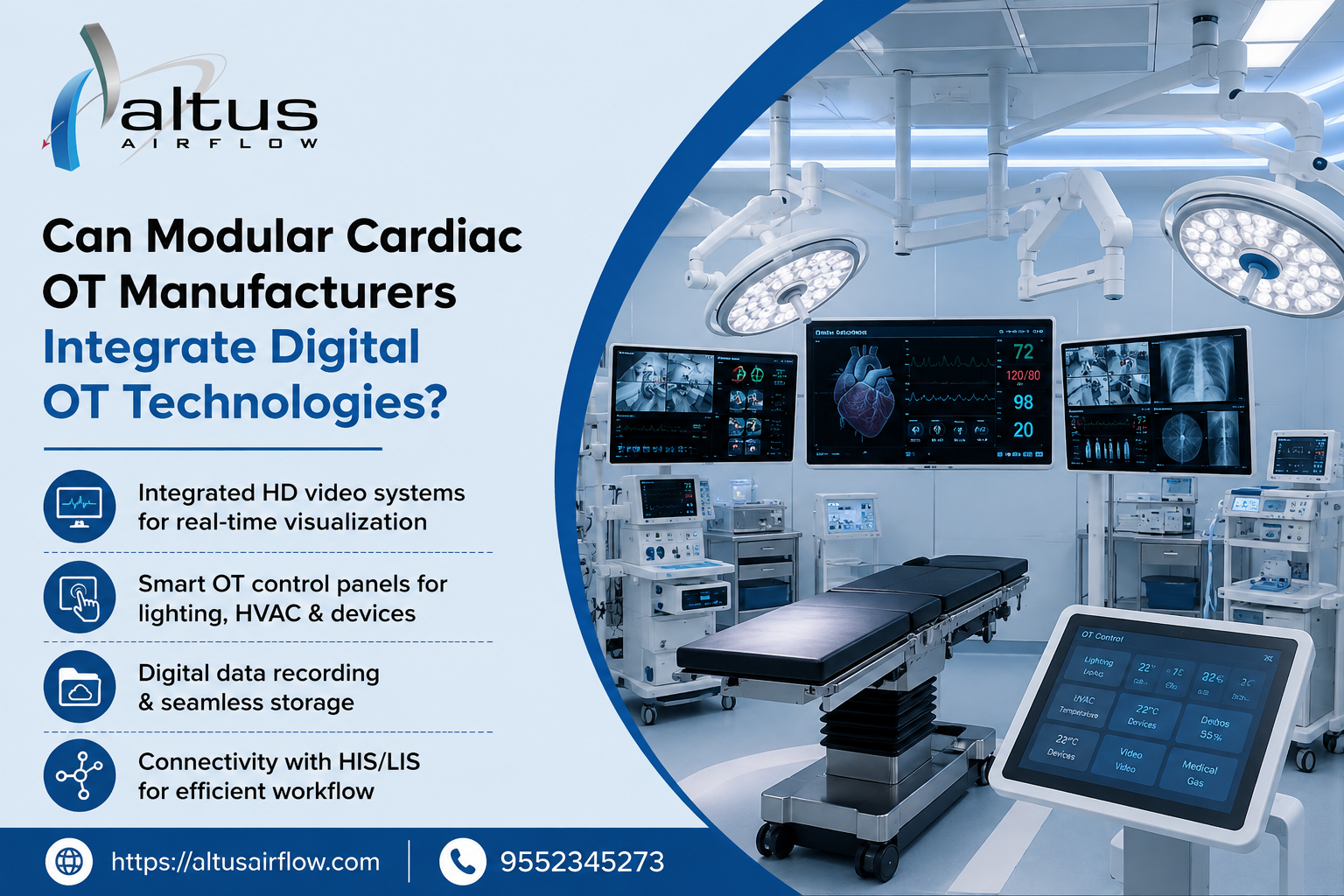
Modern cardiac surgery is increasingly supported by digital technologies that improve visualization, communication, documentation, equipment management, and operating-room coordination. As hospitals invest in advanced surgical infrastructure, the operating theatre itself is becoming more connected and intelligent. Modular Cardiac OT Manufacturers can integrate digital OT technologies into modular operating-room designs by coordinating digital systems with HVAC, electrical infrastructure, medical gases, lighting, ceiling systems, communication networks, and surgical equipment.
Digital integration is not simply about installing monitors or connecting devices. It involves planning the operating theatre as a coordinated environment where technology, infrastructure, clinical workflow, and patient-safety requirements work together. Altus Airflow focuses on specialized healthcare environments where technical infrastructure and controlled environmental systems need to be carefully coordinated.
A digitally enabled cardiac operating theatre can support real-time information access, integrated displays, equipment connectivity, video communication, environmental monitoring, and centralized control. However, the exact technologies incorporated depend on the hospital's clinical requirements, budget, infrastructure, cybersecurity policies, and applicable standards.
What Are Digital OT Technologies?
Digital operating-theatre technologies refer to systems that use digital communication, networking, automation, visualization, data management, and centralized controls to support clinical and operational activities.
Examples include:
- Digital surgical displays
- Integrated operating-room control systems
- Video routing systems
- Surgical recording
- Telemedicine capabilities
- Network-connected medical equipment
- Environmental monitoring
- Digital documentation
- Equipment integration
- Centralized room controls
- Real-time status monitoring
These technologies can be incorporated during the initial modular OT design or added later if suitable infrastructure has been provided.
Why Is Digital Integration Important in Cardiac Operating Theatres?
Cardiac procedures often involve multiple clinical teams and sophisticated equipment operating simultaneously.
A typical cardiac operating theatre may contain:
- Patient monitors
- Anesthesia equipment
- Surgical lights
- Electrosurgical units
- Perfusion equipment
- Imaging systems
- Surgical displays
- Medical communication systems
- Environmental monitoring equipment
Without proper integration, each system may operate independently, creating unnecessary complexity.
Digital integration can help organize information and improve access to relevant data.
How Can Digital Technologies Be Integrated Into a Modular OT?
Digital systems can be integrated at several levels, including infrastructure, communication, visualization, environmental monitoring, equipment connectivity, and room control.
The process usually starts during the design stage.
The project team can identify:
- Required digital equipment
- Network requirements
- Power requirements
- Data points
- Display locations
- Control interfaces
- Equipment connections
- Ceiling requirements
- Maintenance access
- Future expansion needs
Planning these requirements early helps avoid costly modifications later.
1. Integrated Operating-Room Control Systems
An integrated control system can bring multiple room functions into a centralized interface.
Depending on the selected system, users may be able to control or monitor:
- Room lighting
- Surgical lighting
- Displays
- Video sources
- Audio
- Environmental parameters
- Equipment status
The purpose is to reduce the need for staff to interact with multiple independent controls.
The exact level of automation depends on the system specification.
2. Digital Surgical Displays
Large digital displays are increasingly important in modern operating theatres.
They can present information from:
- Patient monitors
- Imaging systems
- Endoscopic cameras
- Surgical cameras
- Hospital information systems
- Other compatible devices
The display arrangement should be designed around the positions of the surgeon, anesthetist, assistants, and other staff.
3. Video Integration
Video integration can allow different sources to be routed to selected displays.
For example, a surgical camera feed could be displayed on multiple screens without requiring separate physical connections for every display.
Video integration may support:
- Surgical visualization
- Teaching
- Documentation
- Remote consultation
- Team communication
The system should be designed according to the hospital's clinical and technical requirements.
4. Surgical Image Recording
Digital recording systems can capture surgical video or images where clinically appropriate.
Potential applications include:
- Medical documentation
- Education
- Training
- Case review
- Research
- Clinical presentations
Hospitals should establish appropriate policies for recording, storage, access, privacy, and retention.
5. Telemedicine Integration
Digital operating rooms can support remote communication with specialists when appropriate.
A connected system may allow authorized personnel to communicate through:
- Live video
- Audio
- Digital images
- Surgical feeds
- Remote consultation platforms
This can be useful when specialist input is required without bringing additional personnel physically into the operating room.
The system should comply with hospital privacy and cybersecurity policies.
6. Digital Environmental Monitoring
Environmental monitoring is particularly important in controlled operating-room environments.
Digital sensors can monitor parameters such as:
- Temperature
- Relative humidity
- Differential pressure
- Air-handling status
- Filter status
- System alarms
Data can potentially be displayed locally or transmitted to a centralized building-management or facility-monitoring system.
7. HVAC Integration
HVAC is one of the most important systems to consider during digital OT planning.
Modern control systems can provide information about:
- Supply-air conditions
- Return-air conditions
- Temperature
- Humidity
- Pressure
- Fan operation
- Filter condition
- Alarm status
Integration can allow technical teams to identify abnormalities more quickly.
However, HVAC automation should always be designed with appropriate manual controls and fail-safe strategies.
8. Digital Pressure Monitoring
Operating theatres may use differential-pressure monitoring to help maintain the intended relationship between the theatre and adjacent areas.
A digital monitoring system can display pressure status and provide alerts when values move outside the defined range.
This can help facility teams identify:
- Door-related disturbances
- HVAC problems
- Unexpected pressure changes
- System failures
The monitoring strategy should follow the hospital's engineering and infection-control requirements.
9. Smart Lighting Controls
Digital lighting systems can provide more flexible control over operating-room illumination.
Depending on the equipment, staff may be able to adjust:
- General lighting
- Surgical-light intensity
- Ambient illumination
- Examination lighting
Some systems may also allow lighting scenes to be configured for different activities.
For example, the room may use one lighting configuration for preparation and another during surgery.
10. Digital Equipment Connectivity
Many modern medical devices can communicate digitally.
Connecting compatible equipment can help create a more coordinated operating environment.
Potentially connected systems include:
- Patient monitors
- Anesthesia machines
- Imaging equipment
- Surgical displays
- Video systems
- Documentation systems
The connection architecture should be planned carefully to prevent network conflicts and maintain reliable operation.
11. Centralized Information Display
A digital operating theatre can use centralized displays to present relevant information.
Depending on the system, displays may show:
- Patient information
- Imaging
- Vital signs
- Surgical video
- Room status
- Environmental parameters
The information shown should be appropriate to each user's role.
12. Integration With Hospital Information Systems
Where technically and clinically appropriate, the operating theatre may connect with hospital information systems.
This can potentially facilitate access to:
- Patient records
- Procedure schedules
- Medical images
- Surgical documentation
- Case information
Integration should be performed according to the hospital's information-technology architecture and data-security requirements.
13. Network Infrastructure
Digital OT technology requires dependable network infrastructure.
Planning may include:
- Data outlets
- Network switches
- Structured cabling
- Fiber-optic connections
- Wireless connectivity
- Server connections
- Equipment-specific networks
Network equipment should be appropriately located and protected.
Critical systems may require redundancy depending on their function.
14. Cybersecurity Considerations
As more equipment becomes connected, cybersecurity becomes increasingly important.
Connected operating-room devices may exchange sensitive clinical data.
Hospitals should consider:
- User authentication
- Access control
- Network segmentation
- Secure communication
- Software updates
- Device management
- Audit trails
- Backup systems
Digital integration should be coordinated with the hospital's IT and cybersecurity teams.
15. Reliable Power Supply
Digital equipment requires stable electrical infrastructure.
The electrical design may need to accommodate:
- Displays
- Network equipment
- Control systems
- Cameras
- Recording systems
- Computers
- Environmental sensors
Critical systems may require appropriate emergency or UPS-supported power.
The classification of loads should be determined by qualified electrical engineers and the hospital's requirements.
16. UPS Integration
Uninterruptible power supplies can help protect selected digital equipment from short-duration power interruptions.
Depending on the system, UPS support may be considered for:
- Control systems
- Network equipment
- Displays
- Monitoring equipment
- Recording systems
The appropriate backup strategy depends on the criticality of each system.
17. Digital Audio Systems
Audio systems can also form part of a connected operating theatre.
Potential uses include:
- Internal communication
- Remote consultation
- Training
- Announcements
- Video-conference communication
Audio controls should be simple enough to operate without interfering with clinical activities.
18. Surgical Camera Integration
Surgical cameras can provide high-quality images of the operative field.
When integrated with the digital OT infrastructure, camera feeds can potentially be sent to:
- Multiple displays
- Recording systems
- Teaching areas
- Remote consultation systems
Camera mounting and cable routing should be coordinated during the modular installation.
19. Digital Documentation
Digital documentation can reduce dependence on separate recording systems.
Depending on hospital procedures, the OT may support electronic documentation of:
- Procedure details
- Equipment usage
- Surgical images
- Environmental readings
- Maintenance information
The documentation system should be integrated with appropriate hospital software where feasible.
20. Equipment Status Monitoring
Connected equipment can potentially provide status information to authorized staff.
For example, a centralized interface may show whether selected systems are:
- Active
- Standby
- Offline
- Experiencing an alarm
- Due for maintenance
Such functionality can help technical teams respond more efficiently.
21. Digital Maintenance Monitoring
Technology can also assist facility-management teams.
Digital monitoring may provide information about:
- Filter replacement
- HVAC alarms
- Equipment faults
- Lighting status
- Environmental deviations
- Preventive maintenance schedules
This can support a more proactive maintenance approach.
22. Integration With Building Management Systems
Some operating-room systems can communicate with a building management system.
This can provide centralized visibility of selected infrastructure parameters.
Potentially monitored systems include:
- HVAC
- Electrical systems
- Environmental sensors
- Alarms
- Energy consumption
However, operating-room systems should be integrated carefully so that building-management functions do not compromise clinical safety or critical room operations.
23. Digital Alarm Management
Modern operating rooms contain numerous alarms.
An integrated system can potentially organize alarms and provide centralized notifications.
Examples include:
- HVAC alarms
- Medical gas alarms
- Equipment alarms
- Power alarms
- Environmental alarms
Alarm priorities should be carefully configured so that important alerts are not lost among less-critical notifications.
24. Touchscreen Interfaces
Touchscreen control panels can simplify interaction with multiple systems.
A properly designed interface may allow authorized users to access:
- Lighting controls
- Video sources
- Audio
- Room settings
- Environmental information
The interface should be intuitive and positioned where it is easily accessible without interfering with clinical activities.
25. Voice or Hands-Free Controls
Some advanced digital environments may incorporate hands-free control technologies.
Potential applications include:
- Camera adjustment
- Display selection
- Lighting changes
- Information access
Such technologies should only be adopted when they provide a genuine clinical or operational benefit and meet the facility's safety and privacy requirements.
26. Digital Integration With Hybrid Operating Rooms
Cardiac surgery may sometimes take place in hybrid operating rooms that combine surgical and advanced imaging capabilities.
These rooms have additional integration requirements.
They may need coordination between:
- Imaging systems
- Surgical displays
- Video routing
- Operating-room controls
- Surgical lights
- Medical equipment
- Networking
The infrastructure should be planned around the movement and operating requirements of large imaging equipment.
27. Integration With Medical Pendants
Medical pendants can provide power, medical gases, data, and equipment support.
Digital devices may require data connections through these systems.
The pendant layout should be coordinated with:
- Surgical table
- Anesthesia workstation
- Equipment carts
- Surgical team movement
- Ceiling airflow
- Surgical lighting
This prevents unnecessary cable exposure and workflow obstacles.
28. Ceiling Coordination
Digital technology often requires ceiling-mounted components.
These may include:
- Cameras
- Displays
- Sensors
- Wireless access points
- Surgical lights
- Medical pendants
At the same time, the ceiling may contain:
- HEPA filters
- Air diffusers
- Return-air grilles
- Fire detectors
- Sprinklers
Therefore, a coordinated ceiling plan is essential.
29. Cable Management
Poor cable management can compromise the operating-room environment.
Unorganized cables may:
- Obstruct staff
- Collect dust
- Create trip hazards
- Make cleaning difficult
- Complicate maintenance
Modular wall and ceiling systems can be planned with concealed or organized service routes where appropriate.
30. Future-Proofing the Digital OT
Technology changes rapidly.
A system that meets today's requirements may need upgrades in the future.
Future-proofing can include:
- Additional data pathways
- Spare electrical capacity
- Flexible mounting points
- Modular service routes
- Upgradeable control systems
- Additional network capacity
This can reduce the need for major reconstruction when new technology is introduced.
31. Benefits of Digital OT Integration
A properly integrated digital operating theatre can provide several potential advantages.
Improved Information Access
Relevant information can be available where it is needed.
Better Communication
Video and audio systems can support communication between teams.
Centralized Controls
Multiple systems can be managed through coordinated interfaces.
Enhanced Documentation
Digital recording and documentation can support clinical records and education.
Environmental Visibility
Facility teams can monitor important room parameters.
Better Workflow
Reducing unnecessary equipment interaction can simplify certain activities.
Future Flexibility
Well-planned infrastructure can support future technology upgrades.
32. Challenges of Digital Integration
Digital technology also introduces challenges.
Initial Planning Complexity
Multiple systems must be coordinated from the beginning.
Cybersecurity
Connected devices require appropriate protection.
Compatibility
Different manufacturers' systems may not communicate seamlessly.
Maintenance
Digital systems require software and hardware support.
Staff Training
Users need to understand new interfaces and procedures.
System Dependence
Critical workflows should have appropriate backup procedures.
33. How Should Hospitals Plan Digital Integration?
Hospitals should begin by identifying clinical requirements rather than selecting technology based purely on features.
The planning process can include:
- Assessing clinical workflow
- Identifying required equipment
- Mapping data requirements
- Planning electrical capacity
- Designing network infrastructure
- Coordinating HVAC and environmental monitoring
- Selecting displays and controls
- Reviewing cybersecurity
- Establishing backup strategies
- Planning maintenance
- Testing integrations
- Training staff
This approach helps ensure that technology solves real operational needs.
34. Testing and Commissioning
Digital systems should be tested before the operating theatre becomes operational.
Testing may include:
- Display functionality
- Video routing
- Camera operation
- Network connectivity
- Audio systems
- Environmental monitoring
- Control interfaces
- Emergency power
- Alarm systems
- Equipment communication
Integrated testing should verify that connected systems work correctly together.
35. Staff Training
Technology is only useful when staff can operate it confidently.
Training may cover:
- Control-panel operation
- Display selection
- Video routing
- Recording
- Environmental monitoring
- Alarm response
- Basic troubleshooting
Technical and clinical staff may require different levels of training.
36. Maintenance of Digital Systems
Digital OT technologies require planned maintenance.
Maintenance can include:
- Hardware inspection
- Software updates
- Network checks
- Camera cleaning
- Display inspection
- Sensor calibration
- Backup testing
- Cybersecurity reviews
Maintenance schedules should follow manufacturer recommendations and hospital policies.
37. Importance of Professional Coordination
Integrating digital technology into a modular cardiac operating theatre requires collaboration between several disciplines.
These can include:
- Healthcare planners
- Architects
- HVAC engineers
- Electrical engineers
- IT professionals
- Medical equipment specialists
- Infection-control teams
- Clinical staff
- Modular OT specialists
Coordination helps ensure that digital systems do not interfere with clinical infrastructure.
38. What Should Be Included in the Project Documentation?
Documentation can include:
- System architecture
- Network diagrams
- Electrical drawings
- Equipment schedules
- Data-point layouts
- Control-system documentation
- HVAC integration details
- Installation records
- Testing reports
- Commissioning documents
- Maintenance instructions
Good documentation simplifies future upgrades and troubleshooting.
39. What Makes a Digital Cardiac OT Effective?
A successful digital operating theatre is not necessarily the one with the greatest number of technologies.
Instead, an effective system should be:
- Clinically useful
- Reliable
- Easy to operate
- Secure
- Maintainable
- Scalable
- Compatible with existing infrastructure
Technology should support the surgical team rather than add unnecessary complexity.
Conclusion
Digital technologies can be integrated into modular cardiac operating theatres when they are considered during the early planning and engineering stages. Displays, video systems, surgical cameras, integrated controls, environmental monitoring, network infrastructure, digital documentation, equipment connectivity, and communication technologies can all contribute to a more connected operating environment.
Successful integration requires much more than installing individual devices. Electrical systems, HVAC, medical gases, modular walls, ceilings, lighting, medical pendants, equipment, networking, cybersecurity, and maintenance access all need to be coordinated. Future expansion should also be considered because healthcare technology continues to evolve.
The most effective approach is to begin with clinical workflow and then build the technology infrastructure around genuine operational needs. Altus Airflow supports specialized healthcare environments where controlled airflow and integrated technical infrastructure are important considerations in modern operating-room projects.
With appropriate engineering, professional installation, testing, commissioning, and ongoing maintenance, digital technologies can become an integral part of a modern cardiac operating theatre without compromising the controlled environment required for complex surgical procedures.
FAQ Questions
1. Can Modular Cardiac OT Manufacturers integrate digital OT technologies?
Yes, Modular Cardiac OT Manufacturers can integrate digital OT technologies such as surgical displays, video routing, cameras, environmental monitoring, centralized controls, network infrastructure, digital documentation, and compatible medical equipment interfaces. The exact integration depends on the hospital's clinical requirements, technical infrastructure, cybersecurity policies, and project specifications.
2. What digital technologies can be integrated into a cardiac operating theatre?
Depending on the project, technologies can include surgical video systems, digital displays, operating-room control panels, environmental monitoring, equipment connectivity, telemedicine systems, digital recording, audio communication, and integration with selected hospital information systems.
3. Why is network infrastructure important in a digital operating theatre?
Network infrastructure allows compatible digital devices and systems to communicate. Adequate data connections, network capacity, security measures, and appropriate segmentation can support reliable operation of connected displays, cameras, monitoring systems, documentation platforms, and other digital technologies.
4. Can HVAC systems be connected to digital OT controls?
Yes, where appropriate, HVAC systems can provide digital monitoring and selected control functions. Temperature, humidity, pressure, airflow-related information, filter status, and system alarms can potentially be monitored through centralized interfaces or facility-management systems, depending on the design.
5. How can a digital cardiac operating theatre be prepared for future technology?
Future readiness can be supported by providing adequate electrical capacity, spare data pathways, flexible mounting locations, scalable network infrastructure, accessible service routes, upgradeable control systems, and sufficient maintenance access. Planning these provisions during initial construction can make future technology upgrades easier.



 English
 Arabic
 French
 Spanish
 Portuguese
 Deutsch
 Turkish
 Dutch
Dutch
 Italiano
 Russian
 Portuguese (Brazil)
 Greek
Greek
 Bengali