


10 Signs Your Business Needs Professional eCommerce Development Services
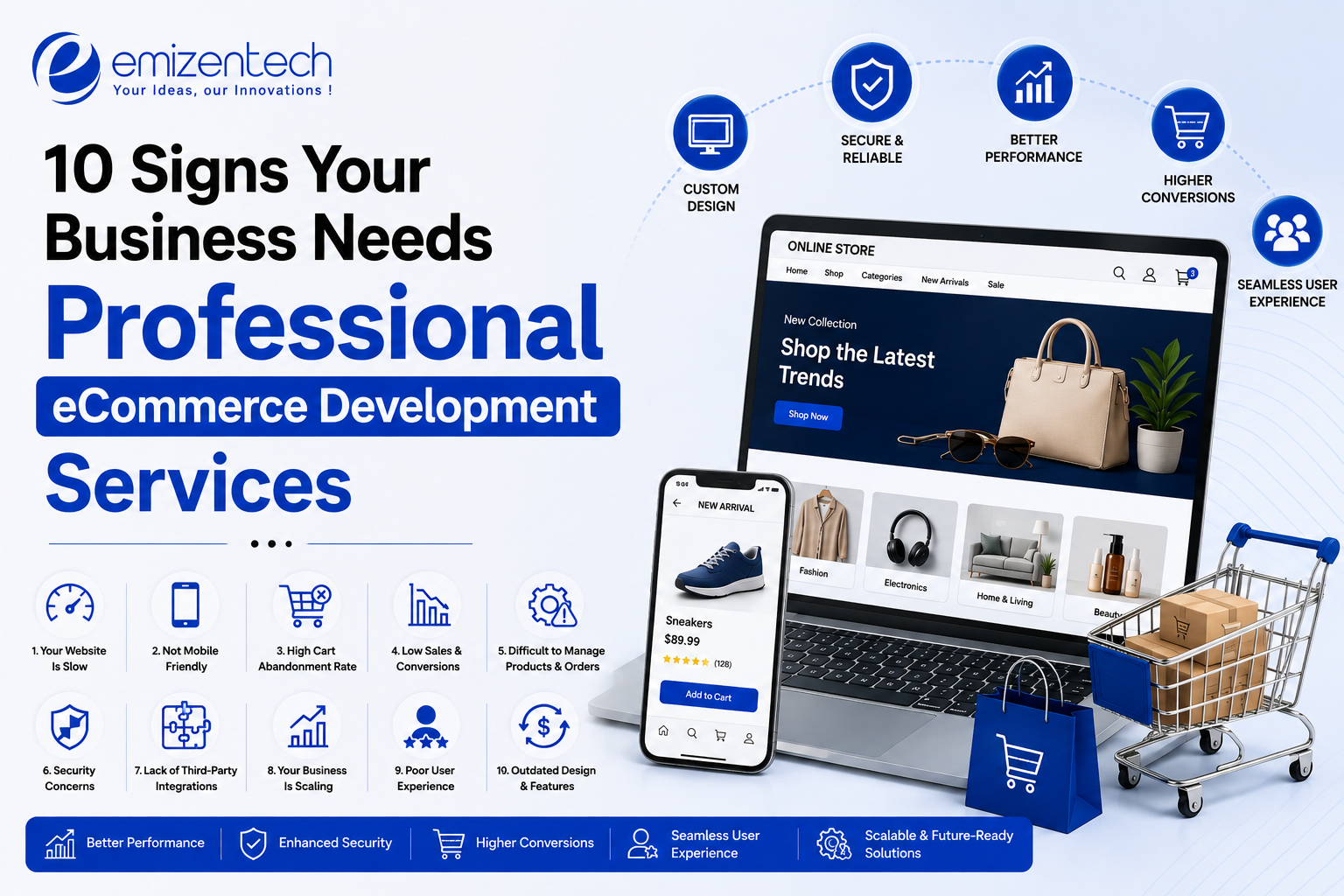
Running an online store today means competing with businesses that update their sites regularly, deliver fast browsing experiences, and make checkout simple. If your store feels slower or harder to manage than it should, the problem may not be your products. Technical limitations can gradually affect customer experience, operations, and sales.
Cart abandonment remains a major challenge for online retailers. Baymard Institute's research places the average documented online shopping cart abandonment rate at around 70%, showing how many shoppers leave before completing a purchase. For small and mid-sized businesses and growing direct-to-consumer brands, these problems can build gradually. A store that worked well at launch may struggle as traffic, catalog size, integrations, and customer expectations increase.
This article covers ten signs that your current ecommerce setup may be reaching its limits. It also explains the potential benefits of professional development and what to consider when evaluating a development partner.
What Is eCommerce Development?
eCommerce development refers to the technical work behind an online store, including its design, coding, integrations, functionality, and infrastructure. These elements determine how customers browse products, complete purchases, and interact with the business.
Many businesses begin with DIY platforms such as Shopify or Wix because templates and built-in features make launching relatively straightforward. For a small catalog and simple purchasing process, this can be enough.
The situation changes when a business needs functionality that standard templates cannot easily provide. Custom product configurations, advanced search, ERP integrations, complex pricing, specialized checkout workflows, or performance improvements may require professional technical development. The goal is not necessarily to build everything from scratch, but to create a setup that fits the store's actual requirements.
10 Signs Your Current eCommerce Setup Needs an Upgrade
A growing store can usually reveal when its current technology is becoming a constraint rather than simply a tool for selling products.
1. Your Website Loads Slowly
Slow product pages, search results, or checkout screens can frustrate shoppers and increase drop-offs. Problems may come from excessive scripts, poorly optimized images, database queries, third-party apps, or inefficient code that requires technical investigation.
2. Customers Frequently Abandon Their Carts
A high abandonment rate does not always indicate a technical problem, because some shoppers are simply browsing or comparing prices. However, unexpected costs, complicated checkout steps, limited payment choices, and account requirements can create avoidable friction. Baymard's research identifies several of these issues among common abandonment reasons.
3. Your Store Needs Features That Templates Cannot Provide
Standard ecommerce features work for many businesses, but unusual requirements can expose their limitations. For example, a furniture retailer might need custom product configurations, while a B2B seller may require customer-specific pricing and approval workflows. Repeated workarounds can indicate a need for more flexible development.
4. The Mobile Shopping Experience Is Poor
A store may look acceptable on a desktop but still perform poorly on smartphones. Difficult navigation, tiny buttons, slow pages, awkward filters, or lengthy checkout forms can make mobile shopping frustrating. If responsive design changes cannot solve these issues, deeper development work may be necessary.
5. Your Business Systems Are Not Connected
Ecommerce rarely operates as a standalone system once a business reaches a certain size. Inventory, accounting, CRM, ERP, shipping, payment, and marketing systems may all need to exchange information. If employees regularly copy data between platforms, reliable integrations can reduce manual work and data inconsistencies.
6. Managing Your Product Catalog Takes Too Much Time
A small catalog can be managed manually, but hundreds or thousands of products introduce greater complexity. Multiple variants, regional pricing, product attributes, stock levels, and category structures can make administration difficult. A better catalog architecture can simplify these processes and reduce errors.
7. You Keep Installing Apps to Fix Individual Problems
Third-party apps can be useful, but continuously adding them can create conflicts, duplicate functionality, performance issues, or maintenance challenges. If your store has accumulated numerous extensions simply to compensate for platform limitations, reviewing the underlying architecture may be more effective.
8. Technical Errors Are Affecting Orders
Failed payments, incorrect inventory, broken product pages, missing discounts, or inconsistent pricing can directly affect customer confidence. Occasional issues are normal, but recurring problems suggest that the store needs systematic troubleshooting rather than repeated temporary fixes.
9. You Are Expanding Into New Markets
Selling internationally introduces additional requirements such as currencies, languages, taxes, payment methods, shipping rules, and regional product availability. A configuration designed for one market may not handle these requirements efficiently without additional development or restructuring.
10. Your Platform Is Limiting Future Growth
Sometimes the warning sign is not a current technical failure but what the store cannot do next. If planned features repeatedly depend on platform limitations, businesses may struggle to introduce new sales channels, integrations, personalization, or operational improvements. Technology should support growth rather than restrict it.
Benefits of Hiring Professional eCommerce Development Services
When an ecommerce operation becomes more complex, professional development can help address technical problems systematically instead of relying on repeated temporary fixes.
Better Performance
Developers can investigate the technical causes of slow pages, including inefficient code, third-party scripts, database queries, image handling, caching, and hosting configuration. Addressing the underlying causes can create a smoother browsing experience.
Greater Flexibility
Custom development can support business processes that standard templates may not handle effectively. This can include complex product options, subscription models, wholesale pricing, specialized checkout flows, and customer-specific experiences.
More Reliable Integrations
Connecting ecommerce with ERP, CRM, inventory, accounting, shipping, or payment systems can reduce repetitive data entry. Properly designed integrations can also help keep information consistent across business operations.
Improved Scalability
As order volumes, product catalogs, traffic, and integrations increase, the technical requirements of a store change. A properly planned architecture can make it easier to accommodate growth without repeatedly rebuilding core functionality.
Easier Maintenance
Professional development also considers testing, updates, monitoring, security, backups, and documentation. These areas help keep an ecommerce store dependable after launch and make future changes easier to manage.
How to Choose the Right eCommerce Development Partner
Choosing a development partner should start with your business requirements rather than a technology name or the lowest quoted price. The right eCommerce development services provider should understand your goals, technical needs, and long-term growth plans.
Review Relevant Experience
Look for experience with businesses that have similar catalogs, integrations, customer journeys, or operational requirements. A team familiar with your type of ecommerce challenge may understand potential issues more quickly.
Check Platform Expertise
Different platforms have different strengths and limitations. Confirm that the development team has practical experience with the platform you use or are considering, whether that is Shopify, WooCommerce, Adobe Commerce, BigCommerce, or a headless architecture.
Ask About the Technical Approach
Discuss architecture, integrations, testing, security, performance, deployment, and maintenance before development begins. A clear technical approach can help identify risks and prevent misunderstandings later in the project.
Evaluate Communication
Development involves ongoing decisions, so communication matters. The team should explain technical issues in understandable terms, document important decisions, and provide a clear process for reviewing progress and managing changes.
Ask About Post-Launch Support
An ecommerce website continues to require maintenance after launch. Ask how updates, bug fixes, monitoring, security issues, performance problems, and future improvements will be handled.
Conclusion
A slow website, complicated checkout, poor mobile experience, disconnected business systems, recurring technical errors, or a platform that cannot support planned features can all indicate that an ecommerce store has outgrown its current setup.
That does not mean every business needs a completely custom website. In many cases, better configuration, optimization, or selected integrations may solve the problem. The important step is identifying the underlying limitation before deciding on a development approach.
A technical and ecommerce audit can help businesses evaluate performance, usability, integrations, security, and scalability. Looking at these areas can help identify what needs improvement and whether the current platform can support future growth. EmizenTech helps businesses explore practical approaches to improving their ecommerce stores as their needs evolve.
FAQs
1. How much does eCommerce development cost?
The cost depends on the platform, design requirements, custom features, integrations, catalog size, data migration, testing, and maintenance. A basic store can cost considerably less than a complex ecommerce platform with specialized workflows.
2. How long does it take to build a custom eCommerce site?
A relatively simple project may take several weeks, while a complex ecommerce platform can take several months. The timeline depends on the scope, integrations, design, content, data migration, testing, and number of custom features.
3. What platform is best for eCommerce development?
There is no single platform that works best for every business. Shopify, WooCommerce, Adobe Commerce, BigCommerce, and headless solutions can all be suitable depending on business size, catalog complexity, budget, integrations, and technical requirements.
4. Do I need custom development or is a template enough?
A template can be sufficient for a store with straightforward products, checkout requirements, and integrations. Custom development becomes more relevant when a business needs specialized workflows, complex integrations, advanced functionality, or greater control over its ecommerce experience.

 Arabic
 French
 Spanish
 Portuguese
 Deutsch
 Turkish
 Dutch
Dutch
 Italiano
 Russian
 Romaian
 Portuguese (Brazil)
 Greek
Greek
 Bengali