


Want to Build an On-Demand Medicine Delivery App? Here’s the Complete 2026 Guide
Introduction
The healthcare industry is rapidly adopting digital solutions, and medicine delivery is one of the areas experiencing significant growth. Customers increasingly expect to order medicines from their smartphones instead of visiting a pharmacy, while pharmacies and healthcare businesses are looking for convenient ways to expand their digital reach. This has created strong demand for an on demand medicine delivery app that connects customers, pharmacies, delivery partners, and administrators through a single platform.
Building a medicine delivery application involves much more than adding an online shopping interface. The platform needs prescription management, pharmacy verification, secure payments, delivery tracking, inventory management, notifications, and appropriate compliance measures. Businesses must also decide whether to develop an application from scratch or launch faster with a ready-made solution.
In this complete 2026 guide, we will explore how to build a medicine delivery app, essential features, business models, development approaches, revenue opportunities, technology requirements, development costs, and practical strategies for launching a scalable platform.
Key Takeaways
-
Understand the medicine delivery app business model.
-
Learn which features customers, pharmacies, and delivery partners need.
-
Explore the complete app development process.
-
Compare custom development with ready-made solutions.
-
Understand major technology requirements.
-
Learn about revenue-generating opportunities.
-
Identify factors that influence development costs.
-
Discover strategies for building a scalable platform.
What Is an On-Demand Medicine Delivery App?
An on-demand medicine delivery app is a digital platform that allows customers to search for medicines, upload prescriptions when required, place orders, make payments, and receive medicines at their preferred location.
The application generally operates as a multi-sided marketplace involving:
-
Customers
-
Pharmacies
-
Delivery partners
-
Platform administrators
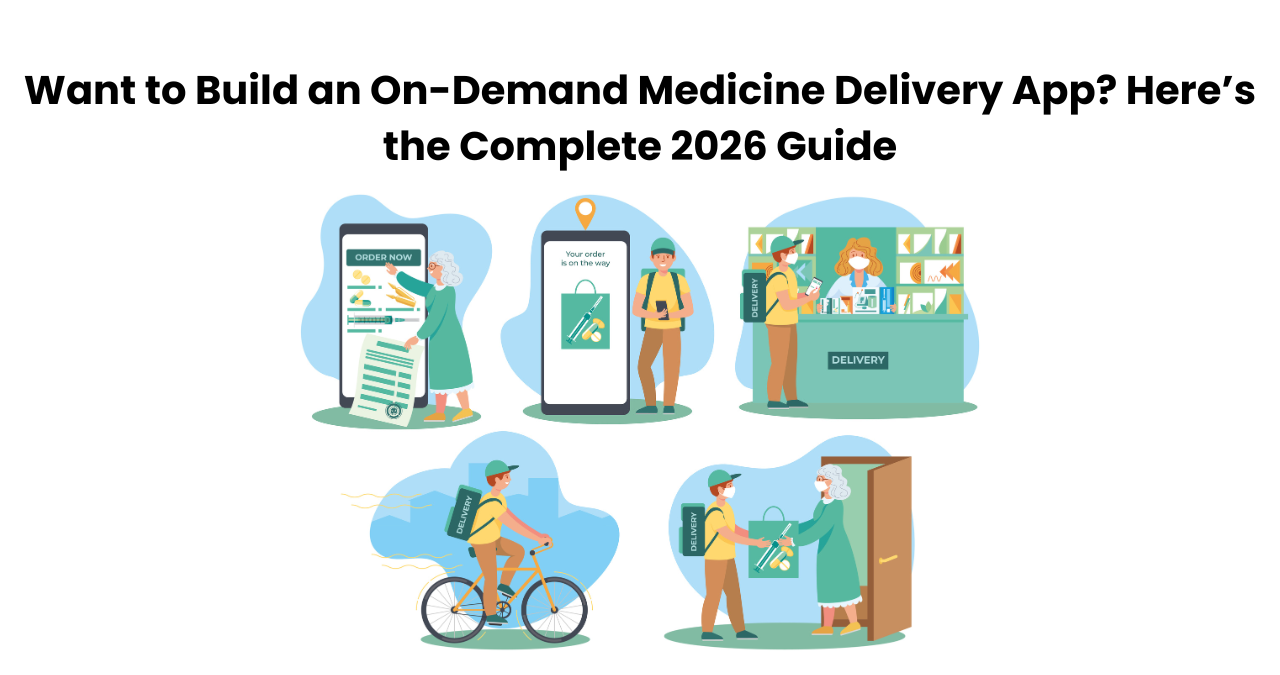
A typical process looks like this:
Customer places order → Pharmacy confirms order → Medicine is prepared → Delivery partner collects order → Customer receives medicine
The platform can also support healthcare products, wellness items, personal care products, medical equipment, and other permitted categories depending on the business model and applicable regulations.
Why Invest in Medicine Delivery App Development in 2026?
Consumer expectations have changed significantly. People now use mobile applications for food, groceries, transportation, shopping, and other everyday services. Healthcare services are following the same digital transformation.
A medicine delivery application can provide businesses with an opportunity to:
Reach more customers
Instead of depending entirely on physical pharmacy traffic, businesses can serve customers through digital channels.
Improve convenience
Customers can browse available products and order from home.
Increase pharmacy visibility
Partner pharmacies can receive orders from customers beyond their immediate physical location, depending on the service area.
Automate operations
Digital order management can reduce manual processes related to order collection, payments, delivery coordination, and notifications.
Build customer loyalty
Personalized offers, refill reminders, loyalty programs, and reliable delivery can encourage repeat purchases.
Expand geographically
Once the platform has a stable operational model, businesses can potentially expand into additional locations.
How Does a Medicine Delivery App Work?
Before starting development, you should understand the complete operational workflow.
Step 1: Customer Registration
Customers create an account using information such as:
-
Name
-
Mobile number
-
Email address
-
Delivery address
-
Password or social login
The app can use OTP verification to improve account security.
Step 2: Medicine Search
Customers search for medicines by:
-
Product name
-
Category
-
Brand
-
Health-related category
-
Prescription requirements
Search filters can make it easier to find relevant products.
Step 3: Prescription Upload
For prescription-required medicines, customers can upload a prescription through the application.
The pharmacy or authorized professional can review the prescription before confirming the order, according to applicable rules.
Step 4: Cart and Checkout
Customers review their products, select an address, choose a delivery option, and proceed to checkout.
Step 5: Payment
The platform can integrate supported payment methods such as:
-
Credit and debit cards
-
Digital wallets
-
Bank-based payment methods
-
Cash on delivery where permitted
Step 6: Pharmacy Processing
The selected pharmacy receives the order and checks product availability.
Step 7: Delivery Assignment
After the order is prepared, a delivery partner can be assigned.
Step 8: Real-Time Tracking
Customers can track the delivery status and receive relevant notifications.
Step 9: Order Completion
After successful delivery, the order is marked completed and the customer can provide feedback where appropriate.
Essential Features of an On-Demand Medicine Delivery App
A successful platform needs different features for each participant.
Customer App Features
User Registration and Login
Provide a simple registration process using mobile numbers, email addresses, OTPs, or supported authentication methods.
Medicine Search
A powerful search system helps customers quickly locate medicines and healthcare products.
Product Categories
Organize products into categories such as:
-
Prescription medicines
-
Over-the-counter products
-
Vitamins
-
Personal care
-
Medical devices
-
Wellness products
Medicine Details
Each product page can display relevant information such as:
-
Product name
-
Manufacturer
-
Price
-
Availability
-
Product description
-
Usage information where appropriate
Information should be presented responsibly and in accordance with applicable requirements.
Prescription Upload
Prescription upload is one of the most important features for a medicine delivery platform.
Customers should be able to:
-
Upload prescription images
-
View upload status
-
Associate prescriptions with orders
-
Receive relevant verification updates
Shopping Cart
Customers can add multiple products to their cart and review quantities and pricing before checkout.
Multiple Addresses
Allow users to save commonly used delivery addresses.
Order Tracking
Customers should be able to view order status from confirmation to delivery.
Push Notifications
Notifications can communicate:
-
Order confirmation
-
Prescription status
-
Order preparation
-
Delivery assignment
-
Delivery progress
-
Order completion
Order History
Customers can view previous orders and, where appropriate, reorder eligible products.
Reviews and Ratings
Customers can share feedback about eligible products or delivery services.
Customer Support
Provide access to customer service through appropriate communication channels.
Pharmacy Panel Features
Pharmacies are central to the medicine delivery ecosystem, so the pharmacy dashboard needs strong operational features.
Pharmacy Registration
Pharmacies can submit business information and required documentation for verification.
Product Management
Pharmacy staff can manage:
-
Product listings
-
Prices
-
Availability
-
Stock quantities
-
Categories
Order Management
The dashboard should allow pharmacies to:
-
Receive orders
-
Review prescriptions
-
Confirm availability
-
Prepare orders
-
Update order status
Inventory Management
Real-time or frequently updated inventory can reduce situations where customers order unavailable products.
Earnings Dashboard
Pharmacy owners can monitor order revenue, commissions, settlements, and other relevant financial information.
Reports and Analytics
Useful reports can include:
-
Daily orders
-
Revenue
-
Popular products
-
Cancellation rates
-
Customer activity

Delivery Partner App Features
If your business model includes an independent delivery network, a dedicated delivery application can simplify operations.
Important features include:
Delivery Partner Registration
Delivery partners can submit required details and documents for verification.
Availability Toggle
Partners can indicate whether they are available to accept deliveries.
Order Requests
Available delivery partners can receive nearby delivery requests.
Navigation
Map integration can help delivery partners navigate to pharmacies and customer locations.
Delivery Status Updates
Partners can update statuses such as:
-
Accepted
-
Picked up
-
In transit
-
Delivered
Earnings Management
Delivery partners can monitor completed deliveries and earnings.
Delivery History
Partners can review their previous delivery activity.
Admin Panel Features
The admin dashboard provides centralized control over the platform.
User Management
Administrators can manage customer accounts and account-related activities.
Pharmacy Management
Admins can verify, approve, suspend, or manage pharmacy partners according to platform policies.
Delivery Management
The admin panel can monitor delivery partners and active orders.
Order Management
Admins can view and manage order activity across the platform.
Commission Management
The system can calculate and track marketplace commissions.
Content Management
Administrators can manage banners, categories, promotional content, and other platform information.
Analytics Dashboard
Business owners can monitor:
-
Total orders
-
Revenue
-
Active users
-
Pharmacy performance
-
Delivery performance
-
Popular products
Advanced Features to Consider
Once your core platform is stable, advanced functionality can improve customer experience and operational efficiency.
Medicine Refill Reminders
Customers can receive reminders for recurring medicine purchases where appropriate.
Smart Recommendations
The platform can recommend relevant products based on permitted shopping behavior and customer preferences.
Loyalty Programs
Offer points, rewards, discounts, or other incentives to encourage repeat purchases.
Subscription-Based Ordering
For eligible products, recurring orders can provide additional convenience.
Multi-Pharmacy Ordering
A marketplace model can allow customers to compare product availability across participating pharmacies.
AI-Powered Search
AI-assisted search can help customers find products using natural-language queries, but healthcare-related recommendations should be carefully designed and should not replace professional medical advice.
Delivery Optimization
Routing and delivery assignment algorithms can help improve operational efficiency.
How to Build an On-Demand Medicine Delivery App
Developing the application requires a structured approach.
1. Define Your Business Model
Start by identifying what you want the platform to accomplish.
Determine:
-
Target audience
-
Service locations
-
Pharmacy partnership model
-
Delivery model
-
Product categories
-
Revenue model
A clear business model prevents unnecessary development.
2. Research Your Target Market
Study your target customers and competitors.
Analyze:
-
Customer expectations
-
Existing pharmacy apps
-
Pricing strategies
-
Delivery times
-
Available product categories
-
Competitor strengths and weaknesses
This research can help you identify gaps in the market.
3. Select Your Development Approach
You generally have two primary options:
Custom App Development
A custom application is built specifically for your business.
Advantages:
-
High customization
-
Flexible architecture
-
Custom workflows
-
Greater control over features
-
Easier integration with proprietary systems
However, custom development generally requires more time, planning, and investment.
Ready-Made Medicine Delivery Solution
A ready-made or white-label solution provides pre-built functionality that can be customized and branded for your business.
Advantages:
-
Faster launch
-
Lower initial development effort
-
Pre-built features
-
Easier customization
-
Potentially lower upfront cost
The right option depends on your budget, timeline, technical requirements, and long-term business strategy.
Technology Stack for Medicine Delivery Apps
The technology stack depends on your requirements, platform strategy, and development approach.
A modern application may include:
Frontend
-
Flutter
-
React Native
-
Native Android
-
Native iOS
Backend
-
Node.js
-
Python
-
PHP
-
Java
-
Other scalable backend technologies
Database
-
PostgreSQL
-
MySQL
-
MongoDB
Cloud Infrastructure
Cloud platforms can support:
-
Application hosting
-
Databases
-
File storage
-
Notifications
-
Analytics
-
Scaling
Third-Party Integrations
Depending on the business model, you may need:
-
Payment gateways
-
Maps and location services
-
Push notification services
-
SMS/OTP providers
-
Analytics tools
-
Customer support systems
The technology should be selected based on scalability, security, maintainability, and compliance requirements rather than simply following trends.
Security and Compliance Considerations
Medicine delivery applications handle sensitive customer and transaction information, making security a critical part of development.
Businesses should consider:
Secure Authentication
Use strong authentication mechanisms and protect account credentials.
Data Encryption
Sensitive information should be protected during transmission and storage using appropriate security practices.
Secure Payment Processing
Use established payment providers and avoid storing sensitive payment information unnecessarily.
Access Controls
Different users should have access only to the information and functions required for their roles.
Prescription Protection
Prescription documents should be handled securely and access should be restricted to authorized personnel.
Regulatory Compliance
Medicine sales and delivery are regulated differently across countries and jurisdictions. Businesses should consult qualified legal and healthcare compliance professionals to ensure that their platform follows applicable laws, licensing requirements, prescription rules, data protection requirements, and pharmacy regulations.
How Does a Medicine Delivery App Make Money?
A medicine delivery platform can use multiple revenue streams.
Commission From Pharmacies
The platform can charge pharmacies a percentage or agreed fee for orders generated through the marketplace.
Delivery Charges
Customers can pay delivery fees based on distance, order size, location, or delivery speed where permitted.
Subscription Plans
Offer membership programs with benefits such as:
-
Reduced delivery fees
-
Special offers
-
Priority services
Advertising
Pharmacies and brands can potentially pay for promotional placement, subject to applicable advertising and healthcare regulations.
Featured Listings
Partner businesses can pay for greater visibility within permitted categories.
B2B Partnerships
The platform can explore partnerships with businesses, clinics, healthcare organizations, or other eligible entities depending on the market.
How Much Does It Cost to Build a Medicine Delivery App?
There is no universal development price because costs vary based on project requirements.
Major cost factors include:
-
Number of applications
-
Feature complexity
-
UI/UX requirements
-
Technology stack
-
Backend architecture
-
Third-party integrations
-
Development team location
-
Security requirements
-
Compliance requirements
-
Testing requirements
-
Post-launch maintenance
A basic MVP with customer, pharmacy, delivery, and admin functionality will generally require less investment than a large marketplace with advanced analytics, automation, multiple integrations, and extensive customization.
For an accurate estimate, businesses should first prepare a detailed feature list and technical specification.
How to Reduce Medicine Delivery App Development Costs
You can control development expenses without compromising important functionality.
Start With an MVP
Launch the most important features first.
Prioritize Features
Focus on features that directly affect:
-
Ordering
-
Pharmacy operations
-
Delivery
-
Payments
-
Customer support
Use Cross-Platform Development
Cross-platform frameworks can reduce duplicated development work for Android and iOS in suitable projects.
Choose Ready-Made Solutions
A white-label solution can reduce initial development time when its architecture and features match your business requirements.
Use Cloud Infrastructure
Cloud services can provide flexible infrastructure without requiring large upfront hardware investments.
How to Launch Your Medicine Delivery App Successfully
Building the application is only the first step. A strong launch strategy is equally important.
Build a Pharmacy Network
Customers need access to sufficient product availability. Recruit reliable pharmacy partners before launch.
Establish a Delivery Network
Make sure delivery capacity matches your expected order volume.
Test the Complete Order Flow
Test every stage:
-
Registration
-
Search
-
Prescription upload
-
Checkout
-
Payment
-
Pharmacy confirmation
-
Delivery assignment
-
Tracking
-
Completion
Start With a Limited Location
Launching in one city or service area can help you identify operational challenges before expanding.
Collect Customer Feedback
Use early feedback to improve:
-
App usability
-
Delivery experience
-
Search
-
Product availability
-
Customer support
Monitor Business Metrics
Track important metrics such as:
-
Order volume
-
Customer acquisition
-
Repeat purchases
-
Average order value
-
Delivery time
-
Cancellation rate
-
Customer retention
Common Mistakes to Avoid
Businesses entering the medicine delivery market should avoid several common mistakes.
Ignoring Regulatory Requirements
Healthcare and medicine sales require careful attention to applicable laws and regulations.
Building Too Many Features Initially
A complex first release can increase development time and costs.
Poor Pharmacy Verification
Partner quality directly affects customer trust.
Weak Inventory Management
Incorrect availability information can lead to cancellations and poor customer experiences.
Neglecting Customer Support
Medicine orders can be time-sensitive, so customers need reliable support.
Ignoring Security
Protecting customer and prescription information should be a fundamental development priority.
Launching Without Testing
A platform should be thoroughly tested before handling real customer orders.
Future Trends in Medicine Delivery Apps
The medicine delivery industry is likely to become increasingly technology-driven.
Several trends can influence future development.
Artificial Intelligence
AI can support search, operational analytics, customer service, and other appropriate functions.
Predictive Inventory
Data analytics can help pharmacies forecast demand and manage inventory more efficiently.
Automated Delivery Management
Smart assignment and route optimization can help reduce delivery inefficiencies.
Personalized Experiences
Applications can provide personalized interfaces and product discovery based on appropriate customer activity.
Healthcare Ecosystem Integration
Medicine delivery platforms may increasingly connect with broader digital healthcare ecosystems, where legally and technically appropriate.
Why Scalability Matters
A medicine delivery app may start with a few pharmacies and a small customer base, but successful businesses can grow quickly.
Your architecture should therefore be designed to accommodate:
-
More customers
-
More pharmacies
-
More delivery partners
-
More transactions
-
Larger product catalogs
-
Additional service locations
Scalability should be considered from the beginning rather than treated as an afterthought.
Final Checklist Before Launch
Before launching your medicine delivery platform, review these areas:
-
Business model finalized
-
Target market researched
-
Pharmacy partnerships established
-
Delivery operations planned
-
Customer app developed
-
Pharmacy panel developed
-
Delivery app developed
-
Admin dashboard developed
-
Payment integration completed
-
Prescription workflow tested
-
Security measures implemented
-
Applicable compliance requirements reviewed
-
App thoroughly tested
-
Customer support process established
-
Analytics configured
-
Marketing strategy prepared
Read More: https://whitelabelfox.com/pharmacy-app-development-2026/
Conclusion
The growing demand for digital healthcare services makes medicine delivery a promising area for entrepreneurs, pharmacies, healthcare businesses, and technology companies. A well-designed on demand medicine delivery app can simplify medicine ordering, connect customers with pharmacies, streamline deliveries, and create new opportunities for digital healthcare businesses.
However, successful development requires more than attractive app design. Businesses must carefully plan their marketplace model, pharmacy network, delivery operations, security architecture, prescription workflow, payment system, compliance requirements, and scalability strategy.
Whether you choose custom development or a ready-made medicine delivery solution, start by defining your business requirements and prioritizing the features that create genuine value for customers and pharmacy partners.
A focused MVP can help you enter the market faster, gather real-world feedback, and gradually introduce advanced capabilities. With the right technology, operational model, and customer-first strategy, your medicine delivery platform can evolve into a scalable digital healthcare marketplace.
FAQs
1. How long does it take to build a medicine delivery app?
The development timeline depends on the number of features, platforms, integrations, customization requirements, testing, and compliance considerations. A basic MVP can be developed faster than a fully customized marketplace with advanced features.
2. What are the essential features of a medicine delivery app?
Important features include user registration, medicine search, product catalogs, prescription upload, shopping cart, checkout, payments, order tracking, notifications, pharmacy management, delivery management, inventory management, and an admin dashboard.
3. Can I build a medicine delivery app using a ready-made solution?
Yes. A ready-made or white-label solution can provide pre-built functionality that can be customized with your branding and business requirements. It can be a suitable option for businesses that want to reduce initial development time.
4. How does a medicine delivery app generate revenue?
Common revenue models include pharmacy commissions, delivery charges, subscription plans, featured listings, advertising, and eligible B2B partnerships. The available options depend on your market, business model, and applicable regulations.
5. What factors affect medicine delivery app development cost?
Development cost depends on app complexity, number of platforms, features, UI/UX design, backend architecture, integrations, security requirements, compliance needs, development team, testing, and ongoing maintenance.

 Arabic
 French
 Spanish
 Portuguese
 Deutsch
 Turkish
 Dutch
Dutch
 Italiano
 Russian
 Romaian
 Portuguese (Brazil)
 Greek
Greek
 Bengali