


How to Audit Multiple Google Business Profiles for Multi-Location Businesses
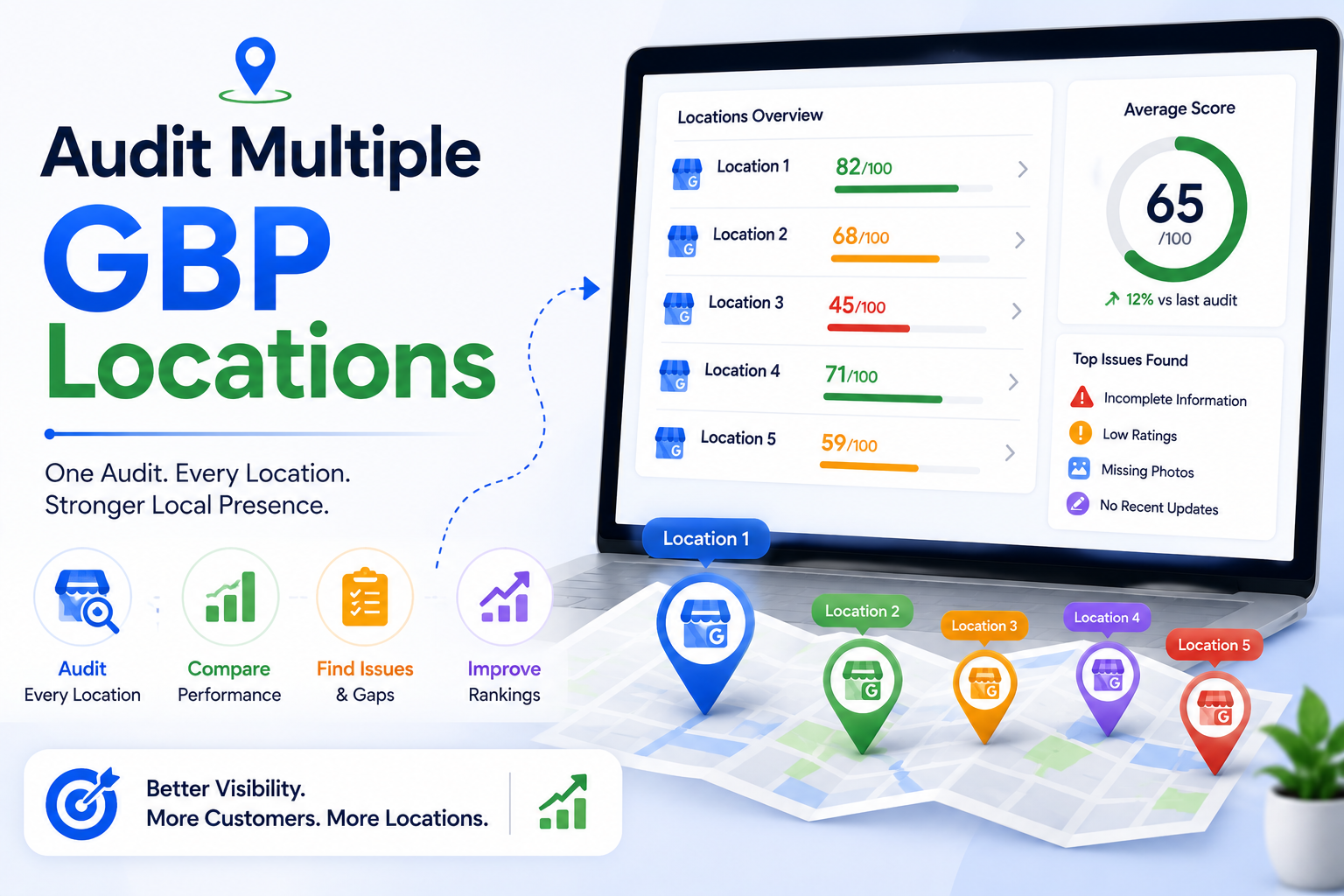
Managing one Google Business Profile can be straightforward. Managing 10, 50, or 100 locations is a completely different challenge. A small error repeated across dozens of listings can affect customer experience at scale, while location-specific problems may remain unnoticed when profiles are managed with a one-size-fits-all approach.
For a multi-location business, a Google Business Profile audit needs to answer two questions: are all locations following consistent brand standards, and is each individual location accurate and optimized for its own market?
Google provides bulk-management features for businesses with 10 or more locations, including spreadsheets and bulk verification options. This makes centralized management possible, but regular auditing is still necessary to identify errors and location-level opportunities.
Start by Creating a Master Location List
Before auditing individual profiles, create one reliable list of every active business location. Each branch should have its own identifiable record containing the business name, address, phone number, website or location page, opening hours, primary category, and relevant services.
Google's bulk spreadsheet system uses unique business codes for locations. These codes are not displayed publicly, but they help businesses manage locations accurately when working with bulk uploads.
This master list becomes your audit baseline. Without it, determining whether information on individual profiles is correct becomes much harder.
Organize Profiles Before You Audit Them
Multi-location businesses often involve several employees, regional managers, agencies, or franchise teams. Before optimization begins, review how profile access is organized.
Google Business Groups allow multiple users to manage collections of Business Profiles without sharing a single account password. Google specifically describes Business Groups as a safer way to share profile management among team members.
Review who currently has access and whether former employees or previous agencies still have unnecessary permissions.
Good organization reduces the risk of conflicting changes across locations.
Check Business Information Location by location.
Brand consistency matters, but every branch still needs an individual accuracy check.
Compare each GBP with your master database. Verify the address, local phone number, website, opening hours, map position, and other important details.
Do not assume that because 49 profiles are correct, location 50 must also be correct.
One branch may have changed its operating hours. Another may have moved. A third could be linking to an outdated website page.
Google allows businesses to download profile information into a spreadsheet. The download can also show errors and Google updates where applicable, which can make large-scale checks more manageable.
Use a GBP Audit to identify profile-level gaps.
Auditing dozens of locations manually can become time-consuming, particularly when you are trying to determine which profiles need attention first.
A structured audit can provide an initial view of potential optimization gaps.
Run a Google Business Profile Audit:
https://www.fly-social.com/tools/gmb-audit
Use the findings to identify profiles requiring deeper investigation. Automated checks should support manual analysis rather than replace it, especially when location-specific business information needs verification.
Review Category Consistency
Categories are particularly important for multi-location brands.
If all locations provide essentially the same core service, their primary categories will generally need a consistent strategy. Google's bulk spreadsheet guidance says the primary category should be the same across businesses within the same business type, while additional categories can be used to represent other relevant activities.
However, don't force identical categories when locations genuinely operate differently.
For example, a brand may have retail stores, distribution centers, and offices. Those are different business types and should be reviewed accordingly.
Audit category consistency, but always prioritize accuracy.
Compare Services Across Locations
Next, examine the services displayed on each profile.
Multi-location businesses frequently have service inconsistencies because different managers update individual listings independently.
One branch might show ten current services, another only three, while a third displays services the company stopped offering months ago.
Create a standard service framework for services offered across the brand, then document legitimate local differences.
This gives customers consistent information while allowing individual locations to accurately represent what they provide.
Audit Opening and Special Hours
Hours are one of the easiest areas for multi-location profiles to become inaccurate.
Different branches may have different operating schedules, and holiday hours can vary even further.
Check normal hours for each branch rather than copying one schedule across the entire organization.
Google's bulk spreadsheet supports day-specific opening hours, making it possible to manage hours for multiple locations systematically.
Special hours also deserve attention during holidays or temporary schedule changes. Accurate hours matter because they directly influence whether customers decide to visit a location.
Compare Reviews at the Location Level
Do not evaluate reputation only at brand level.
A company might have thousands of reviews across its network while one branch has very little recent feedback or noticeably weaker customer sentiment.
Compare individual locations based on review volume, rating, recent activity, recurring feedback, and owner responses.
Look for outliers.
If most locations maintain strong customer feedback but one branch repeatedly receives complaints about waiting times, staff behaviour, availability, or another issue, the problem may be operational rather than purely SEO-related.
A multi-location GBP audit can therefore reveal useful business insights beyond rankings.
Standardize Review Responses Without Making Them Robotic
Large brands often create standard review-response templates to save time. Templates can help maintain tone, but repeating exactly the same response across every review can feel impersonal.
Create guidelines instead of relying exclusively on scripts.
Define how teams should respond to positive feedback, complaints, service problems, and sensitive situations while allowing enough flexibility to address the customer's actual experience.
This creates consistency without making every branch sound identical.
Check Photos for Every Branch
Photos should accurately represent the individual location customers are considering.
A common multi-location mistake is relying almost entirely on corporate brand images.
Customers may want to see the actual storefront, entrance, interior, facilities, team, products, or environment at the specific branch they plan to visit.
Audit whether each location has useful and current images.
Brand assets can remain consistent, but location-specific photos provide customers with a more accurate understanding of what they will experience.
Audit Website Links Carefully
Each profile should send customers to the most useful page available.
For a business with many locations, directing every profile to the same homepage may not always create the best customer journey.
If the website has dedicated location pages, review whether each GBP connects to the correct corresponding page.
Then audit those pages.
Check the address, phone number, opening hours, services, directions, and contact options. Information displayed on the website should accurately reflect the corresponding business location.
A GBP audit that ignores location pages misses an important part of the customer's journey.
Search for Duplicate and Closed Profiles
Duplicate profiles become harder to identify as a business expands.
Branches may move, franchise ownership can change, and new profiles may accidentally be created for existing locations.
Search for duplicates using business names, addresses, and phone numbers. Also identify profiles associated with permanently closed or relocated branches.
Do not take action solely because two profiles look similar. Confirm that they genuinely represent the same business before attempting to resolve a duplicate.
Maintain a record of active, relocated, temporarily closed, and permanently closed locations so the status of every profile is clear.
Compare Local Competitors Separately
A multi-location brand does not compete with the same businesses everywhere.
A branch in one neighborhood may face entirely different competitors from a branch elsewhere.
That means competitor analysis should happen at the location level.
Select relevant competitors around each branch and compare categories, reviews, services, websites, and local visibility.
This can reveal that one location needs stronger review activity while another faces competitors with much stronger website visibility.
Your Local SEO strategy can then adapt to each market rather than applying exactly the same recommendations everywhere.
Compare Performance Across Locations
One major advantage of managing multiple profiles is the ability to identify high- and low-performing branches.
Google allows managers to download Business Profile performance information for multiple profiles into a spreadsheet, making it possible to compare locations over the same period. Available performance information can include views, clicks, and other customer interactions.
Look for unusual differences.
If one branch receives substantially more customer engagement than similar locations, investigate what is working there. If another location receives visibility but limited interaction, examine its reviews, services, photos, website experience, and competitive environment.
The strongest locations can provide useful lessons for weaker ones.
Create a Location Audit Scorecard
For ongoing management, create a consistent internal scorecard.
Instead of producing a completely different report for every branch, evaluate the same core areas across locations: information accuracy, categories, services, hours, reviews, photos, website connection, competitor strength, and customer interactions.
This makes it easier to identify outliers and prioritize resources.
For example, five locations may need urgent accuracy fixes, ten may need review-management attention, while the remaining profiles may already be in good condition.
That is more efficient than treating every location as equally problematic.
Don't Apply Every Change to Every Profile
Centralized management makes bulk changes easier, but convenience can create mistakes.
Not every recommendation should be applied across the entire network.
Opening hours, services, attributes, website pages, photos, and competitive conditions may differ by location.
Google's spreadsheet workflow also requires care: when updating existing businesses, Google warns that including a column heading with empty cells can delete existing information in that field.
Bulk updates should therefore be reviewed carefully before upload.
Build a Repeatable Audit Schedule
Multi-location GBP management works best as an ongoing process rather than an annual cleanup.
Maintain your master location data, monitor profile changes, review customer feedback, check new and closed locations, and compare performance regularly.
When the profile audit reveals that GBP itself is healthy, expand your analysis to the broader Local SEO environment.
Explore more SEO and digital marketing tools:
https://www.fly-social.com/tools
This can help determine whether website SEO or wider search visibility deserves attention instead of making unnecessary changes to already healthy profiles.
Conclusion
Auditing multiple Google Business Profiles requires a different approach from auditing a single location.
You need centralized standards combined with location-level analysis.
Start with a reliable master location database. Organize profile access, verify core information, review categories and services, audit hours, compare reviews, check photos and website links, identify duplicates, and analyze each branch against its actual local competitors.
Then use performance data to find your strongest and weakest locations.
The objective is not to make every GBP identical. It is to ensure that every profile is accurate, consistent with the brand, relevant to its individual location, and useful to local customers.
For multi-location businesses, that structured approach turns GBP auditing from a large manual task into a scalable Local SEO process.
FAQs
How can businesses manage many Google Business Profiles efficiently?
Google provides Business Profile Manager, Business Groups, spreadsheets, and bulk-management options. Businesses with 10 or more locations can be eligible for bulk management and verification.
Should every business location use identical GBP information?
Brand information should be consistent where appropriate, but location-specific details such as addresses, phone numbers, hours, services, and photos must remain accurate.
Can I compare GBP performance across multiple locations?
Yes. Google allows performance data for multiple Business Profiles to be downloaded into a spreadsheet for comparison.
Should competitors be analyzed separately for each location?
Yes. Each branch can face a different competitive environment, so location-level competitor analysis provides more meaningful local SEO insights.

 Arabic
 French
 Spanish
 Portuguese
 Deutsch
 Turkish
 Dutch
Dutch
 Italiano
 Russian
 Romaian
 Portuguese (Brazil)
 Greek
Greek
 Bengali