


Sudoku Puzzle Challenge That Sharpens Logic and Daily Focus
Introduction to Sudoku
Sudoku is one of the most popular logic puzzle games in the world. Millions of players enjoy Sudoku every day because it combines entertainment, concentration, and problem-solving skills. Unlike many puzzle games that rely on vocabulary or mathematical calculations, Sudoku focuses on logical thinking. Every completed grid brings a sense of achievement and encourages players to tackle even greater challenges.
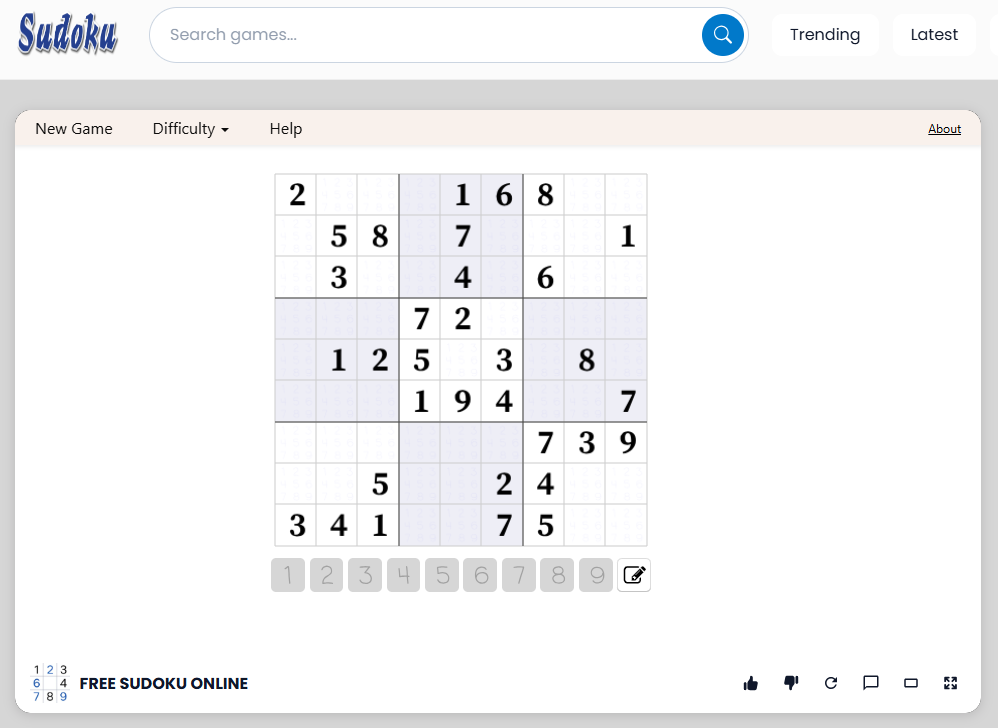
The classic Sudoku format consists of a 9x9 grid divided into nine smaller 3x3 sections. The objective is simple: fill every empty cell with a number from 1 to 9 while following specific rules. Each row, each column, and each 3x3 section must contain every number exactly once.
This straightforward concept makes Sudoku easy to learn while offering endless opportunities for mental stimulation.
Why Sudoku Remains Popular
Easy Rules with Deep Strategy
One reason behind the lasting popularity of Sudoku is the simplicity of the rules. New players can understand the basic objective within minutes. However, mastering advanced solving techniques requires patience and practice.
Many puzzles begin with only a few numbers already placed in the grid. Players must carefully analyze possibilities and eliminate incorrect options. This process transforms a simple puzzle into a rewarding intellectual challenge.
Suitable for All Ages
Sudoku appeals to a wide range of players. Children can use Sudoku to develop logical reasoning and concentration. Adults often play Sudoku as a relaxing activity during breaks or while traveling. Older individuals may enjoy Sudoku as a way to keep the mind active and engaged.
Different difficulty levels ensure that everyone can find a suitable challenge. Beginner puzzles provide a gentle introduction, while expert puzzles test even experienced enthusiasts.
Accessible Across Platforms
Modern technology has expanded access to Sudoku. Players can enjoy puzzles in newspapers, books, websites, mobile applications, and gaming platforms. Online versions often include helpful features such as hints, timers, and progress tracking.
This accessibility allows Sudoku to remain relevant in a rapidly changing digital environment.
Understanding the Core Rules
Completing Rows and Columns
Every row must contain the numbers 1 through 9 without repetition. The same rule applies to every column. If a number already exists within a row or column, it cannot appear again in that location.
Careful observation helps identify which numbers are missing and where they can logically fit.
Managing the 3x3 Sections
The grid contains nine smaller 3x3 sections. Each section must also include the numbers 1 through 9 exactly once.
Players often begin solving puzzles by focusing on these smaller areas. Identifying missing numbers within a section can reveal important clues for completing the surrounding rows and columns.
Using Logic Instead of Guessing
Successful Sudoku solving depends on logic rather than random guessing. Every placement should be supported by evidence from the existing numbers in the puzzle.
Consistent logical analysis reduces mistakes and increases the likelihood of completing difficult puzzles efficiently.
Effective Sudoku Solving Techniques
Scanning for Obvious Numbers
Scanning is one of the simplest and most effective strategies. Players examine rows, columns, and sections to identify locations where only one number can fit.
This technique often provides a strong starting point and creates momentum for solving the rest of the puzzle.
Candidate Elimination
Candidate elimination involves listing possible numbers for empty cells and gradually removing invalid options.
As more numbers are placed, the list of possibilities becomes smaller. Eventually, only one valid choice remains, allowing progress without guesswork.
Hidden and Naked Pairs
More advanced puzzles may require specialized techniques. Hidden pairs occur when two numbers can only appear in two specific cells within a row, column, or section.
Naked pairs involve two cells sharing the same pair of candidates. Recognizing these patterns helps eliminate possibilities from nearby cells and reveals new solutions.
Pattern Recognition
Experienced players often rely on pattern recognition. Familiarity with common Sudoku structures allows faster identification of opportunities and logical relationships.
Regular practice improves this skill and contributes to more efficient puzzle solving.
Benefits of Playing Sudoku
Improved Concentration
Sudoku requires sustained attention and careful analysis. Players must track information across multiple areas of the grid while avoiding errors.
Frequent practice can strengthen concentration and improve the ability to focus on complex tasks.
Enhanced Logical Thinking
Every Sudoku puzzle encourages structured reasoning. Players evaluate possibilities, test assumptions, and reach conclusions based on available evidence.
These cognitive processes support logical thinking that may also prove useful in academic, professional, and everyday situations.
Stress Reduction
Many people view Sudoku as a relaxing activity. The puzzle provides a temporary escape from daily distractions and creates an opportunity to focus on a single objective.
Completing a challenging grid can deliver satisfaction and contribute to a positive mental state.
Mental Exercise
Just as physical activity helps maintain physical fitness, mental exercises help keep the brain active. Sudoku offers a stimulating workout that challenges memory, reasoning, and problem-solving abilities.
Regular engagement with puzzles may help maintain cognitive sharpness over time.
Different Variations of Sudoku
Mini Sudoku
Mini Sudoku uses smaller grids, making puzzles quicker to complete. This variation is ideal for beginners or players with limited time.
Despite the reduced size, mini puzzles still require logical thinking and careful planning.
Killer Sudoku
Killer Sudoku combines traditional Sudoku rules with additional numerical constraints. Groups of cells display target sums that must be achieved without repeating numbers.
This variation introduces a unique layer of complexity and appeals to players seeking a greater challenge.
Samurai Sudoku
Samurai Sudoku consists of multiple overlapping grids connected together. Solving this format requires attention across several puzzle areas simultaneously.
The larger structure creates a highly engaging experience for dedicated enthusiasts.
Hyper Sudoku
Hyper Sudoku includes additional highlighted regions that must also contain the numbers 1 through 9 exactly once.
These extra constraints increase difficulty while preserving the core principles of traditional Sudoku.
Tips for Becoming a Better Sudoku Player
Start with Easier Puzzles
Building confidence through beginner-level puzzles helps establish strong fundamentals. Understanding basic techniques creates a solid foundation for tackling more difficult challenges.
Practice Consistently
Regular practice improves speed, accuracy, and pattern recognition. Even a few puzzles each week can produce noticeable progress over time.
Learn Advanced Strategies
Exploring advanced solving methods expands problem-solving options. Techniques such as X-Wing, Swordfish, and candidate chains can help overcome difficult situations in expert-level puzzles.
Stay Patient
Complex puzzles may require significant time and effort. Patience allows careful analysis and prevents unnecessary mistakes.
A calm approach often leads to better results than rushing through the grid.
Conclusion
Sudoku remains a timeless puzzle game because it balances simplicity with intellectual depth. Easy-to-understand rules make Sudoku accessible to newcomers, while advanced strategies provide endless challenges for experienced players. Benefits such as improved concentration, stronger logical thinking, stress reduction, and mental stimulation contribute to widespread appeal.
Whether solving a quick beginner puzzle or tackling an expert-level challenge, Sudoku delivers a rewarding experience that continues to attract players around the globe. Regular practice can sharpen analytical skills, boost confidence, and transform every puzzle into an enjoyable journey of discovery.

 Arabic
 French
 Spanish
 Portuguese
 Deutsch
 Turkish
 Dutch
Dutch
 Italiano
 Russian
 Romaian
 Portuguese (Brazil)
 Greek
Greek
 Bengali