


The Business Risks of Depending Too Heavily on Social Media for Sales
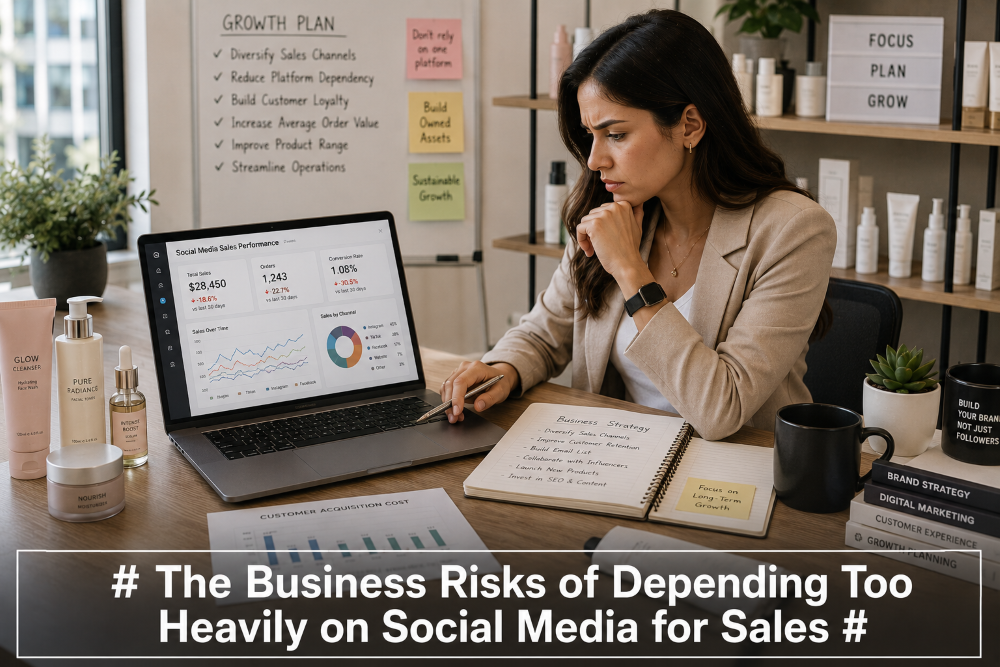
A beauty brand builds real momentum on a single social media platform. Content performs well, a few influencer partnerships bring in a wave of new followers, and sales climb steadily month after month. The founder starts to feel like they have found the formula: post consistently, engage the audience, watch the orders come in. Then something shifts. Organic reach quietly declines. Advertising costs creep upward until the same budget delivers far fewer results. Engagement drops for reasons that are never fully explained, or an account faces an unexpected restriction. Almost overnight, a business that felt predictable becomes unpredictable, and sales that once flowed steadily start to fluctuate in ways the founder cannot control. Social media can be one of the most powerful tools a beauty or cosmetic brand has for reaching new customers. But when it becomes the only foundation a business stands on, that same platform can just as easily become its biggest vulnerability.
When a Growth Channel Becomes a Business Dependency
There is an important difference between using social media strategically and relying on it as the primary source of revenue. A brand that treats social platforms as one part of a broader marketing mix can adapt when performance shifts. A brand that generates the vast majority of its traffic, leads, and purchases from a single platform has far less room to maneuver. This kind of dependency tends to develop gradually. Early success on one channel feels like validation, so more budget and attention flow toward it, while other channels receive less investment. Over time, the business becomes concentrated in a way that feels comfortable until something on that platform changes.
Algorithm Changes Can Create Sudden Revenue Problems
Businesses have very little control over how a platform's algorithm decides what content gets shown and to whom. A brand cannot predict when a platform will adjust how it distributes content, and it is not accurate to assume that every change will reduce reach. Some updates favor certain content types over others, and performance can shift in either direction. What matters most is the uncertainty itself. A brand with strong alternative channels can absorb a shift in one platform's performance without much disruption. A brand with no alternative feels every fluctuation directly in its sales numbers.
Large Audiences Do Not Always Create Predictable Sales
A large following can feel like a strong indicator of business health, but follower counts and engagement numbers do not always translate into consistent revenue. Audience quality matters more than audience size. A smaller group of highly engaged, purchase-ready followers can outperform a much larger audience that browses content without buying. Purchase intent, platform behavior, and shifting consumer interests all influence whether attention actually converts into sales. Tracking actual business outcomes, such as revenue, conversion rate, and repeat purchases, gives a far more accurate picture of health than watching follower growth alone.
Rising Advertising Costs Can Reduce Profit Margins
As more brands compete for attention on the same platforms, the cost of reaching an audience through paid advertising tends to rise. What once delivered a strong return can gradually become a much more expensive way to acquire the same customer. Monitoring customer acquisition cost and comparing it against customer lifetime value and product margins helps a brand understand whether its advertising spend is still working in its favor, rather than assuming that past performance will continue indefinitely.
Losing Access to an Account Can Disrupt the Entire Business
Account restrictions, security issues, policy changes, and technical disruptions can all limit or temporarily remove a brand's ability to reach its audience through a given platform. When a business has built its entire customer relationship inside that platform, losing access, even briefly, can disrupt operations in ways that are difficult to recover from quickly. This risk is not about any single platform being unreliable. It reflects a broader reality: a business relationship built entirely on infrastructure it does not own and cannot fully control carries an inherent vulnerability.
Why Owned Customer Relationships Matter More
Channels where a brand has a more direct relationship with its customers provide a level of stability that social platforms cannot. An email list, an SMS program where appropriate, customer accounts, a loyalty program, and useful website content all give a brand ways to reach its audience that are not subject to a third-party algorithm. These owned channels tend to support repeat purchases more reliably than social platforms, since the brand is not competing for visibility in a constantly shifting feed. Building these relationships reduces the pressure to constantly reach new audiences through social content alone.
A Strong Brand Experience Should Not Depend on One Platform
Consistency across the website, product information, customer communication, and every post-purchase interaction shapes how customers perceive a brand, and that experience should hold together regardless of which platform first introduced a customer to the business. This consistency extends to physical touchpoints as well. Elements like luxury cosmetic packaging boxes contribute to how a customer experiences the brand once a product arrives, and maintaining that experience independently of any single social platform helps ensure the brand feels cohesive no matter where the customer relationship began. A brand discovered through a video should feel just as polished once the product is actually in the customer's hands.
How Social Media Dependency Makes Sales Harder to Forecast
When most of a brand's traffic comes from unpredictable reach, fluctuating engagement, and advertising performance that can shift week to week, forecasting revenue becomes considerably harder. A founder planning inventory or cash flow needs some degree of predictability, and a single volatile channel rarely provides that on its own. Diversifying acquisition channels tends to smooth out this volatility. When one channel slows down, others can help maintain a more balanced and predictable flow of potential customers.
Building a More Resilient Sales Strategy
- Identify how much of current revenue depends on each social platform.
- Build and grow an email subscriber base.
- Invest in a high-converting website and customer experience.
- Improve organic search visibility through genuinely useful content.
- Encourage repeat purchases and stronger customer retention.
- Develop referral and word-of-mouth strategies.
- Test additional acquisition channels gradually rather than all at once.
- Track customer acquisition costs by channel, not just overall.
- Strengthen first-party customer data and direct relationships.
- Treat social media as part of an integrated growth strategy rather than the entire strategy.
Finding the Right Balance Between Social Media and Owned Channels
None of this means abandoning social media. Social platforms remain genuinely valuable for brand awareness, community building, product discovery, ongoing customer engagement, and influencer partnerships that introduce new audiences to a brand. The strongest approach uses social media to attract and introduce customers to the brand, while gradually building direct relationships the business can maintain independently. Social media becomes one strong channel among several, rather than the single point of failure an entire business depends on.
Conclusion
Depending too heavily on social media exposes a beauty or cosmetic business to risks that sit largely outside its control. A shift in algorithm performance, rising advertising costs, changing consumer behavior, or unexpected account access issues can all affect traffic and sales quickly when no alternative channels exist to absorb the impact. Sustainable growth comes from diversification rather than dependency. The strongest beauty brands treat social media as an important and valuable growth tool while also investing in owned audiences, direct customer relationships, search visibility, repeat purchases, and multiple sources of revenue that give the business room to adapt when any single channel changes.

 Arabic
 French
 Spanish
 Portuguese
 Deutsch
 Turkish
 Dutch
 Italiano
 Russian
 Romaian
 Portuguese (Brazil)
 Greek
 Bengali