


Components of an Automated Weather Observing System Explained
When a pilot prepares for landing, they need a precise, up-to-the-minute report of the weather conditions on the ground. A calm flight can quickly become hazardous if unexpected fog, wind, or rain appears at the runway. In the past, this vital information came from human observers, but today, this task is managed by a network of tireless, highly accurate robotic stations.
These stations operate 24/7, providing a continuous stream of data that is critical for aviation safety. They are the local eyes and ears for pilots, air traffic controllers, and even national weather forecasters. By automating data collection, they eliminate human error and provide reports from remote locations where staffing would be impossible.
The technology behind this network is a marvel of engineering, combining durable sensors, powerful computers, and reliable communication systems into a single, cohesive unit. These units are designed to withstand harsh weather while delivering the consistent, trustworthy data that the aviation industry depends on.
At the heart of this infrastructure are Automated Weather Observing Systems (AWOS). These self-contained units are more than just a collection of instruments; they are a fully integrated system where each component has a distinct and critical role. This article will break down the essential components of an AWOS, explaining what each part does and how they work together to keep our skies safe.
The Sensor Suite: The Eyes and Ears of the System
The most visible and fundamental part of any AWOS is the sensor suite. This is the collection of instruments that directly interacts with the atmosphere to measure specific weather variables. These sensors are built to be incredibly durable and precise, as they form the foundation for all the data the system reports. Depending on the complexity and level of the AWOS, the suite can include a wide range of instruments.
Thermometer and Hygrometer
These two sensors work together to measure air temperature and humidity. The data is used to calculate the dew point, which is the temperature at which air becomes saturated and water vapor condenses into dew or fog. The difference between the temperature and dew point is a key indicator for pilots regarding the potential for fog formation or carburetor icing in piston-engine aircraft.
Barometer
The barometer measures atmospheric pressure. This is one of the most critical pieces of data for a pilot, as it provides the altimeter setting. An aircraft’s altimeter measures altitude based on air pressure, so it must be calibrated to the local pressure at the airport to give an accurate reading. An incorrect altimeter setting can lead a pilot to believe they are higher or lower than they actually are, a dangerous situation during an instrument approach in clouds.
Anemometer and Wind Vane
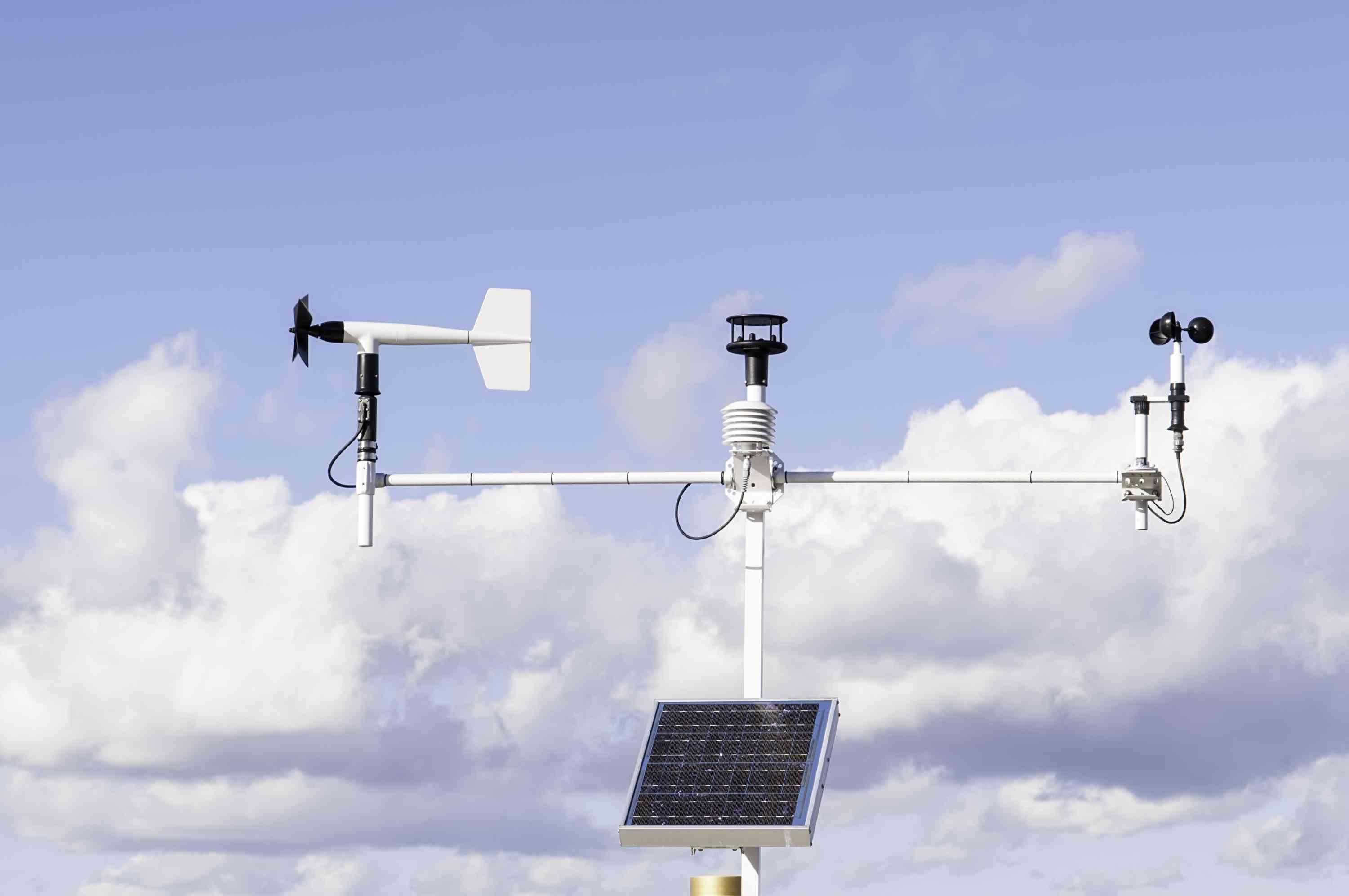
This pair of sensors measures wind speed and direction. Traditional systems use a cup anemometer (spinning cups) and a wind vane (a fin that points into the wind). More advanced systems use ultrasonic anemometers, which have no moving parts. They send pulses of sound between multiple posts and measure how the wind affects the sound's travel time to calculate both speed and direction. This wind data is vital for choosing the correct runway for takeoff and landing to avoid dangerous crosswinds.
Ceilometer
A ceilometer is a specialized sensor that measures the height of the cloud base above the ground. It works by shooting a powerful, vertically-aimed laser beam into the sky. A detector next to the laser emitter measures the time it takes for the light to reflect off the bottom of the clouds and return to the sensor. From this time, the system calculates the exact height of the cloud ceiling, which is critical for pilots flying under instrument flight rules.
Visibility Sensor
Knowing how far you can see is essential for a safe landing. A visibility sensor measures this by transmitting a beam of infrared light over a known distance (called the baseline) to a receiver. The sensor measures how much of the light is scattered by particles in the air, such as fog, rain, snow, or haze. From this "light extinction," the system calculates the horizontal visibility, often reported in fractions of a mile.
The Data Collection and Processing Unit
The raw electrical signals generated by the sensors are just meaningless noise without a brain to interpret them. This is the job of the Data Collection and Processing Unit (DCPU), the central computer of the AWOS. This unit is typically housed in a weatherproof enclosure at the base of the sensor tower.
The DCPU performs several essential functions:
- Data Acquisition: It continuously polls the sensors, collecting their raw analog or digital signals.
- Signal Conversion and Calculation: It converts these raw signals into meteorological values. For example, it translates the resistance reading from a thermistor into a temperature in degrees Celsius, or it converts the rotation count of an anemometer into a wind speed in knots.
- Quality Control: The DCPU runs sophisticated algorithms to check the data for errors. It looks for impossible values, sudden unrealistic jumps, or sensors that are not responding. If a sensor's data is deemed unreliable, the system will report it as "missing" rather than broadcasting false information.
- Report Generation: The processor assembles the validated data from all sensors into a standardized weather report format, as defined by aviation authorities like the FAA. It also calculates averages and identifies peak wind gusts over a specific period.
The Power Supply System
An AWOS must operate continuously, 24/7, in all weather conditions. A power failure is not an option, as it would create a dangerous gap in critical safety information. Therefore, the power supply system is a core component designed for maximum reliability.
Most AWOS units use a combination of primary and backup power. At airports with access to the electrical grid, the system will run on AC power. However, it is always equipped with a battery backup system. These rechargeable batteries are kept fully charged by the main power and can run the entire AWOS for several hours or even days in the event of a grid outage. For remote locations without grid access, the AWOS is often powered entirely by a solar panel array connected to a large-capacity battery bank.
The Communication and Dissemination System
Once a complete weather report is generated, it must be delivered to the end-users: the pilots and air traffic controllers. The communication component of the AWOS handles this dissemination through multiple channels to ensure the information is widely and easily accessible.
Automated Voice Broadcast
The most common method of dissemination is an automated voice broadcast. The DCPU uses a text-to-speech synthesizer to create a computerized voice message that reads the current weather report. This message is then broadcast on a continuous loop over a dedicated VHF radio frequency. Pilots can tune their aircraft's communication radio to this frequency to hear the latest weather as they approach the airport.
Digital Data Transmission
The AWOS is also connected to national and international data networks. It transmits its data electronically to organizations like the FAA and the National Weather Service. This allows the weather information to be integrated into:
- Air traffic controllers' displays.
- Flight planning software used by pilots and airlines.
- Publicly available aviation weather websites.
Telephone Access
Many AWOS installations also have a dedicated phone number. Pilots can call this number from the ground before a flight to hear the same automated voice broadcast that is transmitted over the radio, allowing them to get a preliminary weather briefing before even heading to the airport.
By integrating these robust components, an AWOS functions as a reliable, self-sufficient weather sentinel. From the sensors that touch the wind and clouds to the synthesized voice that reaches the cockpit, each part plays a vital role in a system that makes our skies significantly safer.

 Arabic
 French
 Spanish
 Portuguese
 Deutsch
 Turkish
 Dutch
Dutch
 Italiano
 Russian
 Romaian
 Portuguese (Brazil)
 Greek
Greek
 Bengali