


Commercial LED Lighting in Dubai: Benefits for Modern Interiors
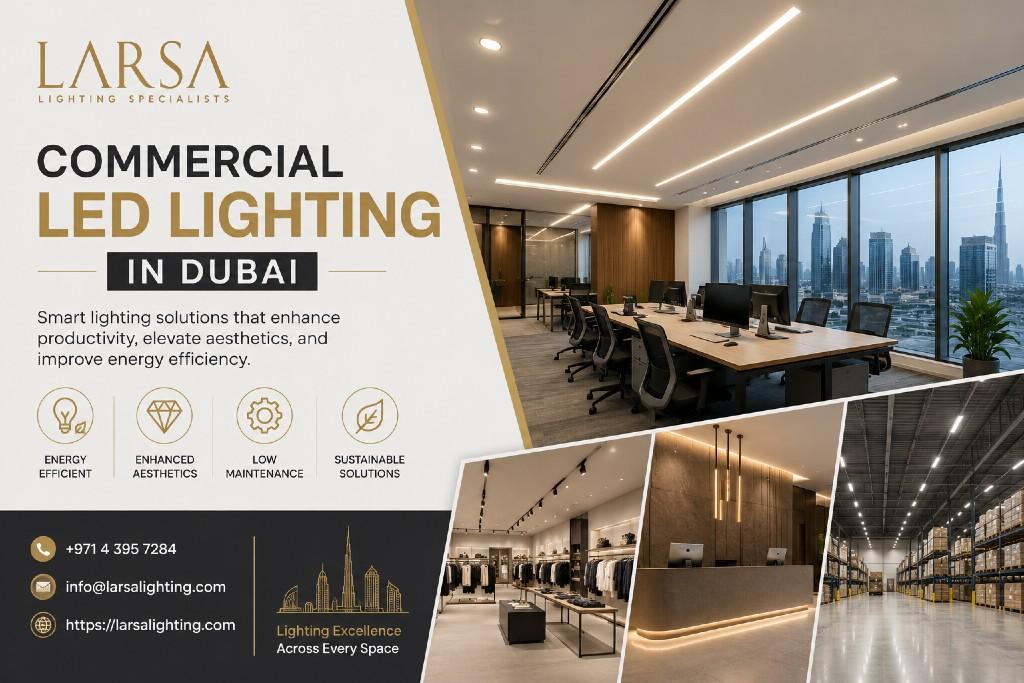
Modern commercial interiors depend on more than attractive furniture, finishes, and architecture. Lighting plays a central role in how people experience a space, from the first impression in a reception area to the comfort of employees working throughout the day. Commercial LED Lighting in Dubai offers businesses an efficient and flexible way to create interiors that are functional, visually appealing, and suited to different activities.
However, effective lighting is not simply about making a room brighter. The right solution considers the purpose of the space, architectural features, operating hours, materials, maintenance requirements, and the atmosphere a business wants to create.
Why LED Lighting Matters in Commercial Interiors
Commercial properties often operate for long hours, making energy efficiency an important consideration. LED technology generally uses less energy than traditional lighting sources while providing consistent illumination and a wide range of design possibilities.
For offices, retail stores, hotels, restaurants, showrooms, and other commercial environments, LED fixtures can be selected according to the specific requirements of each area. Options such as recessed downlights, linear systems, track lights, pendants, and concealed LED strips allow designers to combine practical illumination with architectural character.
Another advantage is flexibility. LED systems are available in different color temperatures, beam angles, lumen outputs, and optical designs. This makes it easier to develop a lighting scheme that responds to the function and visual identity of a particular interior.
Create a More Comfortable and Productive Environment
Lighting has a direct influence on how comfortable people feel in a commercial space. Poorly positioned fixtures or excessive brightness can create glare and visual fatigue, while insufficient illumination can make tasks more difficult.
In offices, well-planned LED lighting can provide comfortable illumination for desks, meeting rooms, circulation areas, and collaborative spaces. Retail environments may require stronger illumination around merchandise, while hospitality interiors often benefit from softer, layered lighting that creates a welcoming atmosphere.
The objective should not be uniform brightness throughout the entire property. Instead, lighting should establish a visual hierarchy by determining which areas need functional light, which features deserve emphasis, and where softer illumination can create contrast.
Enhance Architectural Features and Interior Design
One of the most valuable benefits of Commercial LED Lighting in Dubai is its ability to complement architectural design. Lighting can highlight textures, create depth, define circulation routes, and draw attention to important interior elements.
For example, recessed downlights can provide discreet general illumination, while adjustable spotlights can emphasize artwork, displays, furniture, or branded features. Linear LED systems can follow architectural lines, while concealed lighting can add depth beneath shelves, inside joinery, or along wall details.
Decorative fixtures can also become part of the interior identity. Pendants and statement luminaires may contribute visual character in reception areas, restaurants, hotels, and retail spaces. Combining decorative fixtures with architectural lighting ensures that visual appeal does not come at the expense of functionality.
Improve Energy Efficiency and Operational Control
Energy consumption is an important consideration for commercial properties, particularly where lighting operates for extended periods. LED technology can help reduce electricity use while delivering the required illumination levels.
The benefits can be increased when lighting is combined with suitable control systems. Dimming, occupancy sensors, daylight harvesting, scheduling, and zoning can allow different areas to operate according to actual requirements.
For instance, an office can reduce lighting levels in areas receiving sufficient natural daylight, while meeting rooms can be controlled independently. A retail store can create separate lighting scenes for general areas and product displays. Hospitality venues can use different settings during daytime operations, evening service, and cleaning.
The most effective control system is not necessarily the most complicated. It should be intuitive enough for staff to operate confidently while providing the flexibility the building genuinely needs.
Choose Light Quality Carefully
Selecting LED lighting based only on wattage can lead to disappointing results. Factors such as lumen output, efficacy, color temperature, beam distribution, glare control, and color rendering should all be considered.
Warm white light can complement timber, stone, textiles, and hospitality interiors, while neutral white lighting may be appropriate for contemporary offices, retail areas, and circulation spaces. The choice should reflect the materials, natural daylight, and intended atmosphere.
Color rendering is particularly important in retail, food service, galleries, showrooms, and other environments where accurate colors influence the customer experience. Testing lighting against actual finishes and products can help designers make more informed decisions before installation.
Control Glare for Better Visual Comfort
Glare can significantly affect the quality of a commercial interior. Exposed light sources, unsuitable beam angles, reflective surfaces, and poorly positioned luminaires can make an otherwise attractive space uncomfortable.
Effective glare management begins during the design stage. Deep-recessed fixtures, appropriate optics, baffles, louvers, and careful aiming can help direct illumination where it is needed without creating unnecessary visual discomfort.
This is especially relevant in offices, meeting rooms, reception areas, retail stores, and hospitality environments where people may spend extended periods under artificial lighting.
Consider Maintenance and Long-Term Performance
Commercial lighting should be evaluated as a long-term investment rather than simply a design feature. Fixtures need to be accessible for cleaning, adjustment, inspection, and servicing. High ceilings, decorative structures, and fixed joinery can make maintenance more difficult if access is not considered during planning.
Although LED sources typically have long service lives, other components such as drivers, connectors, and controls can require attention. Environmental conditions, heat, dust, moisture, voltage fluctuations, and operating hours can also affect performance.
A coordinated specification can help maintain consistent light quality across large or phased projects. Using compatible fixture families reduces differences in color, beam performance, appearance, and control behavior.
Plan Lighting Before Installation
Successful Commercial LED Lighting in Dubai begins well before fixtures arrive on site. Lighting layouts should be coordinated with ceilings, HVAC systems, sprinklers, signage, furniture, electrical infrastructure, and interior finishes.
Mockups can also be valuable for detail-sensitive projects. Testing actual fixtures in representative areas allows teams to assess glare, color, shadows, beam direction, finishes, and dimming before committing to a complete installation.
Commissioning is equally important. Proper aiming, zoning, dimming levels, scene programming, and control testing ensure that the completed installation performs according to the original design intent.
A Balanced Approach to Modern Commercial Lighting
The best commercial lighting schemes combine efficiency, visual comfort, architectural enhancement, flexibility, and practical maintenance. Commercial LED Lighting in Dubai can provide the technological foundation, but thoughtful specification and careful coordination determine how successfully that technology performs in a real environment.
For architects, designers, developers, and facility teams, the goal is to create spaces where people can work, shop, relax, move, and interact comfortably. Larsa Lighting supports this approach by considering both technical requirements and the visual experience of each project, helping transform lighting concepts into practical commercial environments.

 Arabic
 French
 Spanish
 Portuguese
 Deutsch
 Turkish
 Dutch
Dutch
 Italiano
 Russian
 Romaian
 Portuguese (Brazil)
 Greek
Greek
 Bengali