


Printing Toner Market Trends: Sustainability, Smart Cartridges and the Shift Toward Efficient Printing
The Printing Toner Market Is Being Reshaped by the Economics of Every Page
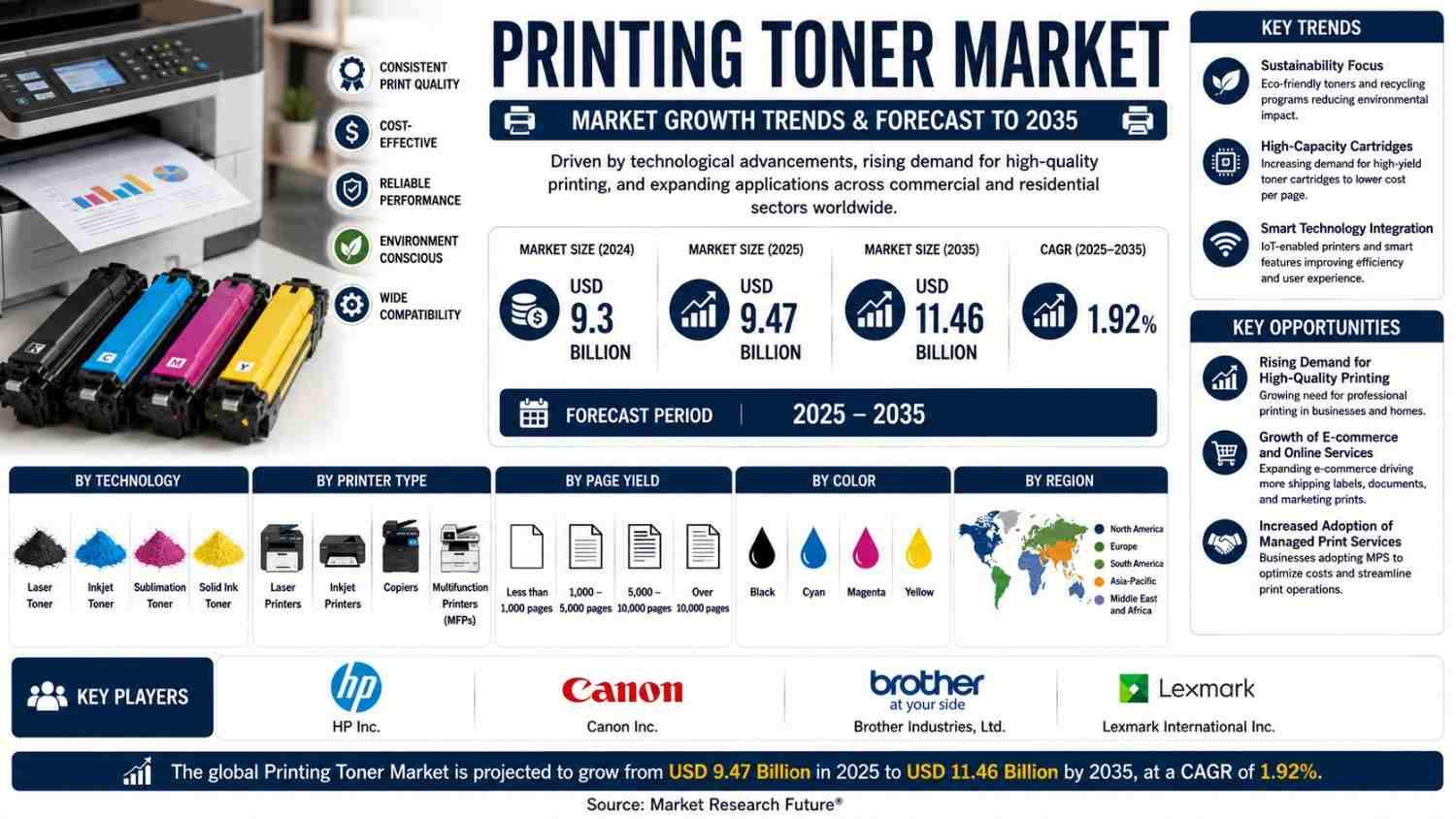
A printer can sit idle for hours and still be strategically important when a business suddenly needs hundreds of accurate documents, labels or reports. That tension between lower routine printing and continued dependence on reliable physical output is shaping the Printing Toner Market Trends. The market reached USD 9.47 billion in 2025 after being valued at USD 9.3 billion in 2024 and is projected to reach USD 11.46 billion by 2035, expanding at a CAGR of 1.92% during 2025–2035. The modest growth rate reflects the pressure created by digitalization, but demand for dependable print quality, high-capacity cartridges, connected equipment and managed print services continues to give toner a durable role in business operations.
The central question is no longer whether organizations will print everything they once did. It is whether the pages they continue to print can be produced more efficiently.
What Is Creating New Demand in a Mature Category
The biggest change in toner demand is coming from the growing importance of productivity per cartridge.
A business does not necessarily want the cheapest cartridge. It wants a predictable cost structure. Frequent cartridge changes consume employee time, create inventory requirements and can interrupt workflows. High-capacity cartridges address part of this problem by increasing the number of pages produced before replacement.
That calculation becomes particularly important in organizations operating centralized multifunction printers. Offices with large print fleets can accumulate significant administrative costs when consumables are managed manually.
Managed print services are therefore creating a more sophisticated purchasing environment. Instead of waiting for a printer to stop working, service providers can monitor utilization and replenish consumables according to actual usage. This makes toner part of an operational service rather than simply a replacement item.
E-commerce is also influencing the market in less obvious ways. Online retail has shifted large portions of commerce into digitally managed systems, but the physical movement of goods still requires documentation. Warehouses, fulfillment centers and distribution operations can generate printing requirements for shipping, inventory and order processing.
Print Quality Is Becoming a Business Requirement
Not all pages have the same economic value.
A basic internal document can tolerate a different quality level from a customer-facing brochure, product label or presentation. As businesses bring more short-run printing in-house, toner must support a wider range of output requirements.
Laser toner remains particularly relevant where fast and consistent output is required. Color printing introduces additional demands because cyan, magenta, yellow and black components must work together to deliver accurate visual reproduction.
The segmentation by color therefore has commercial significance. Black toner continues to serve high-volume document requirements, while color toner supports marketing, design, customer communications and specialized commercial applications.
Page yield is another important differentiator. Products designed for less than 1,000 pages address very different users from cartridges intended to exceed 10,000 pages. This creates opportunities for suppliers to serve both occasional printers and high-volume enterprise environments.
The Real Economics Are Found in Total Cost of Ownership
Cartridge price alone can be misleading.
Suppose a lower-priced cartridge requires frequent replacement. The business may spend more time managing stock, replacing cartridges and dealing with interruptions. A higher-capacity option may have a higher initial price but produce a lower cost per printed page.
This is why procurement teams increasingly examine yield, reliability and service arrangements alongside purchase price.
The same logic affects printer manufacturers. A printer that performs well but consumes toner inefficiently can become expensive over its operating life. Conversely, equipment designed around optimized consumable usage can provide stronger long-term value.
This creates a competitive environment where toner formulation, printer engineering and software management increasingly overlap.
Sustainability Is Moving From Marketing Language to Procurement Criteria
Printing sustainability has several layers.
The first is consumption. Higher page yields can reduce the number of cartridges required for a given volume of output. The second is material use. Cartridge construction, packaging and component selection influence resource consumption. The third is end-of-life management, including collection and recycling.
These issues are becoming more relevant as companies establish environmental procurement policies.
However, sustainability creates trade-offs. A cartridge designed for higher capacity may require additional material, while a smaller cartridge may generate more frequent replacements. Recycling programs can reduce waste but require collection systems that are commercially viable.
The industry therefore faces a more difficult challenge than simply producing a "green" cartridge. It must evaluate the lifecycle economics and environmental impact of the complete consumable system.
Smart Printing Is Changing How Consumables Are Managed
Connected printers are changing the traditional cartridge replacement model.
When devices can report toner levels, usage patterns and maintenance requirements, businesses can move toward predictive consumable management. This reduces the risk of running out of toner at critical moments and can improve procurement planning.
Smart technology also gives manufacturers more information about how their products are used. That information can help support service contracts, fleet optimization and customer-specific recommendations.
This is especially relevant to managed print services, where the objective is not to maximize the number of cartridges sold but to manage printing efficiently.
Where Regional Markets Differ
North America has a mature installed base of business printers and multifunction devices, making replacement demand and fleet optimization important. The market opportunity is therefore closely linked to efficiency, service contracts and high-value business printing.
Europe brings a strong sustainability dimension to procurement decisions, alongside established office and commercial printing infrastructure. Cartridge recovery, resource efficiency and lower-waste solutions can influence product development and customer expectations.
Asia-Pacific presents a broader mix. Large manufacturing and commercial ecosystems generate substantial documentation requirements, while expanding business services and infrastructure create new printer demand. At the same time, price sensitivity varies widely across the region.
Markets across the Middle East, Africa and South America can benefit from modernization of business infrastructure and expanding digital commerce. The challenge is ensuring that equipment, consumables and technical support are available consistently.
Competitive Dynamics Are Becoming More Integrated
The market includes HP Inc., Canon Inc., Brother Industries Ltd., and Lexmark International Inc. Their competitive relevance is linked to their broader printing ecosystems.
HP Inc. and Canon Inc. can connect toner with extensive printer and imaging portfolios. Brother Industries Ltd. has a strong position in business-oriented printing equipment, while Lexmark International Inc. has particular relevance in enterprise printing and managed print environments.
This matters because customers increasingly evaluate printing as a system. Hardware, toner, software, maintenance and service can all influence the purchasing decision.
Companies that improve the connection between these elements can defend customer relationships more effectively than suppliers that compete solely through cartridge pricing.
Emerging Opportunities Are Moving Beyond Conventional Office Printing
The strongest opportunities may come from specialized rather than traditional office applications.
High-quality color printing can support organizations that need professional materials without outsourcing short production runs. High-capacity cartridges can serve large offices, service centers and commercial users. Smart consumables can improve inventory control.
E-commerce and online services also create demand in areas where physical documentation remains essential. Warehousing and fulfillment operations need dependable printing even when the broader business is highly digital.
Another opportunity lies in managed print services. As organizations seek to reduce unnecessary equipment and consumable spending, service providers can use usage data to optimize device placement, maintenance and cartridge replacement.
Risks That Could Slow Market Expansion
The largest structural risk remains digital substitution. Cloud documents, electronic signatures, digital invoices and paperless workflows continue to reduce some forms of printing.
Economic uncertainty can also influence equipment purchases. Businesses may postpone printer upgrades when existing devices remain functional.
Sustainability requirements could create additional development costs if manufacturers need to redesign cartridge materials, packaging or recovery systems.
Finally, competition can put pressure on margins in a mature market. Manufacturers need to justify premium products through measurable benefits such as higher yield, improved quality, reliability or service efficiency.
What the Next Decade Could Look Like
The market's future is unlikely to depend on a return to the high-volume office printing culture of previous decades. Instead, toner will increasingly be associated with targeted, high-value and operationally necessary printing.
Smart devices, high-capacity consumables, better color performance and managed services can help suppliers capture value even when total page volumes remain restrained.
The key shift is from quantity to efficiency. The most competitive products will not necessarily be those that generate the most printing; they will be those that make essential printing cheaper, more reliable, more connected and easier to manage.
Another Trending Topics
Hexylene Glycol Market | High Gloss Label Market | High Performance Ceramic Coating Market

 Arabic
 French
 Spanish
 Portuguese
 Deutsch
 Turkish
 Dutch
Dutch
 Italiano
 Russian
 Romaian
 Portuguese (Brazil)
 Greek
Greek
 Bengali