


Due Diligence Folder Structure: Keeping Review Documents Organized
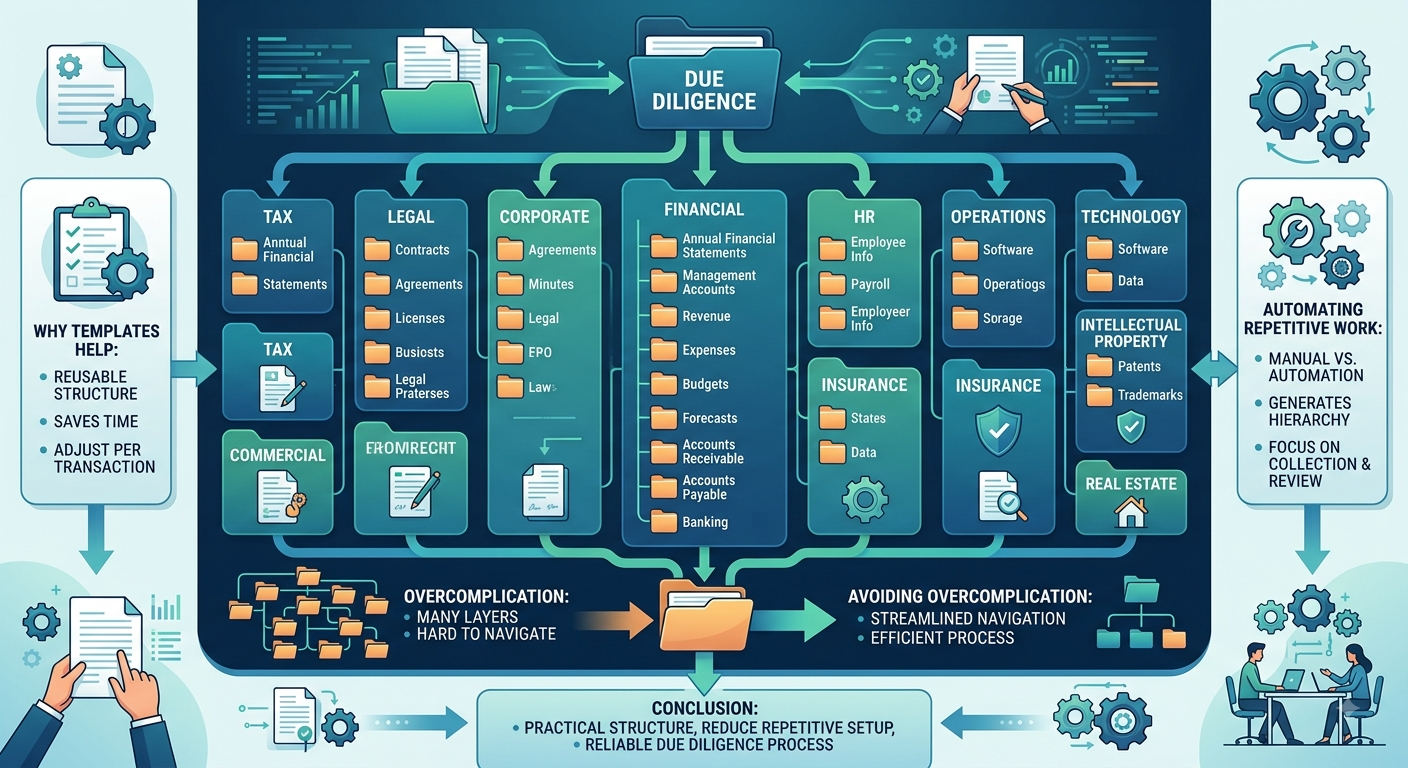
Due diligence can involve an extensive collection of documents. Financial records, contracts, employee information, intellectual property, operational records, tax documents, and regulatory materials may all need to be reviewed.
A clear due diligence folder structure provides a logical framework for organizing these materials before the review process becomes complicated.
What Makes a Good Due Diligence Structure?
A useful structure should be logical, consistent, and easy to navigate.
Instead of placing every document into one general folder, information should be separated according to its purpose.
Common categories include:
-
Corporate
-
Financial
-
Tax
-
Legal
-
Commercial
-
Human Resources
-
Operations
-
Technology
-
Intellectual Property
-
Insurance
-
Real Estate
Each category can contain relevant subfolders.
Example of a Financial Section
The Financial folder might contain:
-
Annual Financial Statements
-
Management Accounts
-
Revenue
-
Expenses
-
Budgets
-
Forecasts
-
Accounts Receivable
-
Accounts Payable
-
Banking
This arrangement helps reviewers locate financial information without searching through unrelated files.
Organizing Legal Documents
Legal documentation can also become extensive.
A structured section might contain:
-
Corporate Agreements
-
Customer Contracts
-
Supplier Contracts
-
Employment Agreements
-
Litigation
-
Licenses
-
Regulatory Documents
Consistent naming makes it easier for different team members to understand the structure.
Why Templates Help
Many businesses perform similar due diligence processes repeatedly. A reusable structure can therefore save significant setup time.
Instead of designing the folder hierarchy from scratch for every project, teams can maintain a standard template.
The template can then be adjusted based on the requirements of each transaction.
Automating Repetitive Work
Manual folder creation becomes particularly inefficient when a due diligence workspace contains dozens or hundreds of folders.
Automation tools can generate a predefined hierarchy without requiring users to create each folder individually.
This approach allows teams to establish the workspace quickly and focus on document collection and review.
Avoiding Overcomplication
A folder hierarchy should provide useful organization without becoming excessively deep.
If users have to navigate through many layers before reaching a document, the structure may become difficult to use.
The best approach is usually to group related documents together while keeping navigation straightforward.
Conclusion
A practical due diligence folder structure makes large document collections easier to manage and review. With standardized categories, logical subfolders, consistent naming, and automation, teams can reduce repetitive setup work and create a more reliable process for future projects.

 Arabic
 French
 Spanish
 Portuguese
 Deutsch
 Turkish
 Dutch
Dutch
 Italiano
 Russian
 Romaian
 Portuguese (Brazil)
 Greek
Greek
 Bengali