


Quartz Countertop Prices in India 2026: A Buyer's Breakdown by Brand and Thickness
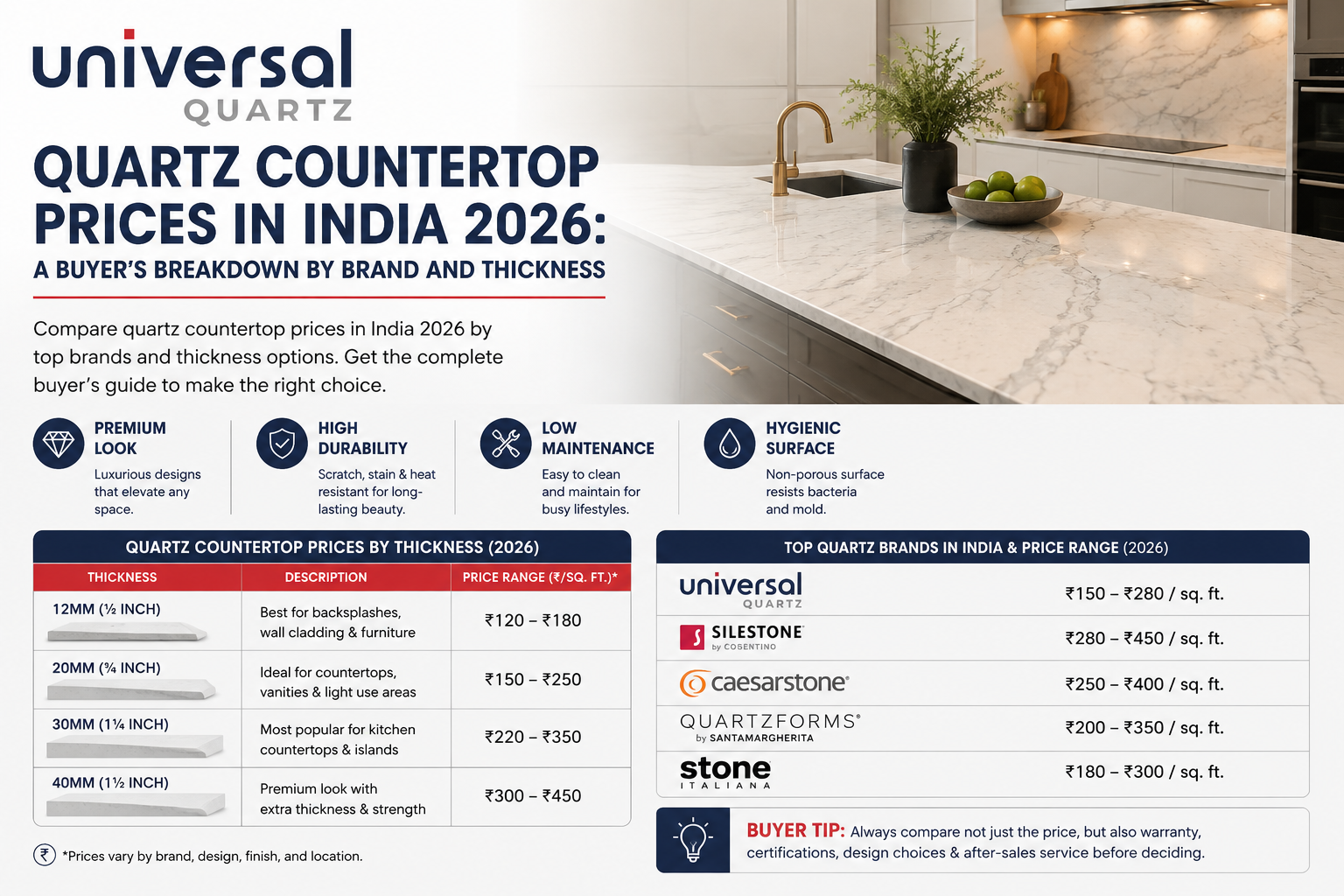
If you've started pricing out quartz countertops for a kitchen renovation or a commercial project in India this year, you've probably noticed the numbers don't line up neatly. One quote comes in at ₹180 per sq ft, another at ₹550, and a third — for what looks like a nearly identical slab — comes in above ₹1,000. That spread isn't random. It's the result of a handful of specific variables stacking on top of each other, and once you understand them, comparing quotes becomes a lot less confusing.
Why Quartz Prices Vary So Much in India
Engineered quartz isn't a single product category — it's a range spanning budget imports, mid-tier Indian manufacturing, and premium certified brands, each built to a different quality specification. In 2026, that range runs from roughly ₹130 to over ₹1,200 per sq ft at the ex-factory level, before fabrication and installation are added.
Four factors drive most of that spread:
1. Manufacturing technology. Not all quartz is bound the same way. Standard resin-binding processes are cheaper but produce less consistent hardness and colour uniformity across batches. Technologies like Christobalite Powder binding — used by a handful of premium Indian manufacturers — cost more to produce but deliver measurably better density and durability, which is part of why brands using it sit in the ₹180–₹420 range rather than the sub-₹150 budget tier.
2. Certification level. A slab with ISO 9001:2015, GREENGUARD Gold, and NSF certification has been through testing and quality control that an uncertified import simply hasn't. That testing costs money, and it shows up in the price — but it also means the slab is verified for things like food-contact safety and indoor air quality, which matter enormously in kitchens, hospitals, and schools.
3. Slab thickness. 12mm is typically used for cladding and furniture panels, 18–20mm is the standard for kitchen and commercial countertops, and 30mm shows up in premium vanities and statement pieces. Thicker slabs use more material and cost proportionally more.
4. Origin. Domestically manufactured Indian quartz generally undercuts imported product on price, simply because it avoids international shipping, duties, and currency conversion. Imported entry-level slabs from China or Turkey often land in a similar price band to premium Indian brands — but without the same certification depth.
A Realistic 2026 Price Breakdown by Segment
Based on current market data, here's roughly where things stand:
- Premium Indian manufacturers (certified, Christobalite technology): ₹180–₹420/sq ft, 12–20mm
- Mid-range Indian brands: ₹130–₹220/sq ft, 12–18mm
- Imported entry-level (China/Turkey): ₹250–₹450/sq ft, 15–20mm
- Premium imported (Israel/EU brands): ₹550–₹1,200+/sq ft, 20–30mm
- Natural granite, for comparison: ₹120–₹300/sq ft, 18–20mm
These are ex-factory or wholesale reference rates. Installed cost typically adds ₹60–₹150/sq ft for transport, fabrication, and edge profiling — a step buyers frequently forget to budget for when comparing quotes side by side.
What This Means When You're Actually Comparing Quotes
The mistake most buyers make is comparing the per-square-foot number in isolation. A ₹150/sq ft uncertified slab that turns out to have colour inconsistency across the batch can generate 20–30% material wastage on a large job — at which point a ₹220/sq ft certified slab with better batch consistency and pre-fabrication support often works out cheaper on the total project cost, not just the sticker price.
Before comparing prices, it's worth asking any manufacturer for:
- A Technical Data Sheet (TDS) with Mohs hardness, water absorption, and flexural strength figures
- Confirmation of current, verifiable certifications — not just a logo on a brochure
- Slab format and batch consistency guarantees, especially for large commercial areas
For a detailed, current price breakdown across brands and thickness tiers — including a step-by-step process for comparing quotes and identifying genuine certified quartz — Universal Quartz's 2026 pricing guide is a useful reference point, particularly for architects and PMCs who need to defend a specification decision with documentation rather than just a brand name.
The Bottom Line
Quartz pricing in India in 2026 isn't opaque once you know what to look for — it's a function of technology, certification, thickness, and origin, in that order of impact. The lowest quote on paper isn't always the lowest cost once wastage, rework, and lifecycle maintenance are factored in. Get the TDS, verify the certifications, and compare total installed cost before signing off on a supplier.

 English
 Arabic
 French
 Spanish
 Portuguese
 Deutsch
 Turkish
 Dutch
Dutch
 Italiano
 Russian
 Romaian
 Portuguese (Brazil)
 Bengali