


What is Proprietorship Underwriting? Process, Benefits, and Best Practices
Sole proprietorships make up a significant portion of India's business ecosystem, especially among small businesses, retailers, traders, manufacturers, consultants, and service providers. These businesses often seek loans, working capital, supply chain finance, or trade credit to support growth. However, evaluating the creditworthiness of a sole proprietorship can be challenging because these businesses generally do not have the same disclosure requirements as private limited companies.
This is where proprietorship underwriting becomes essential. It is the process of evaluating the financial strength, operational stability, business credibility, and repayment capacity of a sole proprietorship before approving credit or financial assistance.
Modern underwriting no longer relies solely on manual document verification. Instead, lenders increasingly use Artificial Intelligence (AI), business intelligence, GST analytics, banking data, predictive analytics, and automated risk assessment to make faster and more accurate underwriting decisions.
What is Proprietorship Underwriting?
Proprietorship underwriting is the process of assessing the risk associated with lending to or financing a sole proprietorship business.
The objective is to determine whether the business has the financial capacity and operational stability to repay its obligations.
A comprehensive underwriting process evaluates:
- Business profile
- Proprietor identity
- GST registration
- Business turnover
- Banking behaviour
- Financial statements (where available)
- Tax filings
- Credit history
- Industry risk
- Business continuity
- Compliance records
The outcome helps lenders determine whether to approve, reject, or request additional information before extending credit.
Why is Proprietorship Underwriting Important?
Effective proprietorship underwriting benefits both lenders and businesses.
Reduces Credit Risk
Identify financially weak or high-risk businesses before approving loans.
Improves Lending Decisions
Use verified business intelligence instead of relying solely on manual reviews.
Faster Loan Approvals
Automation significantly reduces underwriting turnaround time.
Enhances Portfolio Quality
Better underwriting leads to lower default rates and stronger loan portfolios.
Supports Financial Inclusion
Reliable underwriting enables lenders to confidently finance small businesses and sole proprietors.
Key Factors Evaluated During Proprietorship Underwriting
A comprehensive proprietorship underwriting process examines several important parameters.
Business Verification
Verify business existence using GST registration, trade licenses, PAN, and other available documents.
Financial Assessment
Evaluate turnover, cash flow, profitability, banking transactions, and repayment capacity.
GST Analysis
Review GST filings, filing frequency, tax payments, and business activity trends.
Credit History
Analyze repayment behavior, outstanding loans, and credit bureau information where applicable.
Business Stability
Assess years of operation, customer base, supplier relationships, and operational continuity.
Industry Risk
Evaluate risks associated with the business sector, market competition, and economic conditions.
Proprietorship Underwriting Process
Modern proprietorship underwriting typically follows these steps.
Step 1: Information Collection
Collect KYC documents, GST information, bank statements, and business details.
Step 2: Data Verification
Verify submitted information using trusted business and regulatory data sources.
Step 3: Financial Analysis
Assess revenue trends, banking behaviour, liquidity, and repayment ability.
Step 4: Risk Scoring
Assign a risk score using predefined underwriting policies and AI-based analytics.
Step 5: Credit Decision
Approve, decline, or request additional documentation based on the underwriting assessment.
Benefits of Automated Proprietorship Underwriting
Faster Processing
Automation significantly reduces manual underwriting time.
Improved Accuracy
AI-powered analytics reduce human errors and improve consistency.
Better Fraud Detection
Business verification helps identify fraudulent or inactive businesses.
Stronger Credit Decisions
Use multiple verified data sources instead of relying on limited financial documents.
Scalable Lending Operations
Financial institutions can process larger application volumes efficiently.
Technology Transforming Proprietorship Underwriting
Modern proprietorship underwriting is powered by advanced technologies.
Artificial Intelligence (AI)
AI analyzes business information to identify hidden credit risks and unusual financial patterns.
Machine Learning
Machine learning continuously improves underwriting models based on historical lending outcomes.
Predictive Analytics
Forecast repayment behavior, financial stress, and potential defaults before they occur.
Business Intelligence
Interactive dashboards provide a complete view of business performance, financial health, and underwriting risk.
Automation
Automates document verification, credit scoring, reporting, and underwriting workflows to improve efficiency.
Why Businesses Choose Credhive
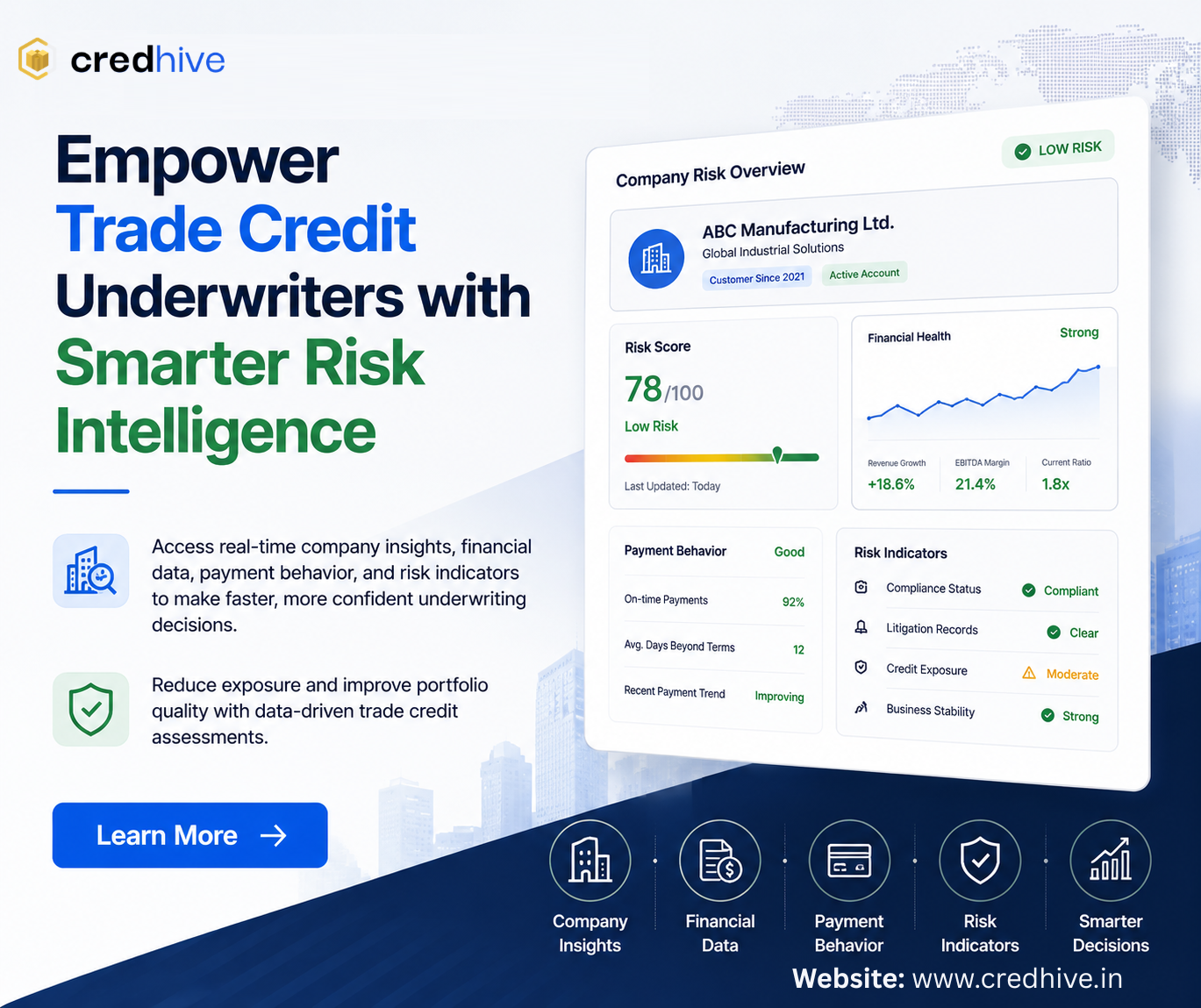
Accurate proprietorship underwriting requires access to reliable business intelligence and real-time financial insights. Credhive offers an AI-powered underwriting platform that helps banks, NBFCs, fintech companies, insurers, and financial institutions evaluate sole proprietorship businesses with greater confidence. Through its advanced Credit Decision Engine, Business Information Reports, Portfolio Monitoring, Vendor Risk Assessment, Early Warning Signals, MCA insights, GST analytics, financial data, litigation records, compliance intelligence, and business verification capabilities, Credhive provides a comprehensive view of business health and repayment capacity. Its AI-driven analytics, automated underwriting workflows, and continuous monitoring enable lenders to reduce credit risk, accelerate loan approvals, improve underwriting accuracy, and build stronger lending portfolios.
Best Practices for Proprietorship Underwriting
Verify Business Information
Validate GST registration, PAN, banking information, and business identity using trusted data sources.
Analyze Multiple Risk Factors
Evaluate financial, operational, industry, and compliance risks together rather than relying on a single parameter.
Use AI-Based Risk Models
Leverage predictive analytics for better credit assessment and fraud detection.
Automate Routine Underwriting
Use technology to process standard applications quickly while reserving manual review for complex cases.
Monitor Borrowers Continuously
Continue monitoring business performance after loan approval to identify emerging risks.
Conclusion
Proprietorship underwriting plays a crucial role in helping lenders evaluate the financial health and repayment capacity of sole proprietorship businesses. As small businesses continue to drive India's economy, efficient underwriting has become essential for expanding responsible lending while minimizing credit risk.
AI-powered underwriting platforms combine business verification, GST analysis, predictive analytics, financial intelligence, and automation to deliver faster, more accurate, and more consistent credit decisions. Organizations that modernize their proprietorship underwriting processes can improve operational efficiency, reduce defaults, strengthen portfolio quality, and support sustainable business growth.
Frequently Asked Questions (FAQs)
1. What is proprietorship underwriting?
Proprietorship underwriting is the process of evaluating the financial strength, business stability, repayment capacity, and overall risk of a sole proprietorship before approving loans, trade credit, or other financial products.
2. What factors are considered during proprietorship underwriting?
Lenders typically assess business verification, GST filings, banking transactions, turnover, credit history, financial performance, industry risk, operational stability, and compliance records to determine creditworthiness.
3. How does AI improve proprietorship underwriting?
Artificial Intelligence automates data analysis, verifies business information, detects fraud, predicts repayment behavior, and generates accurate risk scores. This enables faster underwriting decisions, reduces manual effort, and improves overall lending accuracy.

 English
 Arabic
 French
 Spanish
 Portuguese
 Deutsch
 Turkish
 Italiano
 Russian
 Romaian
 Portuguese (Brazil)
 Greek
Greek
 Bengali