


ZulfiTech: How AI Is Changing Digital Marketing for Modern Businesses
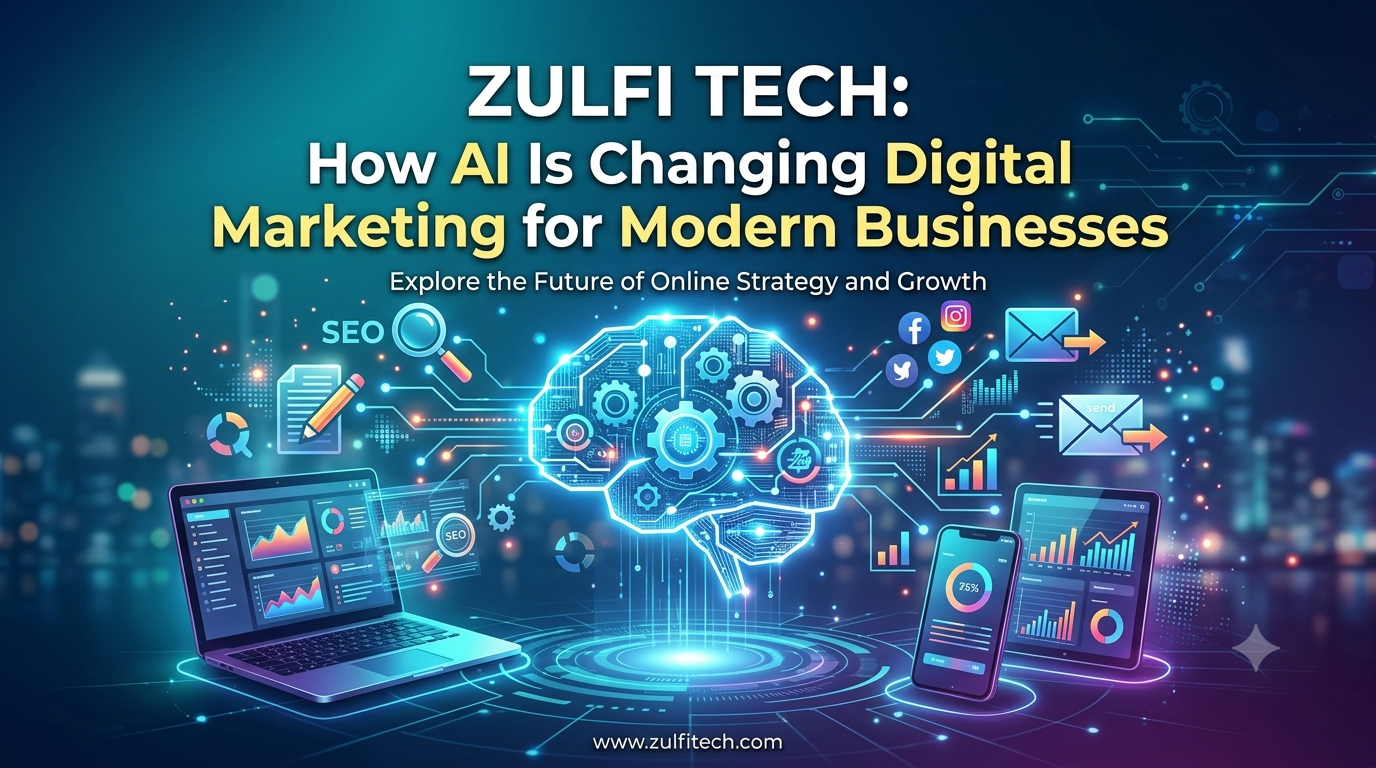
Artificial intelligence (AI) is changing the way businesses approach digital marketing. From creating personalized customer experiences to automating repetitive tasks, AI is helping companies make smarter decisions, save time, and improve marketing performance.
For modern businesses, digital marketing is no longer just about publishing content, running ads, or managing social media. Customers expect faster responses, relevant recommendations, personalized experiences, and useful information at every stage of their journey. AI makes it possible for businesses to meet these expectations at scale.
What Is AI in Digital Marketing?
AI in digital marketing refers to the use of artificial intelligence technologies to analyze data, understand customer behavior, automate marketing processes, and support better decision-making.
AI-powered tools can process large amounts of information much faster than humans. They can identify patterns, predict potential customer actions, generate content ideas, analyze campaign performance, and help businesses communicate with their audiences more effectively.
For example, an AI-powered marketing system may help a business:
-
Understand what customers are searching for
-
Identify potential leads
-
Personalize website experiences
-
Automate email campaigns
-
Generate content ideas
-
Analyze advertising performance
-
Predict customer behavior
-
Improve customer support
-
Optimize marketing workflows
The goal is not simply to replace human marketers. Instead, AI helps marketing teams work more efficiently while allowing people to focus on strategy, creativity, relationships, and decision-making.
Why AI Is Becoming Important for Modern Businesses
The digital marketing landscape is becoming more competitive. Businesses are competing for attention across search engines, social media platforms, email, websites, and emerging AI-powered search experiences.
At the same time, customers have more choices than ever. They can compare products, read reviews, research companies, and ask AI tools for recommendations before making a purchase.
This creates a need for businesses to understand their customers and deliver relevant experiences quickly.
AI can help businesses respond to these challenges by turning large amounts of data into actionable insights. Instead of relying only on assumptions, marketing teams can use AI to identify trends, understand audience behavior, and make more informed decisions.
For a technology company like ZulfiTech, AI represents an important part of the future of digital business. By combining AI with web development, CRM solutions, automation, and digital marketing strategies, businesses can create more connected and efficient customer journeys.
1. AI Is Making Customer Personalization More Powerful
Personalization has become an important part of modern marketing.
Customers are more likely to engage with content and offers that match their interests and needs. However, manually creating personalized experiences for every customer can be difficult, especially for businesses with large audiences.
AI can analyze customer information and identify patterns in behavior. This may include browsing activity, previous interactions, purchase history, engagement levels, and other available data.
Businesses can then use these insights to deliver more relevant experiences.
For example, an online business might use AI to recommend products based on a customer's previous interactions. A service company may use customer data to identify which services are most relevant to a specific audience.
AI-powered personalization can help businesses move from a one-size-fits-all marketing approach toward more targeted customer experiences.
2. AI Is Transforming Content Marketing
Content marketing remains an important part of digital marketing, but AI is changing how businesses plan and produce content.
AI tools can help marketing teams discover content ideas, analyze search intent, identify common customer questions, and organize topics into content clusters.
This can make content planning more efficient.
For example, a business selling CRM software may want to create content around customer relationship management. AI-assisted research can help identify related topics such as:
-
CRM automation
-
Lead management
-
Customer retention
-
Sales pipeline management
-
AI-powered CRM
-
Marketing automation
-
Customer data management
Marketers can use these insights to build a more comprehensive content strategy.
However, AI-generated content still needs human oversight. Businesses should review AI-assisted content for accuracy, originality, brand voice, and usefulness. The strongest approach combines AI efficiency with human expertise and real-world experience.
3. AI Is Changing Search and SEO
Search engine optimization is also evolving because of AI.
Traditional SEO focused heavily on ranking web pages for specific keywords. While keywords remain important, modern search is increasingly focused on understanding user intent and providing useful answers.
AI-powered search experiences are changing how people discover information. Users may ask detailed questions instead of searching with short keywords.
For businesses, this means content needs to be clear, helpful, structured, and relevant to real customer questions.
AI can support SEO teams by helping them:
-
Research search queries
-
Identify related topics
-
Analyze competitors
-
Discover content gaps
-
Understand search intent
-
Organize topical clusters
-
Improve content briefs
-
Monitor ranking trends
Businesses should still focus on creating content for people first. AI can support research and optimization, but high-quality content should provide genuine value and demonstrate expertise.
4. AI Is Improving Marketing Automation
Marketing automation has been around for years, but AI is making it more intelligent.
Traditional automation follows predefined rules. For example, a customer fills out a form, and the system automatically sends an email.
AI can take automation further by helping businesses understand customer behavior and determine what action may be more relevant.
An AI-powered marketing workflow might identify a high-intent lead, recommend the next step, personalize communication, and alert a sales representative when human interaction is needed.
This can help businesses reduce manual work and improve the speed of lead follow-up.
AI automation can be especially useful for businesses that manage large numbers of leads or customers. Instead of requiring employees to perform every repetitive task manually, businesses can automate routine processes while keeping humans involved in important decisions.
5. AI Is Making CRM Systems Smarter
Customer relationship management (CRM) systems are central to many modern businesses. They help companies organize customer information, manage leads, track sales activities, and maintain relationships.
AI-powered CRM solutions can make these systems more intelligent.
Instead of simply storing information, AI can help businesses understand what that information means.
For example, AI may help identify:
-
Which leads are most likely to convert
-
Which customers may need additional support
-
Which opportunities require immediate attention
-
Which communication patterns lead to better engagement
-
Which customers may be at risk of leaving
This allows sales and marketing teams to focus their efforts where they are most likely to have an impact.
For businesses exploring AI-powered CRM solutions, the combination of customer data, automation, and intelligent insights can create a more efficient approach to managing customer relationships.
6. AI Is Changing Digital Advertising
Digital advertising requires constant monitoring and optimization.
Businesses need to understand which campaigns are generating results, which audiences are responding, and where advertising budgets should be allocated.
AI can analyze campaign data and identify patterns that may not be obvious through manual analysis.
It can assist marketers with:
-
Audience segmentation
-
Ad performance analysis
-
Campaign optimization
-
Budget allocation
-
Creative testing
-
Customer targeting
-
Conversion prediction
AI can also help marketers generate different creative concepts and variations for testing.
However, marketers still need to monitor campaigns carefully. AI recommendations should be evaluated based on business goals, customer behavior, brand guidelines, and actual performance.
7. AI Is Improving Customer Service
Customer expectations are changing. People often want quick answers regardless of the time of day.
AI-powered chatbots and virtual assistants can help businesses respond to common customer questions without requiring a human employee to handle every interaction.
For example, AI can help answer questions about:
-
Business hours
-
Services
-
Product information
-
Order status
-
Appointment processes
-
Frequently asked questions
This does not mean every customer interaction should be automated.
Complex questions, complaints, and sensitive situations often require human support. The best approach is to use AI for routine interactions and allow customers to connect with a human when necessary.
This creates a balance between efficiency and personal service.
8. AI Helps Businesses Make Data-Driven Decisions
Modern businesses collect huge amounts of data from websites, CRM systems, advertising platforms, social media, and other marketing channels.
The challenge is not always collecting data. The challenge is understanding it.
AI can help analyze large datasets and identify patterns that may support better decisions.
For example, businesses can use AI-assisted analysis to understand:
-
Which marketing channels generate the best leads
-
Which content attracts the most engagement
-
Where customers drop out of the buying journey
-
Which audiences have the highest conversion potential
-
Which campaigns deliver the strongest return
With better insights, businesses can make marketing decisions based on evidence instead of relying only on assumptions.
9. AI Is Helping Businesses Scale Their Marketing
One of the biggest advantages of AI is scalability.
A small marketing team may have limited time and resources. AI can help that team complete certain tasks faster.
For example, AI can assist with research, content ideation, data analysis, customer segmentation, reporting, and workflow automation.
This allows businesses to spend more time on strategic activities.
However, scaling with AI requires a clear strategy. Businesses should identify which processes are repetitive, time-consuming, and suitable for automation.
Not every task should be automated.
Creative strategy, brand positioning, relationship building, and important business decisions still benefit from human expertise.
The Human Side of AI Marketing
While AI is becoming more powerful, successful digital marketing still requires people.
AI can analyze data, generate ideas, automate workflows, and identify patterns. But human marketers provide context, creativity, empathy, judgment, and strategic thinking.
For example, AI may suggest several marketing messages, but a human needs to determine whether the message fits the brand and resonates with the target audience.
AI may identify a customer trend, but business leaders need to decide how to respond.
This is why the future of digital marketing is likely to be a combination of AI and human expertise rather than AI replacing marketing teams completely.
How Businesses Can Start Using AI in Digital Marketing
Businesses do not need to transform their entire marketing operation overnight.
A practical approach is to start with specific areas where AI can provide immediate value.
Step 1: Identify Repetitive Tasks
Look for marketing activities that take significant time but follow predictable processes.
These might include reporting, lead organization, basic customer responses, content research, or data analysis.
Step 2: Start With One Use Case
Choose one area where AI can make a measurable difference.
For example, a business could start with AI-assisted CRM automation or content research.
Step 3: Connect Your Data
AI becomes more useful when it has access to accurate and relevant information.
Businesses should organize their customer, marketing, and sales data to create a stronger foundation for AI-powered insights.
Step 4: Keep Humans in the Loop
AI-generated recommendations should be reviewed by people, particularly when they affect customers or important business decisions.
Step 5: Measure the Results
Businesses should track performance before and after implementing AI.
Useful metrics may include:
-
Lead conversion rate
-
Customer response time
-
Marketing efficiency
-
Cost per lead
-
Customer engagement
-
Sales productivity
-
Customer retention
This helps businesses understand whether AI is actually improving performance.
The Future of AI and Digital Marketing
AI is likely to become even more integrated into digital marketing in the coming years.
Businesses may increasingly use AI to connect marketing, sales, customer service, CRM, and business intelligence into a single ecosystem.
Search behavior is also expected to continue evolving as AI-powered search and conversational tools become more common.
This means businesses will need to focus on more than traditional rankings. They will need to build strong digital brands, create useful content, maintain accurate business information, and provide clear answers to customer questions.
The businesses that benefit most from AI will likely be those that use it strategically rather than simply adopting AI tools because they are popular.
How ZulfiTech Can Help Businesses Embrace AI
AI adoption can be challenging when businesses do not have the right technology, systems, or strategy in place.
This is where a technology partner like ZulfiTech can play an important role.
From AI-powered CRM solutions and software development to digital solutions designed around modern business needs, the right technology can help businesses improve how they attract, engage, and manage customers.
The key is to build an approach that connects technology with actual business goals.
AI should not be implemented simply because it is trending. It should solve real problems, improve efficiency, support better customer experiences, and help businesses make smarter decisions.
Final Thoughts
AI is changing digital marketing by making it more intelligent, personalized, automated, and data-driven.
From content marketing and SEO to CRM, advertising, customer service, and analytics, AI is becoming part of nearly every stage of the modern customer journey.
However, technology alone is not enough.
The most successful businesses will combine AI with human creativity, strategic thinking, and genuine customer understanding. AI can help businesses work faster and make better use of their data, while people provide the judgment and experience needed to turn those capabilities into meaningful results.
For modern businesses looking to stay competitive, the question is no longer whether AI will influence digital marketing. The real question is how businesses can use AI responsibly and strategically to create better experiences and achieve sustainable growth.
ZulfiTech is helping businesses explore this evolving digital landscape by bringing together technology, AI, CRM, automation, and modern digital solutions. As AI continues to reshape marketing, businesses that adapt early and build the right foundations will be better prepared for the future.

 Arabic
 French
 Spanish
 Portuguese
 Deutsch
 Turkish
 Dutch
Dutch
 Italiano
 Russian
 Romaian
 Portuguese (Brazil)
 Greek
Greek
 Bengali